Ichthyology & Specimen Deep Jigging · Volga 2026 Encyclopedia
Zander (Pikeperch)
Sander lucioperca (Linnaeus, 1758)
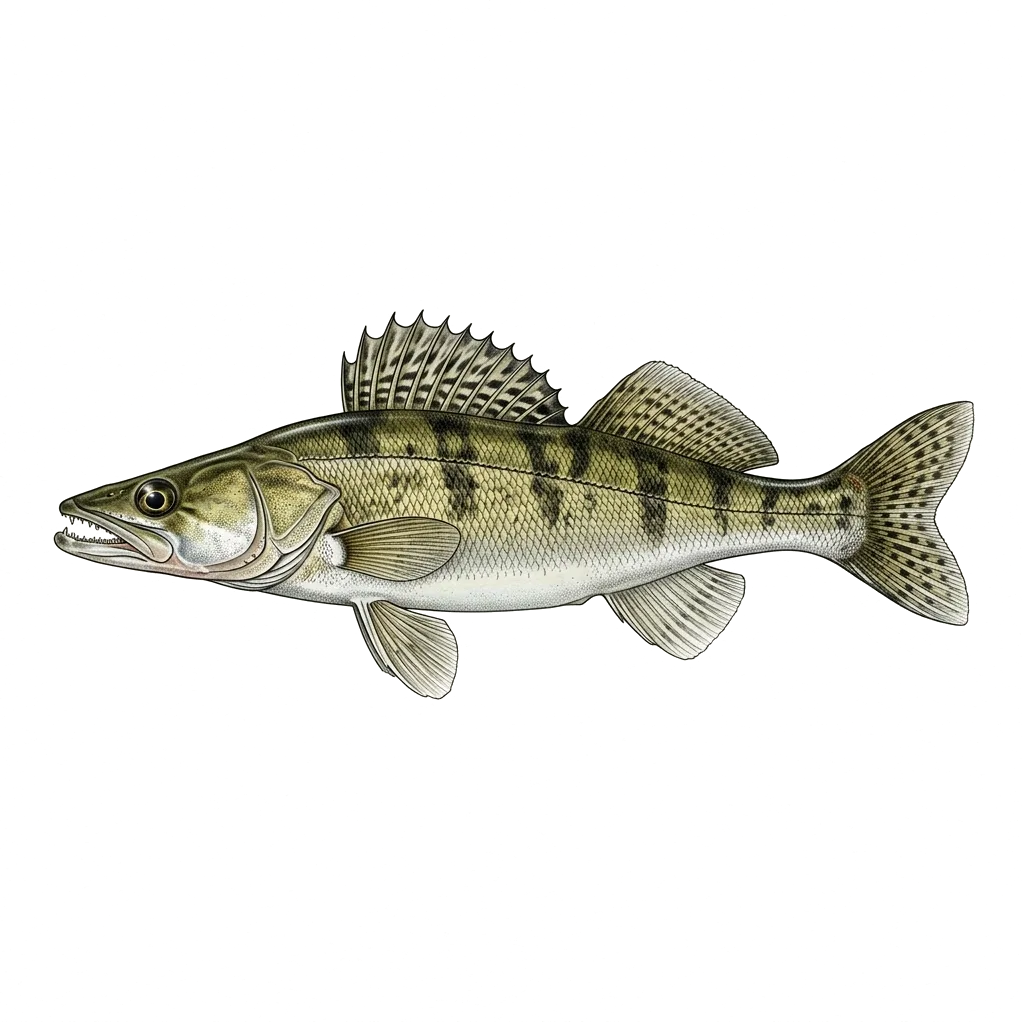
Zander (Pikeperch) Zander (Sander lucioperca, or pikeperch) is a premier nocturnal predator of the percid family (Percidae) inhabiting deep, oxygenated rivers and gravel lakes across Europe. The species features canine fangs on jaws, a light-reflecting tapetum lucidum retina for low-light hunting, and weight up to 15 kg. Anglers target zander with jigging softbaits, blade baits, and minnow crankbaits.
Zander demands an uncompromising Extra-Fast rod (to drive hooks through hardened bone palate), high-viz PE #0.8–1.2 braid, abrasion-proof fluorocarbon trace against mussel edges, and a calibrated 1–2s jig hang time.
- ✅ You want to definitively distinguish zander from Volga bersh and perch by canine fangs and cheek scalation.
- ✅ You want to master crisp jig hops with Mandulas, foam fish, and scented Keitech swimbaits.
- ✅ You need proven nocturnal shallow-crank tactics targeting gravel bars and sandy spits.
- ✅ You want to explore the science of tapetum lucidum optics and narrow gullet prey selectivity.
- ✅ You want to master zander strike timing and deep drop-off hunting in 'Volga 2026'.
Ichthyology & Adaptations: Biological Profile of Sander lucioperca
Zander (*Sander lucioperca*) is an elite deep-water pelagic predator engineered with specialized sensory mechanisms:
Retinas are lined with guanine crystal plates (tapetum lucidum). Light passing through photoreceptors reflects back, doubling optical sensitivity in near-total darkness, producing a characteristic glassy glow under headlamps.
Upper and lower jaw tips house pairs of elongated canine fangs. On impact, clamping jaw muscles drive these spikes into prey spines or skulls, leaving deep telltale punctures in soft lead jigheads.
Unlike pike or catfish, zander possesses a rigid, narrow esophagus. Unable to swallow wide-bodied bream or crucian, it feeds exclusively on slender forage: bleak, kilka, gudgeon, dace, and gobies.
Zander strikes descending jigs from above, pinning the lure against bottom or clamping shut. This instantaneous shock radiates through taut braid into the graphite blank like a crisp electric pulse.
Zander vs Bersh vs European Perch: Identification Guide
Comparative anatomical guide for three premier percids:
- Fangs: TWO PAIRS OF HEAVY CANINES on upper and lower jaws.
- Cheeks (operculum): BARE or scaled only at the very upper margin.
- Body: long, sleek, grey-green with 8–10 indistinct vertical bars.
- Mouth: wide, extending well past the rear eye margin.
- Size: reaches 8–15 kg.
- Fangs: COMPLETELY ABSENT (uniform small bristle teeth only).
- Cheeks (operculum): FULLY SCALED from top to bottom ('rough cheeks').
- Bars: sharp, vivid, jet-black vertical bands.
- Eyes: noticeably large and bulging.
- Size: rarely exceeds 1.2–2.0 kg (protected in certain zones).
- Body: deep-backed, high-humped, compressed flanks.
- Fangs: ABSENT (fine brush teeth).
- Fins: vivid crimson/orange pelvic and anal fins.
- Dorsal fin: distinct jet-black spot on rear tip of first dorsal.
- Size: 0.2–2.0 kg.
Mechanics of the Electric Jig Strike & Bone Hookset
As the jig drops toward bottom, zander hovers 20–30cm above substrate and attacks downward. Jaws snap shut with hydraulic force. On a slack line the opportunity is lost, but on tight braid the impact registers as a ringing metallic shock ('the tick').
The zander's mouth is composed of armored bone plates and tough cartilage. A timid strike merely scrapes bone, leading to hook pulls. The strike must be instantaneous, broad, and immensely powerful—driving hook barbs clean through bone!
Seasonal Habitats: Channel Breaks, Snag Deeps & Gravel Bars
Zander shift vertically based on sunlight intensity and prey migrations:
🌱 Spring (Post-Spawn Guarding): Spawns at +10–14°C on gravel bars and submerged root nests (1.5–3.5m depth). Males guard egg nests fiercely. Post-spawn shoals drop to 4.0–7.0m channel breaks.
☀️ Summer (Nocturnal Invasions): Daytime spent resting in 6.0–11.0m deep channel timber. At twilight and midnight (10:00 PM–3:00 AM), packs invade 0.8–2.0m shallow sandbars to hammer bleak on shallow minnows.
🍂 Autumn (Peak Specimen Jigging): Specimen zander mass on 7.0–14.0m deep channel shelves, holes, and mussel flats. Mandula lures, 4.5–5.5" paddle tails, and heavy 30–50g jigs dominate.
❄️ Winter (Ice VIBs & Kilka): Holds on 6.0–12.0m drop-offs. Targeted with vertical rattling VIBs (70–90mm), balancing jigs, and vertical spoons tipped with fresh kilka.
Zander Baits: Mandulas, Scented Plastics, Cranks & Kilka
1. Natural Baits (Ice & Ledger)
Fresh or frozen Volga kilka (tail or whole fish on jighead); slender livebaits (bleak, gudgeon, dace); fresh whitefish fillets.
2. Articulated Mandula Jigs
Three-section floating EVA foam Mandulas with tinsel tails and heavy trebles. On the pause, the buoyant lure stands dead vertical, tail fluttering in current.
3. Scented Soft Plastics & Foam Fish
Keitech Swing Impact Fat 3.8–4.8", Sawamura One'Up Shad 4–5", snagless foam fish, and squid-scented paddle tails.
4. Shallow Nocturnal Minnows
ZipBaits Orbit 80–90 SP, Megabass Vision 95, Pontoon21 Crackjack 78, OSP Asura 925 on dead-slow straight retrieves over sand spits.
Tackle: Extra-Fast Carbon Blanks, Braids & Fluorocarbon
Zander tackle requires extreme blank stiffness and razor-sharp sensitivity:
Jigging Blank 2.3–2.6m (Extra-Fast / 12–45g)
40T high-modulus carbon with stiff backbone and crisp tip. Transmits every pebble tap and drives heavy hooks through bone on a short wrist snap.
Size 3000–4000 Reel & 8-Strand Braid
Power-crank reel with 5.0–5.2:1 ratio. High-visibility 8-carrier braid (Fluo Yellow/Pink) for tracking line flutter during free-falls.
Fluorocarbon Shockleader (0.35–0.45mm / 1.5m)
Shields delicate PE braid from razor-sharp zebra mussel shells on drop-offs and eliminates optical visibility near wary eyes.
Debunking Common Zander Myths
Fact: By day, zander hunt actively in 7–12m deep channel holes where surface glare is filtered out, smashing jigs in bright midday sun.
Fact: Volga zander (Sander volgensis) is an independent species characterized by an absence of canine fangs and fully scaled cheeks.
Fact: Zander fangs are conical spikes with no cutting edges—they cannot slice line. Invisible fluorocarbon is superior unless pike share the swim.
Scientific Research on Sander lucioperca
'The zander dwells strictly in deep, clean rivers with stony or gravelly beds... Renowned for voracity and rapid growth, it ambushes small fish and pursues them over nocturnal gravel bars.'
'The visual apparatus of Sander lucioperca is adapted to low light levels via a tapetum lucidum layer of guanine microcrystals, providing decisive optical advantages during crepuscular and nocturnal hunting.'
'Sander lucioperca: maximum recorded weight over 18kg, length 130cm. Jaws feature two pairs of canine fangs. Serves as an apex ecological indicator of water quality and dissolved oxygen.'
4 Tactical Strategies for Zander
Two quick reel turns followed by a 1.5–2 second free-fall. Dropping the jighead onto zebra-mussel shelves triggers the electric tick.
After bottom contact, hold a 3–5s pause while lightly quivering the rod tip. The vertical foam body tempts inactive, pressured zander.
Fish sandbars from 11 PM to 3 AM using 90mm shallow minnows on an ultra-slow crawl. Violent smashes occur in 0.5–1.2m shallows.
On the faintest line tick, deliver a broad, high-power body hookset to drive forged hooks clean through the zander's armored palate.
Seasonal Matrix: Depths, Optimal Times, Baits & Rigs
| Season | Peak Feeding Time | Depth Zone | Top Baits | Tackle System |
|---|---|---|---|---|
| Spring (April – May) | 06:30 – 10:30 & 16:00 – 19:30 | 2.5 – 6.0 m (Gravel bars, breaks) | 3.5–4" Swimbaits, mandulas, foam | Extra-Fast rod 10–35g, PE #1.0 braid |
| Summer (June – August) | 04:30 – 07:00 & 22:30 – 03:00 (Night) | 0.8 – 2.0m (Night), 7–11m (Day) | 90mm Minnows (night), jigs (day) | Spinning rod 7–28g, 0.35mm fluro |
| Autumn (Sept – Nov) | 08:00 – 17:00 (All daylight) | 6.5 – 14.0 m (Deep holes & snags) | Mandulas, 4.5–5.5" soft swimbaits | Heavy jig setup 15–50g |
| Winter (Ice Fishing) | 07:30 – 10:30 & 15:00 – 18:00 | 6.0 – 12.0 m (Channel drop-offs) | 75–90mm VIBs, spoons with kilka | Stiff ice carbon jigging rod |
Angling Diagnostic: Identify What's Impeding Your Zander Catch
Select the symptoms you are experiencing for instant technical adjustments:
Zander in 'Volga 2026' Simulator
In 'Volga 2026', zander is simulated with authentic electric bite ticks, nocturnal shallow runs, and high jaw bone penetration requirements. Weight range spans 0.4 to 10.5 kg. Dwells in deep channel snags and mussel beds.
Key in-game locations: 'Deep Fairway', 'Volga Snags', 'Island Reach', 'Old Dam'.
Zander is featured in premier spinning quests ('Midnight Gravel Bar', 'Fang-Bearing Master', 'Jigging Benchmark'), unlocking Extra-Fast blanks, Mandulas, and Japanese VIBs.
Frequently Asked Questions About Zander
Why do zander eyes glow in the dark?
Retinas are lined with guanine crystal plates (tapetum lucidum). This reflective mirror bounces photons back across photoreceptors, doubling light gathering and creating a glassy glow under headlamps.
How do you distinguish zander from Volga bersh?
Key differences: 1) Fangs: zander has prominent canine spikes; bersh has no fangs; 2) Cheeks: zander operculum is bare; bersh cheeks are fully scaled.
Why is an ultra-hard hookset mandatory for zander?
The zander's mouth is armored with dense bone plates. A weak strike fails to drive the barb through bone, causing immediate hook pulls during the fight.
Why are articulated Mandulas so deadly for zander?
Mandulas are made of buoyant EVA foam. When the sinker hits bottom, the lure stands dead vertical, fluttering in current—zander strike the upright silhouette during pauses.
Is a steel wire trace necessary when targeting zander?
Not for zander alone (its conical fangs lack cutting edges). Invisible 0.35–0.45mm fluorocarbon is best. Wire traces are used only if pike share the swim.
Authoritative Ichthyological Sources & Literature: FishBase — Sander lucioperca Biological Summary · IUCN Red List of Threatened Species — Sander lucioperca · Л. П. Сабанеев — «Жизнь и ловля пресноводных рыб: Судак» (Викитека) · Институт биологии внутренних вод им. И. Д. Папанина РАН (ИБВВ РАН)
Prepared by the Volga 2026 Editorial Board in strict adherence to aquatic biology and sport angling standards. Volga 2026 Editorial Methodology.