Ichthyology & Specimen Carp Angling · Volga 2026 Encyclopedia
Wild Carp (Common Carp)
Cyprinus carpio (Linnaeus, 1758)
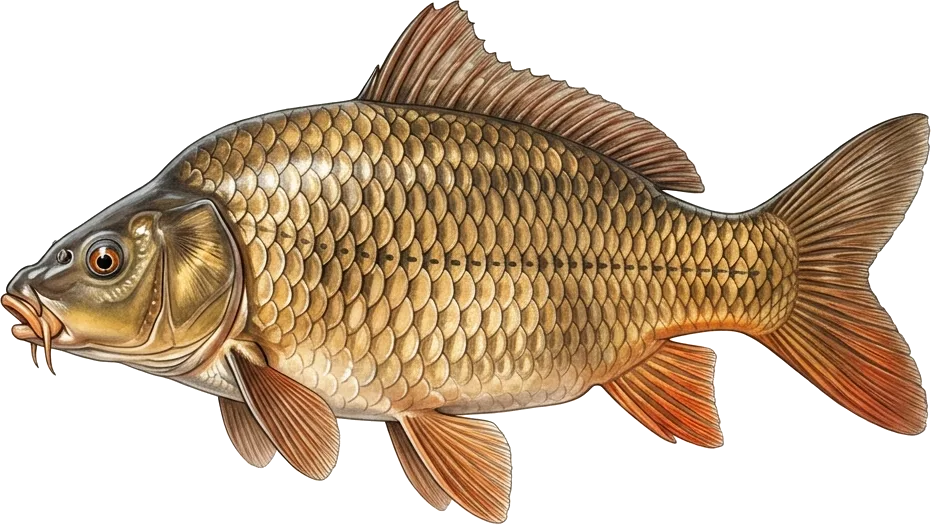
Wild Carp (Common Carp) Common carp (Cyprinus carpio, or wild sazan) is a heavyweight freshwater teleost fish in the family Cyprinidae native to Eurasian river basins and reservoirs. The species is characterized by four sensory barbels, a serrated dorsal spine, three-row crushing teeth (1.1.3-3.1.1), and weight exceeding 35 kg. Anglers target carp with specialized specimen tackle using hair-rigged boilies, tiger nuts, and sweetcorn.
Volga wild carp represents the pinnacle of freshwater heavy sport. It demands rugged gear: 3.5 lb test curve rods, Big Pit reels, lead-dropping safety clips to elevate fish above snags, and selective hard baits (rock-hard 24mm boilies, tiger nuts) impenetrable to nuisance fish and crayfish.
- ✅ You want to master landing specimen river carp out of sunken timber and snag-choked current channels.
- ✅ You want to master modern carp rigs (Blowback Rig, KD Rig) and lead-dropping safety presentations.
- ✅ You seek heavy spodding strategies utilizing maize, tiger nuts, and boilie chops that bypass nuisance species.
- ✅ You want to grasp key anatomical differences between streamlined wild carp and domestic pond varieties.
- ✅ You want to master wild carp flight dynamics and drag control in 'Volga 2026'.
Ichthyology & Adaptations: Biological Profile of Cyprinus carpio
Wild carp (*Cyprinus carpio*) is the ancestral progenitor of domestic carp, honed by strong river currents of the Ponto-Caspian basin:
Heavy pharyngeal teeth with ridged grinding surfaces generate massive compressive forces, pulverizing the thickest zebra mussel shells and bivalve carapaces.
The primary ray of dorsal and anal fins is a formidable serrated bone saw with reverse barbs. Under tension, a surging carp presses this spine against taut monofilament to shear it cleanly.
Equipped with 4 sensory barbels (2 upper lip, 2 long corner barbels) saturated with taste buds, allowing carp to detect amino-acid trails in zero visibility.
Unlike deep-bodied domestic strains, wild river carp features a streamlined cylindrical torpedo profile, minimizing current drag and generating immense sustained sprint torque.
Wild Carp vs Mirror Carp vs Grass Carp: Identification Keys
Comparative analysis of three heavyweight cyprinid species:
- Body: streamlined, muscular, torpedo cylindrical profile (rheophilic).
- Scales: 100% complete tight scale armor, dark bronze with golden edges.
- Barbels: exactly 4 barbels (2 short snout, 2 long corner barbels).
- Fins: powerful serrated bone saw ray in dorsal and anal fins.
- Habitat: river channels, submerged timber, and heavy current shelves.
- Body: exceptionally deep-bodied, humped, rounded girth.
- Scales: reduced pattern; giant polished mirror scales scattered along dorsal and flanks.
- Barbels: 4 barbels (identical to wild carp).
- Fight style: heavy low-gear bottom pressure punctuated by dramatic surface leaps.
- Habitat: sluggish reservoir bays, managed lakes, and tranquil reaches.
- Barbels: ENTIRELY ABSENT (smooth fleshy lips).
- Body: cylindrical, elongated bar-like profile, dark-olive back.
- Teeth: biserial serrated comb saws engineered for slicing tough reed stems.
- Fins: short dorsal fin (7–8 branched rays) lacking any serrated spine saw.
- Habitat: dense shoreline macrophyte beds, overgrown channels, and reservoirs.
Mechanics of the Freight-Train Run & Bolt Rig Self-Hooking
Foraging carp angle downward at roughly 45°, protruding fleshy lips to generate vacuum suction. The hair-rigged offering enters the oral cavity along with substrate. Sensing the hook metal, the fish expels the bait violently.
At this instant, the taut hooklink levers the hook point downward. As the fish retreats, the heavy semi-fixed lead (100–140g) drives the hook point deep behind the firm lower lip cartilage via sheer inertia (the Bolt Rig effect).
Panicked by the hook sting, the carp launches a frantic sprint toward timber cover. Line shrieks from the spool. The first 15–20 meters decide the fight: the angler must apply maximum rod-butt leverage to keep the fish out of submerged limbs.
Seasonal Habitats & Channel Staging for Wild Carp
Volga wild carp movements correlate closely with spring flood stages and water temperature:
Spring (May – early June): Spring floods draw carp into shallow sun-warmed floodplain meadows (0.8–2.0m) to spawn and feed. Supreme action on lobworm bunches and sweetcorn.
Summer (July – August): Receding floodwaters push carp into mainstem habitats: deep snag tangles (3.5–7.5m), undercut clay ledges, and mussel gravel bars. Peak boilie action occurs at night.
Autumn (September – October): Cooling below +12°C pushes carp to deep channel drop-offs (6.0–11.0m). They favor high-protein fishmeal baits (Halibut, Squid) during calm sunny afternoons.
Winter (November – March): Concentrates in dense shoals inside 10–18m deep river sanctuaries, coated in heavy mucus. Foraging ceases entirely. Fishing on wintering pits is legally prohibited.
Carp Nutrition: Boilies, Tiger Nuts, Maize & Pressed Oilcake
1. Selective Heavy Specimen Baits
Tiger nuts (Chufa)—sweet crunchy tubers immune to crayfish and silver fish; 20–24mm dense bottom boilies (Plum, Scopex, Halibut); large field maize; spring bunch of 5–7 lobworms.
2. Balanced Pop-Up Snowman Presentations
A 20mm bottom bait topped with a trimmed 14mm fluorescent pop-up (Snowman rig). This critically balanced bait flies into the carp's mouth with minimal suction effort.
3. Volga Classic: Pressed Sunflower Oilcake
Dense pressed sunflower oilcake bricks ('makukha'). Dissolving slowly over 3–5 hours in current, it releases an irresistible natural plume of roasted seed oils.
4. Heavy Spodding Campaign Strategy
River carp feed beds must be chunky and dense: boiled maize, tiger nuts, 14mm pellets, and boilie chops. Strictly avoid fine powdery groundbait, which attracts hordes of nuisance bream!
Snag Tackle: 3.5 lb Blanks, Big Pit Reels & Armored Leadcore
Wrestling wild carp out of river snags demands unapologetic tackle strength:
Specimen Carp Rods (12–13ft, 3.5 lb Test Curve)
Heavy two-piece high-modulus carbon rods with 3.5 lb test curve and 50mm butt guides with SiC rings. Extreme lower-blank backbone capable of stopping a 15kg charging carp cold.
Big Pit Reels with Quick Drag / Baitrunner
8000–14000 spool capacity for heavy casting and fast retrieve. Massive low-ratio gearing (4.3:1–4.6:1), stainless steel main shaft, and 15+ kg drag power.
Terminal Gear: Leadcore, Braided Shockleader & Forged Hooks
10–12m of 0.35–0.40mm braided shockleader; 1m of 45–65 lb armored leadcore; lead-dropping safety clip with 120–160g swivel lead; forged heavy-wire Wide Gape hooks #2–4.
Debunking Common Wild Carp Myths
Fact: Carp do not intentionally saw lines. During panic lunges, fish tuck their fins and pivot violently. Taut monofilament wraps across the back and snags the razor-sharp serrations, severing under load.
Fact: While oilcake and potatoes are historic classics, modern 20–24mm fishmeal boilies and tiger nuts produce far more consistent results while completely resisting nuisance fish.
Fact: Winter carp metabolism drops near zero in deep wintering pits. Captures are almost exclusively foul-hooked snags, which are illegal and devastating to breeding stock.
Scientific Research on Cyprinus carpio
'Wild carp may justly be called the river titan... Its strength is astonishing, and the resistance it offers during the fight exceeds that of any other freshwater fish of equal weight... The first reflex of a hooked carp is a desperate dash into nearby snags, reeds, or to shear the line with its dorsal saw.'
'Cyprinus carpio: triple-row pharyngeal teeth (1.1.3–3.1.1) bear broad molariform crowns with transversal grinding grooves, crushing thick zebra mussel (Dreissena polymorpha) and bivalve shells with compressive loads of tens of kilograms.'
'Cyprinus carpio: maximum length 120 cm, weight up to 40.1 kg. Strongly developed serrated osseous spine in dorsal and anal fins. Two pairs of barbels (short anterior, long posterior). Broad omnivorous benthic diet.'
4 Snag & Channel Tactical Strategies
Drop a Blowback Rig 1–2m from sunken timber. The safety clip sheds the lead on the take, lifting the carp to the surface instantly.
Deposit 5–7 kg of cooked hempseed, maize, and boilie chops. The oily hemp plume pulls river carp from distant channel runs.
Combine a dense tiger nut with a trimmed 10mm bright pop-up on the hair. The balanced bait enters the carp's mouth effortlessly.
Fish the upper shelf (3–4m) from 11 PM to 4 AM. Trophy carp patrol these shallows in pitch darkness to feed on zebra mussels.
Seasonal Matrix: Depths, Optimal Times, Baits & Rigs
| Season | Peak Feeding Time | Depth Zone | Top Baits | Tackle System |
|---|---|---|---|---|
| Spring (May – June) | 06:00 – 11:00 & 16:00 – 20:00 | 1.0 – 3.0 m (Floodplain shallows) | Worm bunch, sweetcorn, sweet boilies | 3.5 lb Carp rods, heavy feeder |
| Summer (July – August) | 04:30 – 08:30 & 22:00 – 04:00 (Night) | 3.5 – 7.5 m (Snags & mussel bars) | Tiger nuts, 20mm boilies (Plum, Scopex) | 3.5 lb Carp kit, Big Pit reels |
| Autumn (Sept – Oct) | 10:00 – 17:00 (Warm midday) | 6.0 – 11.0 m (Channel breaks) | Fishmeal boilies (Halibut, Crab), pellets | Heavy carp setup with leadcore |
| Winter (Ice Season) | Torpor (Feeding ceases) | 9.0 – 16.0 m (Wintering pits) | Protected in wintering sanctuaries | Protected closed season |
Angling Diagnostic: Identify What's Impeding Your Wild Carp Success
Select the symptoms you are experiencing for instant technical adjustments:
Wild Carp in 'Volga 2026' Simulator
In 'Volga 2026', wild carp is simulated with extreme opening run kinetics and massive stamina reserves. Weight spectrum spans 0.6 to 11.5 kg (specimens reaching 18–25 kg). Dwells in channel snags and demands dedicated carp gear.
Key in-game locations: 'Volga Snags', 'Deep Fairway', 'Island Reach', 'Old Riverbed'.
Wild carp is featured in the endgame questline ('Volga Freight-Train', 'Master of the Snags', 'Bronze Giant'), unlocking 3.5 lb carp rods, bite alarms, and rod pods.
Frequently Asked Questions About Wild Carp
What is the difference between wild carp and mirror carp?
Wild carp is the native ancestral river form with a sleek torpedo profile and complete tight scales. Mirror carp is a domesticated strain with a deep-bodied round girth and scattered mirror scales. Wild carp is far faster and stronger in river currents.
Why is the hair rig mandatory for wild carp angling?
Carp are exceptionally wary, ejecting baits if they sense bare hook metal. With a hair rig, the bait is inhaled cleanly while the bare hook flips point-down under lead inertia to hook the bottom lip cleanly.
What bait is best protected against crayfish and nuisance fish?
Tiger nuts and rock-hard air-dried 24mm boilies. Tiger nuts feature a sweet crunchy interior sealed in a rock-hard skin that crayfish cannot ruin, while carp crush them easily with pharyngeal molars.
Why is a safety lead clip crucial when fishing snags?
In sunken timber, heavy leads jam easily in branches. A safety clip ejects the lead immediately on the strike, allowing the angler to guide the carp safely to the surface without a snagged anchor.
What is the peak feeding time for wild carp in summer?
In summer rivers, peak wild carp feeding occurs at night (10:30 PM to 4:00 AM) and early morning dawn (4:30 to 8:00 AM) when fish leave timber sanctuaries to forage on shallow mussel shelves.
Authoritative Ichthyological Sources & Literature: FishBase — Cyprinus carpio (Linnaeus, 1758) Species Summary · IUCN Red List of Threatened Species — Cyprinus carpio · Л. П. Сабанеев — «Жизнь и ловля пресноводных рыб: Карп» (Викитека) · Институт биологии внутренних вод им. И. Д. Папанина РАН (ИБВВ РАН)
Prepared by the Volga 2026 Editorial Board in strict adherence to aquatic biology and sport angling standards. Volga 2026 Editorial Methodology.