Ichthyology & Extreme Ice Blizzard Angling · Volga 2026 Encyclopedia
Burbot
Lota lota (Linnaeus, 1758)
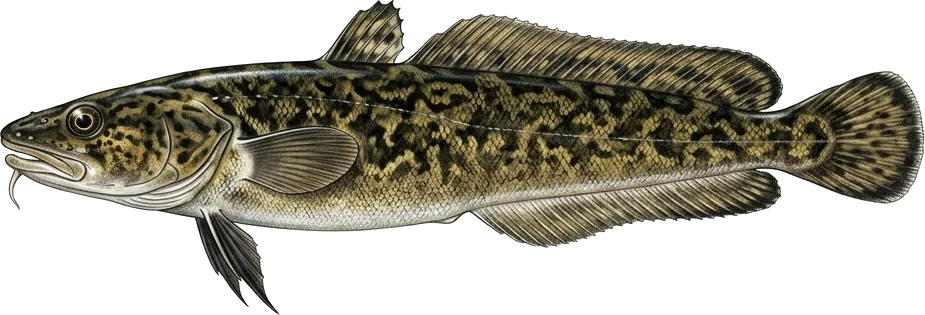
Burbot (Lota lota) is the only freshwater gadiform fish in the world, inhabiting cold rivers and deep lakes across Eurasia and North America. The species is identified by a single chin barbel, elongated second dorsal fin, nocturnal winter spawning at 0–2 °C, and weight up to 19 kg. Anglers catch burbot on bottom setlines and heavy ice spoons.
Burbot demands extreme winter fortitude: braving foul blizzard nights, deploying heavy brass clatter jigs tipped with crushed ruffe, and keeping a gaff ready to steer curled fish into the ice hole.
- ✅ You want to definitively distinguish burbot from catfish and weatherfish by single chin barbel and fin rays.
- ✅ You want to master nocturnal winter clatter-jig tapping over gravel and rocky river bars.
- ✅ You need proven burbot baits: crushed spiny ruffe, fresh Volga kilka, lobworm clusters, and liver strips.
- ✅ You want to explore the science of inverted thermal feeding, hepatic vitamin reserves, and under-ice spawning.
- ✅ You want to master burbot fight mechanics and blizzard ice fishing in 'Volga 2026'.
Ichthyology & Coldwater Adaptations: Biological Profile of Lota lota
Burbot (*Lota lota*) is a unique glacial relict preserving ancient marine cod traits in freshwater river basins:
Burbot is our sole species whose metabolic and spawning peak occurs near 0°C under midwinter ice. When water warms past +15°C feeding halts, and above +20°C it enters deep summer dormancy in dark riverbed burrows.
The lower jaw bears a single flexible chin barbel packed with sensory buds. Dragging it across pitch-black riverbed gravel, burbot physically feels out hidden ruffe and burrowing crayfish.
Burbot liver accounts for 10–15% of its total body mass. Serving as a massive reservoir for lipids, vitamins A/D, and glycogen, it powers midwinter under-ice spawning and long summer fasts.
Burbot possesses sharp hearing and intense curiosity. Rhythmic clattering of heavy lead/brass jigs against stones mimics foraging ruffe or scuttling crayfish, pulling fish from afar right under the hole.
Burbot vs Wels Catfish vs Weatherfish: Identification Guide
Comparative anatomical guide for three serpentine benthic species:
- Barbels: EXACTLY ONE chin barbel (plus tiny nostril flaps).
- Dorsal fin: TWO DORSAL FINS (first short, second very long).
- Scales: microscopic cycloid, deeply embedded in thick slimy skin.
- Peak season: STRICTLY WINTER (spawns under January ice at 0°C).
- Size: reaches 3–8+ kg.
- Barbels: SIX BARBELS (3 pairs: 2 long maxillary + 4 chin).
- Dorsal fin: SINGLE TINY dorsal fin near nape.
- Skin: COMPLETELY BARE (scales entirely absent).
- Season: peak activity in summer warmth (dormant in winter).
- Size: 10–100+ kg.
- Barbels: TEN BARBELS surrounding tiny mouth.
- Body: serpentine with dark longitudinal lateral stripes.
- Size: small (15–25cm, 50–150g).
- Feature: intestinal aerial respiration, squeaks when handled.
- Habitat: silty ditches, marshes, oxbow muds.
Mechanics of the Clatter Take & Defeating the Tail-Brace
Attracted to the rhythmic clatter against gravel, burbot glides over the lure, opens its broad jaws, and vacuums in the crushed ruffe. The take registers on the rod as a smooth, heavy downward pull with zero frantic shakes.
Near the hole, burbot executes its classic defense: it curls into a rigid crescent, bracing its broad tail against the bottom ice rim ('tail-brace'). Never force line tension—slide a small gaff beneath the chin to guide the head cleanly into the hole!
Seasonal Habitats: Gravel Bars, Rocky Drop-Offs & Winter Runs
Burbot movements track ice cover and plummeting water temperatures:
🌱 Spring (Late-Ice Taper): Forages actively over 3.0–6.0m rocky shelves during ice-out. As water warms toward +10°C, activity steadily wanes.
☀️ Summer (Torpor): At temperatures above +18°C, burbot enters estivation, wedged deep into cold spring-fed holes, undercut bank burrows, and log piles without feeding.
🍂 Autumn (Pre-Spawn Awakening): Water dropping below +8°C triggers ravenous feeding. Nightly raids target 1.0–2.5m shallow gravel bars, taking live ruffe and lobworms on ledgers.
❄️ Winter (Peak Season & Under-Ice Spawning): Spawns in January across 1.5–4.5m current-swept gravel ridges. In foul blizzard nights (-15°C to -25°C), burbot aggressively hammer clatter jigs and tip-ups from 8 PM to 3 AM.
Burbot Baits: Crushed Ruffe, Volga Kilka, Lobworms & Clatter Jigs
1. Top Animal Baits
Crushed spiny ruffe (unbeaten #1); fresh Volga kilka; cluster of lively lobworms; fresh strips of roach or perch fillet; raw beef or chicken liver batons.
2. Heavy Brass Clatter Jig
Heavy 25–45g brass, copper, or lead jig fitted with two rigid upward-facing hooks. Crashing onto gravel, it emits a resonant metallic crack that draws burbot in.
3. Natural Scent Plumes
Crushed ruffe mucus and blood, natural fish oils, and fresh liver juices. Burbot relies exclusively on olfactory tracking and acoustic vibration in under-ice darkness.
4. Winter Under-Ice Setlines
Simple winter ledger: 30–50g bottom sinker pinned to gravel, 0.35mm mono snell (20–30cm) with forged #1/0 hook baited with live or crushed ruffe.
Tackle: Stiff Ice Carbon Rods, Heavy Monofilament & Gaff
Clatter jigging demands a robust, stiff carbon ice rod and abrasion-resistant terminal tackle:
Stiff Carbon Clatter Rod (50–70cm)
Heavy carbon blank with high backbone and warm cork/EVA grip. 70–90mm centerpin reel or cold-resistant trigger-release ice multiplier.
Winter Cold-Proof Monofilament (0.35–0.45mm)
In -20°C frost, braided lines freeze solid and slice fingers. Deploy premium 0.35–0.45mm winter monofilament rigged direct—burbot teeth cannot cut thick nylon.
Compact Winter Ice Gaff
Sharp single-hook 40–50cm gaff. Essential for specimens over 1.5 kg to guide curled, tail-braced fish straight into a 130–150mm ice hole.
Debunking Common Burbot Myths
Fact: Burbot is entirely non-toxic; its firm white boneless flesh and giant liver are celebrated delicacies in northern gastronomy.
Fact: In summer, burbot is dormant in cold undercut burrows. Summer catches are extraordinarily rare accidental flukes beside freezing springheads.
Fact: Burbot are shy of direct lantern glare down the hole, though acoustic vibrations from bank fires may arouse curious exploration.
Scientific Research on Lota lota
'The burbot is the sole freshwater member of the cod family... It thrives in cold, pristine water, nocturnal in habit, reaching peak foraging and spawning during severe January frosts.'
'Lota lota is a cryophilic stenothermal relict of the Pleistocene fauna. Gametogenesis is strictly locked to 0.5–2.0°C water, accompanied by massive triglyceride accumulation in the liver.'
'Lota lota: maximum recorded weight over 19kg, length 150cm. Single chin barbel performs chemosensory and tactile navigation in darkness. Protected in southern periphery zones.'
4 Tactical Winter Night Strategies for Burbot
Deliver 5–6 sharp taps on river gravel, lift 2cm, and hold an 8-second freeze with crushed ruffe.
Crush a live ruffe before threading onto hooks to release body juices. The scent trail pulls burbot downcurrent reliably.
Set 5–8 winter setlines at 15m intervals along a 2-to-5m drop-off. Check lines every 2 hours through sub-zero nights.
When the curled burbot jams under the ice rim, slide a gaff under its chin to align its head straight into the hole.
Seasonal Matrix: Depths, Optimal Times, Baits & Rigs
| Season | Peak Feeding Time | Depth Zone | Top Baits | Tackle System |
|---|---|---|---|---|
| Autumn (Oct – Nov) | 20:00 – 02:00 (Cold dark nights) | 1.5 – 3.5 m (Shore gravel spits) | Crushed ruffe, lobworms, kilka | Bank ledger, 0.35mm mono |
| Winter (Dec – Feb) | 19:30 – 03:30 (Blizzards, -20°C) | 1.5 – 5.0 m (Gravel bars, rapids) | Clatter jig + ruffe, kilka, liver | 60cm Ice rod, clatter jig, gaff |
| Spring (March – April) | 21:00 – 01:00 (Late ice-out) | 3.5 – 7.0 m (Channel breaks) | Live ruffe, roach, fish strips | Ice setlines, bottom rigs |
| Summer (May – Sept) | Torpor (Feeding halts) | 8.0 – 16.0 m (Spring-fed burrows) | No angling (Summer dormancy) | Dormant closed season |
Angling Diagnostic: Identify What's Impeding Your Burbot Catch
Select the symptoms you are experiencing for instant technical adjustments:
Burbot in 'Volga 2026' Simulator
In 'Volga 2026', burbot is simulated with authentic nocturnal gravel clatter physics, blizzard feeding multipliers, and tail-wrap hole resistance. Weight spectrum spans 0.5 to 6.5 kg. Dwells along gravel spits and cold spring deeps.
Key in-game locations: 'Stony Headland', 'Winter Rapid', 'Old Riverbed', 'Cold Reach'.
Burbot is featured in winter questlines ('Blizzard Midnight Clatter', 'Master of the Stony Ridge', 'Tsar Soup & Royal Liver'), unlocking brass clatter jigs and titanium ice gaffs.
Frequently Asked Questions About Burbot
Why do burbot spawn in midwinter during severe sub-zero frosts?
Burbot is a glacial marine cod relict with an inverted thermal optimum. Its eggs and sperm develop properly only in freezing water at 0...+2°C under thick ice cover.
How does the winter clatter jig work?
A heavy brass or lead jig rhythmically strikes river gravel, producing a resonant metallic crack and a small silt puff that draws curious burbot from up to 50 meters away.
Why is ruffe considered the premier bait for burbot?
Ruffe shares the same benthic gravel habitat and forms burbot's primary food source. Rich mucus and scent juices from crushed ruffe travel far downcurrent, sparking an irresistible feeding response.
Why is burbot liver so highly prized culinarily?
Burbot liver accounts for 10–15% of body weight, boasting a delicate creamy flavor packed with beneficial Omega-3 fatty acids and vitamins A and D.
How do you tell burbot apart from Wels catfish?
Key differences: 1) Barbels: burbot has a SINGLE chin barbel; catfish has 6 barbels (3 pairs); 2) Dorsal fin: burbot features two dorsals (second very long); catfish has one tiny dorsal near the head.
Authoritative Ichthyological Sources & Literature: FishBase — Lota lota Biological Summary · IUCN Red List of Threatened Species — Lota lota · Л. П. Сабанеев — «Жизнь и ловля пресноводных рыб: Налим» (Викитека) · Институт биологии внутренних вод им. И. Д. Папанина РАН (ИБВВ РАН)
Prepared by the Volga 2026 Editorial Board in strict adherence to aquatic biology and sport angling standards. Volga 2026 Editorial Methodology.