Ichthyology & Extreme Heavy Specimen Angling · Volga 2026 Encyclopedia
Wels Catfish
Silurus glanis (Linnaeus, 1758)
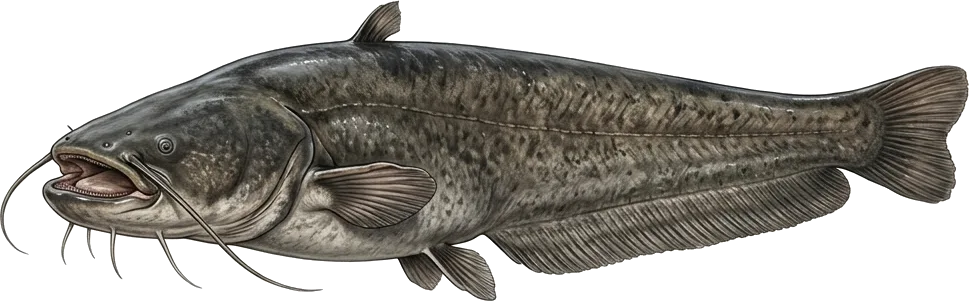
Wels Catfish Wels catfish (Silurus glanis) is the largest native benthic freshwater predator in Europe, belonging to the catfish family (Siluridae). The species features scaleless skin, six sensitive sensory barbels, electroreceptive ampullae, villiform tooth pads, and weight exceeding 150 kg. Anglers catch giant wels using clonk tactics, heavy boat tackle, livebaits, and massive soft rubber lures.
Wels catfish forgives zero weakness: mandatory 30–50 lb boat rods, Big Game multiplier reels, PE #6.0–8.0 braid (50–80kg breaking strain), forged 8/0–10/0 hooks, and rod-tapping techniques to lift glued fish.
- ✅ You want to definitively distinguish Wels catfish from brown bullhead and burbot.
- ✅ You want to master clonk angling (cavitation pop mechanics, heel geometry, 3–4 beat cadence).
- ✅ You need proven baits: 25-lobworm bunches, live green frogs, river mussel meat, and scorched liver.
- ✅ You want to explore the science of barbel taste buds, rasp dental pads, and vacuum ingestion kinematics.
- ✅ You want to master Wels catfish fight dynamics and clonk rises in 'Volga 2026'.
Ichthyology & Adaptations: Biological Profile of Silurus glanis
Wels catfish (*Silurus glanis*) is Europe's largest apex freshwater predator equipped with extraordinary sensory arrays:
A pair of elongated maxillary barbels and two pairs of mandibular chin barbels are packed with taste buds. Catfish literally 'taste' the water across tens of meters, zeroing in on worms or frogs in total darkness.
Jaws lack large fangs, paved instead with thousands of needle-sharp villiform teeth angled inward. Once clamped, prey is locked in an inescapable sandpaper vice.
Approaching prey, catfish flairs massive opercular cavities and drops its jaw floor, generating a violent vacuum depression that engulfs 30 liters of water along with the bait in milliseconds.
Striking the clonk creates an air cavity that implodes upon exit. The low-frequency shockwave (80–120 Hz) mimics surface feeding thumps or frog calls, drawing catfish up from 20m abyss holes.
Wels Catfish vs Brown Bullhead vs Burbot: Identification Guide
Comparative anatomical guide for three benthic barbel-bearing predators:
- Barbels: EXACTLY THREE PAIRS (1 long maxillary pair + 2 chin pairs).
- Skin: COMPLETELY BARE, scaleless, leathery with dense mucus.
- Dorsal fin: TINY, lacking hard venomous spines.
- Anal fin: extremely long, merging near caudal fin.
- Size: reaches 50–150+ kg (lengths to 2.5–3.0m).
- Barbels: FOUR PAIRS (8 barbels around oral cavity).
- Fins: dorsal and pectorals armed with SHARP VENOMOUS SPINES.
- Adipose fin: PRESENT on dorsal peduncle.
- Size: 0.2–1.5 kg (dwarf compared to Wels).
- Coloration: dark brown/olive mottled.
- Barbels: SINGLE LONE BARBEL on chin (plus tiny nostril flaps).
- Family: sole FRESHWATER MEMBER OF CODFISHES (Gadidae).
- Scales: microscopic, deeply embedded cycloid scales.
- Temperature: active strictly in freezing winter water (dormant in summer).
- Size: 0.5–6.0 kg.
Mechanics of Clonk Takes & Heavy Leverage Hooksetting
Drawn by clonk acoustic shockwaves, catfish rises from the depths and hovers 50cm below the offering. Tasting the worm cluster with barbels, it inhales in a violent vacuum pulse. The blank loads with immense immovable weight before plunging downward.
Never strike tentative barbel taps! Allow the catfish to engulf the bait for 2–3 seconds until the blank folds into a full fighting curve, then deliver a two-handed, full-body power hookset to drive the heavy barb through bone rasp pads.
Seasonal Habitats: Channel Abyss Holes, Snag Runs & Shallows
Catfish are thermophilic benthic predators migrating between deep daytime sanctuaries and nocturnal shallows:
🌱 Spring (Post-Winter Foraging): Awakens at +10–12°C. Vacates wintering pits to hunt shallow sandbars and floodplain margins (2.0–4.5m) pre-spawn, taking heavy worm bunches and livebaits.
☀️ Summer (Peak Clonk Season): By day, catfish rest in 12.0–25.0m abyss holes and sunken timber, rising to the clonk. By night (11:00 PM–4:00 AM), they invade 1.0–2.5m shallow gravel bars hunting sabrefish and frogs.
🍂 Autumn (Deep Staging): Pre-winter feeding frenzy. Catfish mass on deep hole exits (8.0–16.0m). Clonking fades, replaced by heavy deepwater jigging with 6–8" soft plastics and livebait ledgers.
❄️ Winter (Torpor Sanctuary): Rests in 15.0–30.0m wintering pits in dense dormant clusters covered in protective winter slime. Feeding ceases entirely.
Catfish Baits: Lobworm Bunches, Frogs, Mussels & Scorched Liver
1. Premier Animal Baits
Bunch of 20–30 large lobworms on a forged 8/0 hook; live green frog (hooked through thigh or lips); river mussel meat (5–8 Unio shells); chunky livebait (crucian, sabrefish 200–500g).
2. Scented Delicacies
Campfire-scorched beef/chicken liver (singed protein scent drives catfish wild); smoked river fish; thick fresh pike or perch fillets.
3. Giant 6–9 Inch Soft Swimbaits
Relax Kopyto 6", Savage Gear 3D Burbot 20cm, Keitech Easy Shiner 8" rigged on heavy 40–80g jigheads with forged 10/0 hooks.
4. Acoustic Clonk (Sound Lure)
Wooden or titanium clonk with a 35–42mm convex oval heel. Delivers a clean cavitation pop that pulls catfish straight up from 20-meter riverbeds.
Tackle: 50 lb Boat Blanks, Big Game Multipliers & Heavy Terminal Gear
Taming a 50–100kg Wels catfish demands extreme Big Game tackle rated for maximum drag forces:
Heavy Boat Blank 1.8–2.1m (200–500g / 50 lb)
Solid fiberglass or heavy composite blank with heavy-duty reinforced SiC or roller guides, built to withstand bone-crushing leverage.
Big Game Multiplier Reel (Lever Drag)
Machined marine multiplier reel delivering 15–25kg max drag. 8-carrier braid PE #6.0–8.0 (60–90kg test) paired with a 1.0–1.2mm mono shock-leader (1.0m).
Forged Heavy-Wire Catfish Hooks (8/0–10/0)
Owner Gorilla or Mustad Catfish hooks (8/0–10/0) with in-turned beak points and welded eyes, tested to withstand 100kg straight pull forces.
Debunking Common Wels Catfish Myths
Fact: Catfish is an active apex hunter. 90% of its diet consists of lively fresh fish (sabrefish, bream, carp), crayfish, and waterfowl.
Fact: The clonk mimics the surface cavitation gulp of another feeding catfish, triggering competitive foraging instincts to rise to the meal.
Fact: A 40+ kg catfish will easily glue to the floor or saw through light lines with its tooth rasp pads on the opening run.
Scientific Research on Silurus glanis
'The catfish is the largest of all freshwater fishes... Living in the deepest snag holes, it consumes fish, crayfish, frogs, and birds, renowned for colossal power and longevity.'
'Silurus glanis exhibits remarkable chemosensory acuity via densely innervated barbels. Auditory sensitivity spans low frequencies (50–200 Hz) mediated by a well-developed Weberian apparatus.'
'Silurus glanis: maximum recorded weight over 250kg, length 5m, lifespan exceeding 50–80 years. Dense scaleless mucus-rich skin protects against benthic pathogens.'
4 Tactical Specimen Strategies for Wels Catfish
Drift downstream over 15–20m holes, delivering 3–4 clonk pops followed by a 10–15s pause. Suspend the bait in mid-water (6–8m depth).
Thread 20–30 large lobworms through mid-bodies on a forged 8/0 hook. The writhing ball broadcasts an irresistible scent trail.
Set bank ledgers with live frogs on 2.0m shallows above deep holes from 11 PM to 4 AM. Monster catfish patrol shallows at night.
When the catfish attempts to anchor to the floor, apply heavy power-pumping and tap the blank to keep the fish moving and exhausting energy.
Seasonal Matrix: Depths, Optimal Times, Baits & Rigs
| Season | Peak Feeding Time | Depth Zone | Top Baits | Tackle System |
|---|---|---|---|---|
| Spring (April – May) | 10:00 – 17:00 (Warm midday) | 2.5 – 6.0 m (Sandbars near deeps) | Lobworm bunch, live crucian | Heavy ledger rod, PE #6.0 braid |
| Summer (June – August) | 06:00 – 11:00 (Clonk), 23:00 – 04:00 (Night) | 6–18m (Day clonk), 1.5–3.0m (Night) | Clonk + worms, live frog, mussels | 50 lb Boat rod, Big Game multiplier, clonk |
| Autumn (Sept – Oct) | 09:00 – 16:30 (Sunny midday) | 8.0 – 16.0 m (Hole drop-offs) | 6–8" Soft swimbaits, fish chunks | Heavy catfish jig setup 40–80g |
| Winter (Ice Season) | Torpor (Feeding ceases) | 15.0 – 30.0 m (Wintering pits) | Protected in wintering sanctuaries | Protected closed season |
Angling Diagnostic: Identify What's Impeding Your Wels Catfish Success
Select the symptoms you are experiencing for instant technical adjustments:
Wels Catfish in 'Volga 2026' Simulator
In 'Volga 2026', Wels catfish is simulated with authentic clonk sonar tracking, immovable low-gear torque, and heavy tackle stress limits. Weight spectrum spans 2.0 to 65.0 kg (monsters exceeding 100+ kg). Inhabits deep abyss holes and channel pits.
Key in-game locations: 'Deep Fairway', 'Volga Snags', 'Old Dam', 'Old Riverbed'.
Wels catfish crowns endgame quests ('King of the Abyss', 'Volga Clonk Secret', 'Clash of Titans'), unlocking Big Game multipliers and titanium clonks.
Try Catching Colossal Wels Catfish in Volga 2026 Simulator →
Frequently Asked Questions About Wels Catfish
How does the clonk work and why does catfish rise to its sound?
The clonk heel traps an air cavity that implodes upon surface exit with a low-frequency pop (80–120 Hz). This mimics another catfish engulfing prey, triggering feeding instincts to intercept the meal.
How do you tell Wels catfish apart from brown bullhead?
Key differences: 1) Barbels: Wels has 6 barbels (3 pairs); bullhead has 8 barbels (4 pairs); 2) Fins: bullhead features sharp venomous fin spines and an adipose fin, both absent in Wels.
What is the single most reliable bait for clonk fishing?
A cluster of 20–30 large lobworms on a forged 8/0–10/0 hook, or a live green frog hooked through its back thigh.
Why is landing a catfish barehanded so dangerous?
Catfish jaws are paved with thousands of razor-sharp rasp teeth. On a violent headshake, these teeth strip skin to the bone instantly. Always use a heavy rubberized Kevlar landing glove.
What should you do if a hooked catfish locks immovable to the riverbed?
Keep the line under firm tension and rhythmically tap the blank with a hard object (knife handle, wooden block). The acoustic resonance travels down the braid, irritating the catfish into lifting.
Authoritative Ichthyological Sources & Literature: FishBase — Silurus glanis Biological Summary · IUCN Red List of Threatened Species — Silurus glanis · Л. П. Сабанеев — «Жизнь и ловля пресноводных рыб: Сом» (Викитека) · Институт биологии внутренних вод им. И. Д. Папанина РАН (ИБВВ РАН)
Prepared by the Volga 2026 Editorial Board in strict adherence to aquatic biology and sport angling standards. Volga 2026 Editorial Methodology.