Ichthyology & Modern Predator Spinning · Volga 2026 Encyclopedia
Northern Pike
Esox lucius (Linnaeus, 1758)
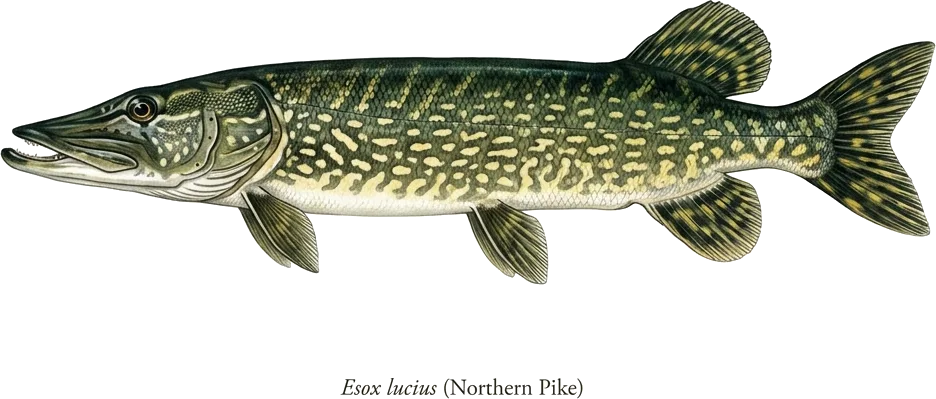
Northern Pike Northern pike (Esox lucius) is an apex freshwater ambush predator of the pike family (Esocidae) distributed throughout circumpolar inland waters. The species features an elongated torpedo body, duckbill snout lined with backward-pointing hinged teeth, and maximum weight reaching 25 kg. Anglers target trophy pike with casting spoons, minnow jerkbaits, soft swimbaits, and live bait rigs.
Pike demands strict spinning discipline: mandatory titanium or steel wire traces (20–25cm length), extended dead-stop twitching pauses (up to 4–8 seconds), and rod-low steering to kill aerial breaches.
- ✅ You want to definitively distinguish pike from zander and asp by jaw morphology and ambush style.
- ✅ You want to master twitching big 110-130mm jerkbaits (Deps Balisong, OSP Rudra, Megabass Vision Oneten).
- ✅ You need proven setups: titanium tooth-proof traces, snagless foam jigs, and unweighted soft plastics in lily pads.
- ✅ You want to explore the science of backward-hinged teeth, lunar tooth replacement, and mandibular sensory pores.
- ✅ You want to master northern pike ambush habits and tackle mechanics in 'Volga 2026'.
Ichthyology & Predatory Adaptations: Biological Profile of Esox lucius
Northern pike (*Esox lucius*) represents the pinnacle of freshwater ambush predator evolution:
Lower jaws feature heavy canines for seizing prey. The palate, vomer, and tongue are covered in hundreds of needle teeth hinged backward, flattening as prey enters the throat but locking rigidly upright if it tries to escape ('one-way trap').
Dorsal and anal fins sit far back on the caudal peduncle, creating a unified propulsion paddle with the tail fin. From a dead stop, pike accelerate to 4.0 m/s in just 0.05 seconds.
Lower jaws feature 5–6 large lateral line sensory pores that detect low-frequency vibrations generated by struggling baitfish in murky water up to 15m away.
Pike replace their canine teeth continuously throughout life. Teeth drop in alternating pairs rather than all at once, with fresh soft teeth hardening within 10–14 days.
Northern Pike vs Zander vs Asp: Predator Comparison Guide
Comparative anatomical guide for three premier Volga apex predators:
- Jaws: flattened 'duck-bill', hundreds of backward-angled needle teeth.
- Tactics: explosive sprint from cover (snags, weeds, shelves).
- Strike: seizes prey ACROSS the body before turning it head-first.
- Fins: dorsal and anal clustered far back near tail.
- Size: specimen females reach 12–20+ kg.
- Jaws: two heavy front canines on upper and lower jaws ('vampire fangs').
- Eyes: large glassy tapetum lucidum optics for night hunting.
- Tactics: twilight pack hunting along deep channel breaks.
- Dorsal fins: TWO SEPARATE fins with sharp spines.
- Size: specimen adults reach 8–12 kg.
- Jaws: TOOTHLESS, bony knob on lower jaw fitting upper notch.
- Tactics: high-speed surface pursuit stunning prey with tail smashes.
- Coloration: brilliant chrome silver with dusky back.
- Tail: rigid, broad, deeply forked.
- Size: specimen adults reach 5–8 kg.
Ambush Kinematics & Controlling Aerial Breaches
Pike launches an S-start ambush sprint in milliseconds, striking the prey crosswise: lower canines puncture scales while palatine needle teeth lock the bait. On jerkbaits, pike usually hook on the belly treble.
Feeling rod pressure, pike rocket upward in a vertical aerial breach ('tail-walk'), flaring gill covers and shaking its head to throw the heavy lure via inertia. To prevent hook throw, instantly plunge the rod tip into the water ('bow to the pike') while keeping line taut!
Seasonal Habitats: Weedbeds, Timber & Channel Breaks
Pike distribution follows water temperatures and prey fish staging:
🌱 Spring (Post-Spawn Gorge): Spawns first at +4–7°C across flooded shallows (0.3–1.0m depth). Two weeks post-spawn, the ravenous spring feed begins—attacking 90–110mm minnows and in-line spinners along reed edges.
☀️ Summer (Weeds & Deep Timber): Grass pike hold in lily pockets (1.0–2.5m), smashing poppers and weedless frogs. Specimen channel pike occupy 4.0–8.0m deep snags and drop-offs, caught on heavy jigs at dawn.
🍂 Autumn (Peak Feeding Frenzy): Cooling water sparks intense foraging. Giant 130–160mm jerkbaits on deep pauses and heavy 25–45g jigs with 5–7 inch soft swimbaits dominate channel breaks.
❄️ Winter (Ice Tip-Ups & VIBs): First ice brings aggressive feeding in 2.0–4.5m depths near reeds on livebait tip-ups, as well as vertical balancing jigs and rattling VIBs.
Pike Baits: 130mm Jerkbaits, Deep Jigging, Spoons & Livebait
1. Livebaits for Tip-Ups
Crucian carp (durable #1 all-rounder); roach; perch in clear water; gudgeon. Hooked beneath the dorsal fin on a double or treble hook.
2. 110–130mm Suspending Minnows
Deps Balisong 130 SP, O.S.P Rudra 130 SP, Megabass Vision Oneten 110, Jackall Mag Squad 128 SP, ZipBaits Orbit 110 SP in natural and Mat Tiger patterns.
3. Soft Plastics & Mandula Jigs (4–7 Inch)
Paddle tails (Keitech Easy Shiner 5–6.5", Relax Kopyto 4–5"), snagless foam fish, and jointed Mandula jigs on double hooks for sunken timber.
4. Classic Casting Spoons
Atom, Shtorlek, Kuusamo Professor, Williams Wabler (15–28g). Slow flutter retrieval over weedbeds and deep drop-offs.
Tackle: Twitching Blanks, Heavy Jigs & Titanium Wire Traces
Pike spinning requires crisp blank stiffness to work heavy jerkbaits and 100% tooth-proof wire protection:
Twitching Rod 2.0–2.2m (Fast / 10–35g)
2.06–2.18m Fast/Extra-Fast rod with powerful backbone. Size 3000–4000 reel. 4-carrier braid PE #1.2–1.5 for maximum knot strength and abrasion resistance.
Boat Jig Rod 2.3–2.5m (15–50g)
High-modulus carbon blank with sensitive tip. Braid PE #1.2–1.5 with forged 4/0–6/0 offset hooks for snag jigging.
Titanium Wire Trace (20–25cm)
Single-strand or 7-strand titanium trace (12–18 kg rating) with zero bend memory, or classic #2 steel wire. Completely eliminates tooth bite-offs.
Debunking Common Northern Pike Myths
Fact: Pike replace teeth cyclically in alternating pairs year-round. Pike never become toothless and feed regardless of lunar phases.
Fact: On deep swallows, sawing tooth edges slice under line tension, easily severing fluorocarbon. Only titanium and steel wire guarantee 100% protection.
Fact: In autumn and spring, 10–15kg specimen pike frequently hunt on 1.5–2.5m shallow weed flats targeting heavy bream.
Scientific Research on Esox lucius
'The pike inhabits all rivers, lakes, and ponds... It represents the most voracious predator, consuming vast quantities of fish, frogs, and waterfowl, famous for its lightning ambush sprint.'
'Esox lucius is a classic ambush sprinter exhibiting distinct habitat polymorphism. Population divergence into shallow macrophyte foragers and deep channel morphs is confirmed by morphometric analysis.'
'Esox lucius: maximum recorded weight exceeding 25kg, length 150cm, lifespan up to 30 years. The oral cavity shelters over 500 backward-hinged teeth preventing prey slippage.'
4 Tactical Spinning Strategies for Northern Pike
Two sharp rod snaps, then a dead freeze for 4–6 seconds. The suspending jerkbait hangs motionless, triggering savage reaction strikes.
Snagless foam fish with tight double hooks on a 28–36g Cheburashka weight. Tap deep woody drop-offs with a crisp 1–2 second hang time.
5-inch paddle tail on a wide-gap offset hook with zero lead. Skim the bait across lily pads, dropping it into weed pockets.
The instant the pike drives upward to breach, plunge the rod tip into the water sideways to prevent aerial headshakes.
Seasonal Matrix: Depths, Optimal Times, Baits & Rigs
| Season | Peak Feeding Time | Depth Zone | Top Baits | Tackle System |
|---|---|---|---|---|
| Spring (April – May) | 08:00 – 17:00 (Overcast days) | 0.8 – 2.5 m (Bays & reed edges) | 90–110mm Minnows, spinners #3–4, jigs | Medium rod 7–28g, titanium trace |
| Summer (June – August) | 05:00 – 08:30 & 19:00 – 21:30 | 1.2 – 5.0 m (Lily windows, snags) | Poppers, weedless swimbaits, 110mm minnows | Fast twitching rod, steel wire trace |
| Autumn (Sept – Nov) | 09:00 – 17:00 (All daylight) | 3.5 – 9.0 m (Channel breaks & deeps) | 130–160mm Jerkbaits, 5–7" soft swimbaits | Heavy rod 15–50g, titanium 25cm |
| Winter (Ice Fishing) | 08:00 – 16:30 (First ice & thaws) | 2.0 – 5.5 m (Reed flats & drop-offs) | Live crucian on tip-ups, 70mm VIBs | Ice tip-ups, vertical jigging rod |
Angling Diagnostic: Identify What's Impeding Your Northern Pike Success
Select the symptoms you are experiencing for instant technical adjustments:
Northern Pike in 'Volga 2026' Simulator
In 'Volga 2026', northern pike is simulated with explosive ambush kinetics, dead-pause strike triggers, and high-risk aerial breaches. Weight range spans 0.3 to 12.0 kg (specimens reaching 18+ kg). Demands wire traces and fast spinning rods.
Key in-game locations: 'Reed Lagoon', 'Volga Snags', 'Lily Cove', 'Old Riverbed'.
Northern pike is the cornerstone of spinning questlines ('Toothy Mistress', '130mm Twitching Master', 'Specimen Alligator'), unlocking tournament jerkbaits and titanium leaders.
Frequently Asked Questions About Northern Pike
Why are pike teeth hinged and angled backward?
Palatine and vomerine needle teeth point backward like a one-way valve: prey slides smoothly into the throat, but any reverse movement locks the teeth upright, clamping the victim immovable.
Why are long pauses critical when twitching for pike?
Pike is an ambush calculator. Snaps pull attention from afar, but the final strike is committed when the wounded 'prey' hangs frozen motionless in mid-water (3–7 second pause).
What leader trace guarantees 100% bite-off protection against pike?
Only metal traces: single-strand titanium leaders or #2 steel wire traces (20–25cm length). Pike teeth can saw through any fluorocarbon when swallowed deeply.
How do you prevent hook throws during a pike's aerial breach?
The moment the pike powers toward the surface to leap, plunge the rod tip into the water sideways ('bow to the fish'), maintaining tension without hauling upward.
Is it true that pike shed teeth on the full moon and stop biting?
This is a myth. Pike replace canines continuously year-round in alternating pairs. They never become toothless and feed in all lunar phases given stable barometric conditions.
Authoritative Ichthyological Sources & Literature: FishBase — Esox lucius Biological Summary · IUCN Red List of Threatened Species — Esox lucius · Л. П. Сабанеев — «Жизнь и ловля пресноводных рыб: Щука» (Викитека) · Институт биологии внутренних вод им. И. Д. Папанина РАН (ИБВВ РАН)
Prepared by the Volga 2026 Editorial Board in strict adherence to aquatic biology and sport angling standards. Volga 2026 Editorial Methodology.