Ichthyology & High-Adrenaline River Angling · Volga 2026 Encyclopedia
Chub (European Chub)
Squalius cephalus (Linnaeus, 1758)
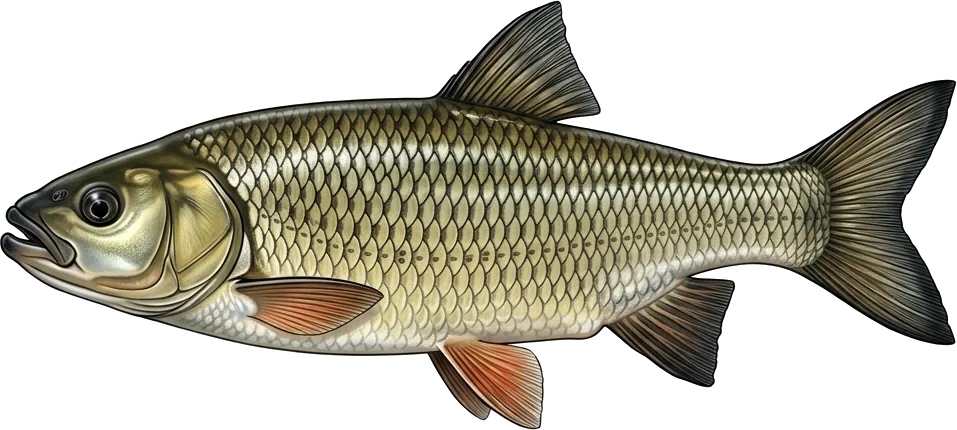
Chub (European Chub) European chub (Squalius cephalus) is a powerful rheophilic predatory cyprinid fish in the family Leuciscidae ruling turbulent river rapids, gravel glides, and undercut banks across Eurasia. The species is characterized by a broad flattened forehead, large terminal mouth, convex scarlet anal fin, and weight up to 6 kg. Anglers target chub using fat crankbaits, micro-spoons, surface flies, and floating bread.
Chub combines razor-sharp eyesight with explosive acceleration. Success demands stealth (long-range casting from cover), rugged hardware (forged Owner/Decoy trebles, #0.6–0.8 PE braid with 0.20–0.22mm fluorocarbon), and precision slap-down presentations tight to overhanging foliage.
- ✅ You want to consistently catch river chub on spinning lures (crankbaits, micro-spoons, inline spinners).
- ✅ You want to master surface free-line drifting with live cockchafers under overhanging willow trees.
- ✅ You want to eliminate hook pulls and straightened trebles during high-speed current takes.
- ✅ You want to distinguish chub from ide and dace with 100% accuracy using the convex scarlet anal fin.
- ✅ You want to master chub strike dynamics and fighting runs in 'Volga 2026'.
Ichthyology & Adaptations: Biological Profile of Squalius cephalus
The European chub (*Squalius cephalus*) is an apex predator of lotic streams in the family Leuciscidae, engineered for ambush hunting in heavy current:
A broad, flattened frontal cranium acts as a hydrodynamic water deflector, steadying head posture in turbulent boils and maintaining visual surface focus.
Unlike ide or dace, the posterior margin of the chub's anal fin is distinctly CONVEX (rounded outward) and colored vibrant scarlet, providing explosive thrust.
Biserial pharyngeal teeth (2.5–5.2) feature sharply hooked crowns, engineered to shatter beetle elytons, crayfish carapaces, and secure slippery forage fish.
Large forward-and-upward canted eyes form an expansive Snell's window, enabling chub to spot falling beetles or splashing lures from 10–15m away.
European Chub vs Ide vs Asp: Anatomical Keys
Identification key for three large predatory cyprinids of the Volga basin:
- Anal fin: distinctly CONVEX (rounded outward), vibrant scarlet red.
- Mouth: enormous, wide, terminal with thick lips.
- Scales: LARGE (44–46 in lateral line), dark pigmented edges form a bold lattice.
- Head: broad, flat cranium; golden-greenish eyes.
- Habitat: torrential riffles, rapids beneath bluffs, fast bridge pilings.
- Anal fin: distinctly CONCAVE (notched), crimson red.
- Mouth: moderate size, oblique, directed upward.
- Scales: FINE (55–61 in lateral line) with a golden-brass hue.
- Body: deeper and thicker; arched dark-olive back.
- Habitat: deep river glides, clay bluff eddies, backwater seams.
- Anal fin: notched grey with dark margin.
- Mouth: massive upturned jaw with mandibular locking peg.
- Scales: VERY FINE (65–75 in lateral line), brilliant silver-steel without net borders.
- Body: streamlined, powerful, steel-blue dorsal hue.
- Habitat: open pelagic currents, explosive surface hunting on bleak.
Biomechanics of the Explosive Chub Strike
Chub attacks oncoming lures at maximum acceleration straight into the river current. Combining sprint velocity, flow resistance, and muscular jaw clamp generates tremendous kinetic shock, transmitting a sledgehammer impact to the rod blank.
Lures landing tight to willows 'on the slap' are frequently engulfed within milliseconds of surface touchdown. Without immediate line tension, chub detects the hard plastic body and expels the lure instantly.
Once hooked, chub turns broadside to the current, bolting downstream or driving for submerged timber. Surviving the opening 10 seconds requires authoritative rod-butt leverage and an immaculate reel drag.
Seasonal Habitats & Staging for European Chub
Chub staging transitions between surface-oriented warm periods and deep benthic winter patterns:
Spring (May): The cockchafer hatch and warming to +14...+16°C pull chub into ambush stations under overhanging trees and gravel shallows. Prime season for surface beetle drifting and wake crankbaits.
Summer (June – August): Peak action on fast riffles, bridge current glides, and weir chutes. Midday hunting targets surface insects; extreme heat shifts large fish to nocturnal foraging on gravel bars.
Autumn (September – November): Vanishing terrestrial falls and water cooling below +10°C drive chub into 2.5–5.5m pool transitions. Targeted on deep-diving crankbaits (DR), micro-jigs, and minnow rigs.
Winter (December – March): Overwinters in deep flowing holes over gravel. Active during thaws, striking ice jigs tipped with fish strips or bloodworms in moderate current.
Chub Nutrition: Lures, Beetles, Cheese & Baits
1. Natural Animal Baits (Insects & Terrestrials)
Live cockchafer (May bug) is the supreme spring classic; grasshoppers in midsummer; black leeches; small gudgeon minnows. After dark, firm 1.5cm cubes of aged cheddar or gouda are lethal.
2. Plant Baits (Fruit & Bread)
Pitted sweet cherries (celebrated Volga tactic); floating crusts of fresh bread; steamed peas and sweetcorn. Chub are renowned gourmands that readily feast on summer riparian fruits.
3. High-Performance Lures (Spinning)
Fat floating crankbaits 32–40mm (Jackall Chubby, Smith Camion, ZipBaits Hickory); micro-spoons 2.0–3.8g in matte black, gold, and copper; #1–2 inline spinners with wide Colorado blades.
4. Bread Chumming Strategy
When float fishing, drift thumb-sized bread crusts downstream every 2–3 minutes. Once heavy surface rises betray feeding chub, float your hookbait crust right into the boil.
Tackle Systems: Stream Spinning, Fly Gear & Surface Drifters
Targeting current chub requires responsive tips paired with uncompromising lower-blank backbone:
Light Stream Spinning Rod (2–10g)
6'6"–7'2" regular-fast carbon blank absorbing shock loads. 2000–2500 spinning reel with smooth line lay. Braid #0.6–0.8 PE with a 1.0–1.5m shock trace of 0.20–0.23mm fluorocarbon.
Fly Tackle for Riffles (#4–5wt)
8'6"–9'0" #4–5wt fly rod, floating WF line, 2.7m tapered leader (0.16–0.18mm tippet). Buoyant foam beetles (Chernobyl Ant, Foam Bug) and Woolly Buggers on #6–10 hooks.
Surface Cockchafer Free-Line Rig
4.0–4.5m match or Bolognese rod, clear water-filled bubble float, or pure free-lining with 0.20mm mono straight to a forged wide-gape hook #6.
Debunking Common European Chub Myths
Fact: Specimen chub is a fierce predator. During warm months, up to 60% of its intake consists of forage fish (bleak, gudgeon), crayfish, and frogs hunted with apex aggression.
Fact: In midsummer, the biggest specimens (2–3+ kg) patrol shallow gravel bars in pitch darkness (23:00 to 03:00), taking night crankbaits and cheese ledgers.
Fact: Steel wire kills micro-crank action and repels ultra-cautious chub 9 times out of 10. A supple 0.20–0.22mm fluorocarbon leader is optimal.
Scientific Research on Squalius cephalus
'The chub is among the handsomest and most spirited fishes of our rivers... Loving fast currents, clean water, and rocky beds, it congregates beneath rapids, dams, and overhanging boughs... The strike on spinning lures or live beetles is extraordinarily violent, hitting at full sprint so careless anglers can easily lose their rods.'
'Squalius cephalus: cranial hydrodynamic profile featuring a flattened frontal shield guarantees stable orientation in turbulent surface vortices. Biserial 2.5–5.2 pharyngeal teeth with hooked crowns securely grip both chitinous beetle armor and slippery fish prey.'
'Squalius cephalus: maximum documented length 60 cm, weight up to 8.0 kg. Anal fin is distinctly convex with 8–9 branched rays. A broad eurythermic rheophil active between +4°C and +26°C with pronounced diurnal and twilight visual predation.'
4 Tactical Strategies for Stream Chub
Skip a floating Jackall Chubby tight under branches on a low trajectory. The crisp surface slap triggers an immediate take before reeling starts.
Hook a live cockchafer on hook #6 and drift it 30–50m downstream with open bail. The take erupts in a heavy surface boil.
Rest a cheddar cube on a 1.0–1.5m gravel bar at midnight. Specimen night chub track the rich dairy scent trail directly to the hook.
Cast a crankbait at 60° across stream, keeping line taut without reeling. The current swings the wobbling lure across the ambush seam.
Seasonal Matrix: Depths, Optimal Times, Baits & Rigs
| Season | Peak Feeding Time | Depth Zone | Top Baits | Tackle System |
|---|---|---|---|---|
| Spring (May) | 09:00 – 19:00 (Warm hours) | 0.2 – 1.2 m (Tree shade, rapids) | Cockchafer, 38mm crankbaits, leech | Light spinning, surface drifter |
| Summer (June – August) | 05:00 – 09:00 & 22:00 – 03:00 (Night) | 0.3 – 2.0 m (Riffles, sandbars) | Crankbaits, grasshopper, cheese, cherry | Spinning, fly #4/5, night feeder |
| Autumn (Sept – Oct) | 11:00 – 16:30 (Midday sun) | 2.5 – 5.5 m (Deep pool seams) | Live minnow, deep crankbaits, jig | Jig rod (3–12g), river feeder |
| Winter (Ice Fishing) | 10:00 – 15:00 (Thaws) | 3.5 – 7.0 m (Flowing deep pools) | Fish strips, bloodworms, micro-balance | Winter stream-jig rod |
Angling Diagnostic: Identify What's Impeding Your Chub Success
Select the symptoms you are experiencing for instant technical adjustments:
European Chub in 'Volga 2026' Simulator
In 'Volga 2026', European chub is simulated with peak strike kinetic force and aggressive riffle behavior. Weight range spans 0.18 to 3.9 kg. It rewards precision casting under bank canopies and fast drag management.
Key in-game locations: 'River Riffle', 'Rocky Riffle', 'Steep Bluff', 'Old Dam'.
Chub is featured in questlines ('Master of the Rapids', 'Riffle Smash', 'May Trophy'), unlocking premium Japanese crankbaits and fly setups.
Frequently Asked Questions About European Chub
Why is the chub strike so violent ('rod-wrenching smash')?
Chub intercept lures head-on at burst velocity against the river flow. Summing the fish's ambush speed, current drag, and explosive jaw clamp generates massive kinetic shock.
How do you distinguish European chub from ide?
Key markers: 1) Anal fin: convex bright scarlet on chub (concave crimson on ide); 2) Scales: large (44–46) with dark net borders on chub, fine (55–61) on ide; 3) Head: chub features a much broader, heavier cranium.
What crankbaits are considered the gold standard for chub?
The undisputed standards are Jackall Chubby 38, Smith Camion SR/DR, ZipBaits Hickory, and Salmo Hornet 3–4cm in natural, black, and gold patterns.
How do you fish for chub using live cockchafers?
Hook a live beetle through the thorax on hook #6 without sinkers. Drift the offering 30–50m downstream directly under overhanging branches with open bail.
Where does chub hold in late autumn and winter?
In late autumn and winter, chub vacate shallow riffles, concentrating in 3.5–7.0m deep flowing holes over stone or clay beds, holding close to bottom in moderate current.
Authoritative Ichthyological Sources & Literature: FishBase — Squalius cephalus (Linnaeus, 1758) Species Summary · IUCN Red List of Threatened Species — Squalius cephalus · Л. П. Сабанеев — «Жизнь и ловля пресноводных рыб: Голавль» (Викитека) · Институт биологии внутренних вод им. И. Д. Папанина РАН (ИБВВ РАН)
Prepared by the Volga 2026 Editorial Board in strict adherence to aquatic biology and sport angling standards. Volga 2026 Editorial Methodology.