Ichthyology & Predator Angling · Volga 2026 Encyclopedia
European Perch
Perca fluviatilis (Linnaeus, 1758)
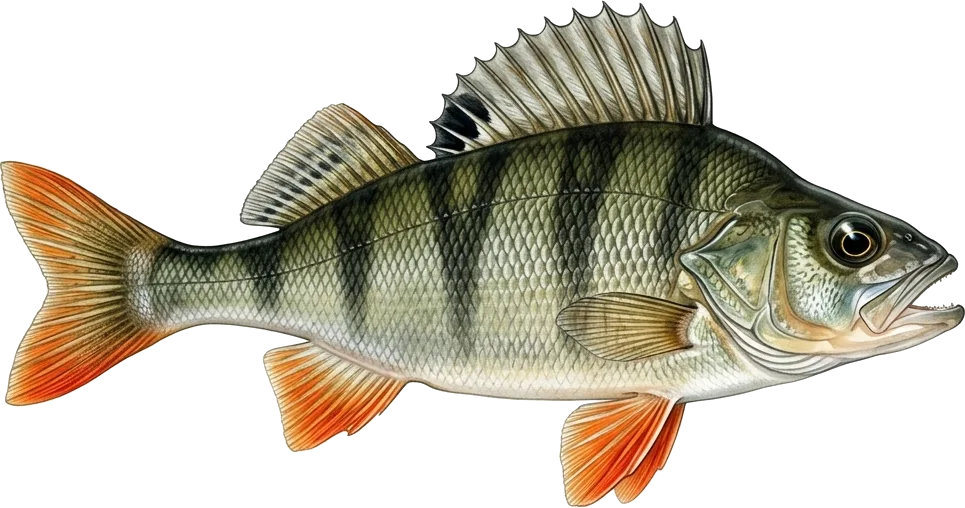
European Perch European perch (Perca fluviatilis) is a predatory freshwater fish of the percid family (Percidae) common across Eurasian rivers, reservoirs, and estuaries. The species features two separate dorsal fins with 13–17 sharp spines, rough ctenoid scales, an opercular spine, and weight up to 4.75 kg. Anglers catch perch with micro-jigs, spinners, minnow plugs, and ice balancers.
Perch is an aggressive yet visually acute predator. Unlocking regular bites from specimen perch requires tuning animation cadence, lengthening pause duration (up to 4–6 seconds), and utilizing subtle fluorocarbon leaders (0.16–0.20mm).
- ✅ You want to systematically target specimen humpback perch (500g–1.5kg) rather than juvenile weed-dwellers.
- ✅ You want to master vacuum strike hydrodynamics and prevent lip-tearing hook pulls during the retrieve.
- ✅ You need proven animation techniques: micro-jig shaking, suspending minnow twitching, and drop-shot presentation.
- ✅ You want to pinpoint surface feeding boils in summer and locate deep winter staging zones on open reservoirs.
- ✅ You want to master predator behavior and lure physics in the 'Volga 2026' angling simulation.
Ichthyology & Adaptations: Biological Profile of Perca fluviatilis
European perch (*Perca fluviatilis*) is a diurnal apex predator equipped with remarkable ecological adaptability. Its specialized anatomy delivers exceptional hunting efficiency:
Lacking sharp seizing fangs, perch hunt via explosive buccal volume expansion. Rapid flaring of opercular gill covers creates an intense suction vortex that engulfs prey and lures in 0.05–0.12 seconds.
Perch shoals coordinate hunting drives, surrounding baitfish schools (bleak, minnows) and corralling them toward the surface. This creates explosive surface 'boils' accompanied by diving terns and gulls.
Deep-rooted ctenoid scales with serrated margins form an armor-like skin. The front dorsal fin boasting 13–17 rigid sharp spines with mild defensive mucus deters attacks from larger pike and zander.
In large waters, perch segregate into two morphotypes: slow-growing littoral weed-dwellers feeding on invertebrates, and deep-bodied benthic 'humpbacks' preying on fish along 4–10m ledges.
Perch vs Zander vs Volga Pikeperch: Percid Identification
The Percidae family encompasses three prime Volga predators. Here is how to distinguish them reliably:
- Body: deep-sided, compressed laterally, developing a pronounced hump in specimen fish.
- Bars: 5–9 crisp vertical dark bars over a golden-green flank.
- Fins: pelvic, anal, and lower caudal are vivid scarlet/orange.
- Dorsal fin: features a prominent circular black spot at the trailing edge.
- Teeth: dense pads of villiform brush-teeth (no fangs).
- Body: elongated, torpedo-shaped stream profile.
- Mouth: armed with formidable sharp fangs on both jaws.
- Eyes: large, glassy milky-white with reflective night tapetum lucidum.
- Fins: muted grey with speckled rows, lacking red pigmentation.
- Scales: fine, rough, firmly embedded in skin.
- Mouth: entirely lacks fangs (all teeth are uniform brush-teeth).
- Cheeks: fully covered with scales (unlike bare cheeks of zander).
- Bars: noticeably sharper and wider transverse dark bars.
- Size: rarely exceeds 1.0–1.2 kg in weight.
- Eyes: proportionally larger relative to head length.
Biomechanics of the Vacuum Inhalation Strike
Approaching prey, perch flares its buccal cavity fractions of a second before jaw closure. The resulting negative pressure gradient sweeps softbaits, spinners, or baitfish directly into the oral cavity with the incoming water column.
If a lure is rigged on an excessively heavy jig head, the perch cannot suck it in completely; the lure bounces off closed lips, resulting in a distinct yet empty 'thump'. Articulated flex-heads or free-sliding links (Carolina, drop-shot) give the softbait the natural freedom needed to fly straight into the predator's throat.
Seasonal Habitats & Migration: Locating Perch Throughout the Year
Annual perch activity tracks forage migrations, thermal gradients, and dissolved oxygen availability:
🌱 Spring (Pre-spawn & Spawning): In April–May at water temperatures of +7–10°C, perch congregate in 1–2m shallows with old weed beds. Eggs are laid in long gelatinous ribbon-like veils across submerged brush. Post-spawn fish feed aggressively on shallow warming flats for 10–14 days.
☀️ Summer (Boils & Shallows): The peak of surface pack hunting. At dawn and dusk, schools raid sandy spits, islands, and shallows in explosive feeding boils. During mid-day heat, fish retreat to shaded bridge piers, sunken timber, and deep snaggy humps (3–6m).
🍂 Autumn (Deep Structure Staging): The prime season for trophy anglers. As waters cool, perch mass along 4–9m channel ledges, gravel bars, and zebra mussel reefs. Shoals concentrate tightly; autumn yields the heaviest 1kg+ specimens on deep jigging and Carolina rigs.
❄️ Winter (Ice Jigging Dynamics): On first ice, perch prowl 1.5–3.5m weed borders with high aggression. In midwinter oxygen drops, packs stage along 5–8m channel breaks with moving current. Gliding vertical spoons ('maropedka') and 3–5cm balance jigs trigger consistent takes.
Perch Lures & Baits: Soft Plastics, Minnow Plugs, Spoons & Livebait
1. Soft Plastics (Microjig & Jig Rigs)
1.5–2.5 inch curly-tail grubs with supple tails; slim paddle-tail minnows (Easy Shiner, Tioga); passive creature baits (crayfish, worms, creature bugs). Top colors: motor oil with glitter, dark olive green, UV-reactive purple (Lox), cola, and smoke pearl.
2. Hardbaits, Twitching Minnows & Topwaters
50–70mm suspending minnow plugs for stop-and-go twitching; compact shallow-running crankbaits (35–45mm) for gravel bars; surface poppers and walk-the-dog stickbaits (45–60mm) for explosive boil action.
3. Spinners, Spoons & Vertical Ice Lures
In-line spinners (Mepps Aglia / Black Fury #1–3) with copper and matte black blades; compact metal vibes and blade baits; 30–50mm vertical winter ice spoons and 3–5cm balance jigs (Rapala / Lucky John).
4. Live Baits & Natural Offerings
Live baitfish (minnow, small gudgeon, round goby) hooked through the upper lip on a single wire hook; juicy bunch of redworms / dendrobaena; large hookable bloodworm for float and winter nymphing.
Tackle & Specialized Rigs for European Perch
Depending on venue dynamics, three dedicated angling setups cover the full spectrum:
Microjig & Finesse Lure Setup
2.0–2.25m spinning rod (0.5–5g or 1–7g rating) with a sensitive solid or tubular carbon tip. 2000–2500 reel with micro-click drag. Braided line PE #0.2–0.4 (0.07–0.10mm) coupled with a 1.0–1.5m fluorocarbon leader (0.14–0.18mm).
Carolina & Drop-Shot Rigs
2.4–2.7m rod (5–21g rating) for long-range casting. 10–20g slim pencil weight on a 20–30cm dropper. Main fluorocarbon leader (0.18–0.22mm) extending 90–120cm to a wide-gap offset hook (#4–8). Unmatched for raking distant shell bars.
Winter Ice Jigging Rod
45–60cm high-modulus graphite ice rod with a smooth reel spool for rapid depth adjustment. Low-memory winter monofilament (0.12–0.16mm). Micro snap link without swivel to maximize vertical spoon flutter.
Debunking Common Myths About European Perch
Fact: While small juveniles attack heedlessly, mature humpback perch (500g+) possess keen binocular vision. Adding an invisible 0.16mm fluorocarbon leader boosts specimen strike rates 3- to 5-fold.
Fact: While shallow summer pack feeding peaks in bright light, the largest solitary specimens hunt channel drop-offs during dawn and dusk twilight windows.
Fact: Perch are driven by fierce shoal feeding competition. Returning the lure to the strike zone within 5 seconds sustains pack excitement, often yielding 10–20 fish in rapid succession.
Scientific Authority: Ichthyological Research on Perca fluviatilis
'The perch inhabits all rivers, lakes, and running ponds across European Russia... It is voracious in diet, yet remarkably astute, retreating to deep brush at the slightest hint of danger.'
'In Volga cascade reservoirs, Perca fluviatilis exhibits pronounced ecomorphological segregation: the benthic morphotype achieves high body mass indexes primarily preying on cyprinid young-of-the-year and tyulka sprat.'
'Perca fluviatilis: trophic level 4.1 (apex mesopredator). Thermal optimum 14–22°C. Capable of thriving in brackish waters up to 10–12 PSU in estuarine river deltas.'
4 Practical Tactical Strategies for Catching Quality Perch
Impart rapid micro-vibrations with the rod tip in place, followed by a sudden slack-line drop. The lure kicks up silt puffs, provoking aggressive strikes as it settles.
Never cast into the dead center of a surface boil. Cast 3–5m past the activity and retrieve along the perimeter where heavy specimen humpbacks patrol the flanks.
Slow bottom-dragging across shell bars with 3–5 second pauses. The unweighted trailing creature bait drifts naturally, triggering bites from dormant autumn fish.
Execute 5–7 wide aggressive sweeps to pull predators from up to 15m away, then downshift to gentle quivers with 4–8 second dead pauses for the decisive strike.
Seasonal Matrix: Depths, Optimal Times, Lures & Rigs
| Season | Peak Feeding Time | Depth Zone | Top Lures / Baits | Tackle System |
|---|---|---|---|---|
| Spring (April – May) | 11:00 – 16:00 (Warming sun) | 1.0 – 2.5 m (Bays, submerged brush) | 2" micro-jig, spinners #1-2, bloodworm | Ultralight rod 0.5–5g |
| Summer (June – August) | 05:00 – 08:30 & Dusk boils | 0.5 – 3.5 m (Bars, boils, shallows) | Poppers, 50–65mm minnow plugs, spinners | Twitching light rod 2–10g |
| Autumn (Sept – Nov) | All daylight hours (peak 12:00–15:00) | 3.5 – 9.0 m (Channel ledges & deep drop-offs) | 2.5–3.5" softbaits, creature bugs, metal vibes | Jig rod 5–18g, Carolina rig |
| Winter (Ice Fishing) | 08:30 – 14:30 (Stable frost) | 2.0 – 6.5 m (Snag piles & drop-offs) | 3–5cm balance jigs, vertical spoons | Ice jigging rod with fluorocarbon |
Angling Diagnostic: Identify What's Impeding Your Perch Success
Select the symptoms you are experiencing for targeted tactical adjustments:
European Perch in 'Volga 2026' Simulator
In 'Volga 2026', European perch is simulated with realistic predatory biomechanics. Weight spectrum ranges from 0.08 to 2.4 kg. The fish responds dynamically to lure cadence variations, pause durations, and bottom contour proximity.
Key in-game locations: 'Old Quay', 'Tram Bend', 'Reed Lagoon', 'Island Reach', 'Rocky Riffle'.
Perch is the featured quarry in early predator questlines ('First Strike', 'Perch Fever', 'Ruler of the Shell Reef'), unlocking advanced spinning tackle and tournament lures.
Try Catching Specimen Humpback Perch in Volga 2026 Simulator →
Frequently Asked Questions About European Perch
How do you tell European perch apart from zander and Volga pikeperch?
Primary markers: perch has a deep, humpbacked body, vivid red pelvic/anal fins, and a black spot on the dorsal fin's trailing edge. Zander and Volga pikeperch have slender torpedo bodies with grey fins; zander features prominent sharp fangs.
What soft plastic colors work best for finicky perch?
The undisputed champion for inactive perch is 'motor oil' infused with fine gold or green flake. In stained water or low light, UV-reactive purple (Lox) and cola shine, while crystal-clear venues favor translucent smoke and natural pearl.
Why is a fluorocarbon leader essential when targeting perch?
Fluorocarbon has a refractive index (1.42) nearly identical to water (1.33), rendering it virtually invisible to keen perch eyes. It also protects delicate braid from abrasion against razor-sharp zebra mussels and rocky ledges.
What is an 'angler boil' (perch cauldron) and how do you fish it?
A boil is a surface feeding frenzy where a coordinated pack pins baitfish against the surface film. Water froths with splashes while terns dive above. Fish it using surface poppers, walking stickbaits, or compact casting metals along the outer edges.
At what depths do specimen winter perch hold on large waterways?
On first ice, large perch roam 2.0–3.5m zones near submerged timber and points. By midwinter, specimen humpbacks concentrate along 5–8m channel contours featuring moving water and firm gravel-mussel substrate.
Authoritative Ichthyological Sources & Literature: FishBase — Perca fluviatilis Biological Summary · ИБВВ РАН — Ихтиофауна и экология хищных рыб Волжского бассейна · Л. П. Сабанеев — «Жизнь и ловля пресноводных рыб»
Prepared by the Volga 2026 Editorial Board in strict adherence to aquatic biology and sport angling standards. Volga 2026 Editorial Methodology.