Cobitid Bioacoustics & Nocturnal Benthic Finesse Angling · Volga 2026 Encyclopedia
Weatherfish
Misgurnus fossilis (Linnaeus, 1758)
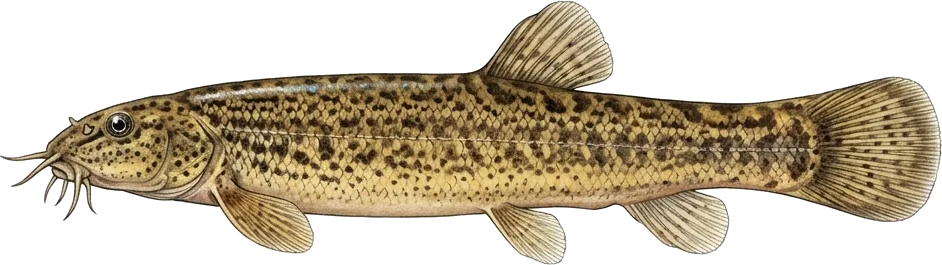
Weatherfish European weatherfish (Misgurnus fossilis, or weather loach) is a benthic, eel-shaped cobitid fish native to silty swamps, backwaters, and oxbows of Europe. The species is equipped with ten sensory barbels, supplementary intestinal air-breathing for anoxic survival, barometric sensitivity to storms, and weight up to 250 g. Caught on light bottom rigs baited with worms.
Weatherfish demands delicate ledgering or float tackle: 2.7m sensitive picker or whip, 0.12–0.14mm mono, 5–10g light sinker, Long Shank hook #12–14 to ease unhooking, and prime baits: juicy redworm segments, small medicinal leeches, or bloodworm clusters.
- ✅ You want to definitively understand Misgurnus fossilis biology: atmospheric intestinal respiration, 10 barbels, and barometric pressure sensitivity mechanisms.
- ✅ You want to master nocturnal and pre-thunderstorm ledgering in heavily silted oxbows, peat ditches, and weed-choked backwaters.
- ✅ You need proven baits: juicy dung worms, soft small freshwater leeches, bloodworms, and dragonfly nymphs.
- ✅ You want secrets to keeping weatherfish as legendary 'indestructible' live bait for wels catfish, pike, and giant winter burbot.
- ✅ You want to master weatherfish mechanics and storm-rain quests in 'Volga 2026'.
Ichthyology & Biophysical Adaptations: Profile of Misgurnus fossilis
European weatherfish (*Misgurnus fossilis*) is an extremophile benthivore possessing remarkable biophysical adaptations:
In anoxic sludge, the loach ascends to the surface, gulps an atmospheric air bubble, and passes it through a vascularized midgut serving as an auxiliary lung. Expelled air escapes forcefully via the vent, producing an audible high-pitched squeak.
Via the Weberian apparatus and cutaneous mechanoreceptors, the loach detects minor atmospheric pressure drops (2–5 mmHg) hours ahead of a thunderstorm. Anticipating rain, it leaves bottom silt, swimming frantically at the surface.
Surrounding the subterminal mouth are 10 flexible barbels (4 maxillary, 6 mandibular). They are densely packed with tactile and taste receptors to locate worms and larvae buried deep in thick mud by touch alone.
When shallow oxbows and peat pools dry out during droughts, weatherfish corkscrew up to 1 meter deep into damp mud, encase themselves in mucus, and survive for months in suspended summer torpor (estivation).
Weatherfish vs Spined Loach vs European Eel: Identification Guide
Comparative anatomical guide for three serpentine benthic species:
- Barbels: STRICTLY 10 BARBELS around mouth.
- Color: yellow-brown with 3 DARK LONGITUDINAL STRIPES.
- Suborbital spines: COMPLETELY ABSENT.
- Tail: rounded fan-shaped caudal fin.
- Size: 15–30 cm (50–380g).
- Barbels: ONLY 6 BARBELS on upper jaw.
- Suborbital spine: SHARP ERECTILE BIFID SPINE under each eye.
- Color: pale sand with large dark quadrate blotches.
- Biotope: clean sandy rivers with moderate current.
- Size: miniature (8–12 cm, 10–25g).
- Barbels: COMPLETELY ABSENT (tubular nostrils only).
- Fins: continuous dorsal-caudal-anal fin ribbon.
- Jaws: powerful predatory jaws with fine teeth.
- Size: MASSIVE (to 1.0–1.5m, 1.5–4.5+ kg).
- Family: Anguillidae (true freshwater eels).
Mechanics of the Nocturnal Take & Serpentine Coiling Fight
Sweeping its 10 sensitive barbels across silty mud in darkness or pre-storm gloom, the weatherfish discovers a juicy redworm piece. The fish methodically inhales the offering. The float performs 2–3 gentle dips ('antenna bobbing') and glides smoothly underwater toward adjacent weed clumps.
Upon the strike, the weatherfish instantly twists into tight, muscular helical coils ('serpentine knot reflex'), generating continuous rotational torque on the line. To prevent gut-hooking, deploy Long Shank hooks #12–14 and keep forceps at hand. A dry micro-fiber cloth provides a secure grip on the slippery mucus-clad body!
Seasonal Habitats: Oxbows, Peat Ditches & Silty Marsh Backwaters
Weatherfish thrives exclusively in still and slow-moving waters over thick organic silt beds:
🌱 Spring (Shallow Flood Meadows): Emerges from winter mud torpor onto flooded 0.3–0.8m peat ditches and meadows. Feeds in daylight and dusk.
☀️ Summer (Peak Storm & Night Season): Inhabits deep silt in oxbows and peat cuts (0.6–1.5m). Peak feeding: 10:00 PM to 3:00 AM and before thunderstorms.
🍂 Autumn (Deep Basin Gathering): Retreats into the deepest 1.2–2.2m oxbow basins. Bites on bloodworm clusters during warm calm evenings.
❄️ Winter (Deep Silt Dormancy): Burrows 0.5–1.0m deep into bottom sludge for winter hibernation. Winter angling inactive.
Weatherfish Baits: Dung Worms, Small Leeches, Bloodworms & Dragonfly Nymphs
1. Natural Animal Baits (Top Choice)
1.5–2cm juicy redworm segment; small soft freshwater leech (Helobdella/Glossiphonia); cluster of 3–4 bloodworms; small dragonfly nymph.
2. Garlic Scented Dough & Paste
Tacky semolina dough lightly scented with garlic juice or anise oil (accepted less frequently than animal baits).
3. Pungent Silt Attractants
Liquid bloodworm extract, crushed dried daphnia, and garlic dip, helping loaches home in on baits buried in liquid muck.
4. Peat Earth Feed with Chopped Worms
Damp wetland peat soil blended with minced redworms and joker bloodworms. Balls rest gently on soft silt without sinking deeply.
Tackle: 2.7m Picker Rod, 0.12–0.14mm Mono, 8g Sinker & Long Shank #12 Hooks
Targeting twisting weatherfish over soft silt requires delicate yet tangle-resistant ledger gear:
Light Picker or Telescopic Whip 2.7–3.6m (10–35g Rating)
Compact, supple blank with a sensitive 0.75–1.0 oz tip engineered for close-quarters fishing in narrow peat ditches and reed gaps.
0.12–0.14mm Monofilament Mainline with 20cm 0.10–0.12mm Hooklink
Supple, twist-resistant monofilament absorbing rotational torque when the hooked fish executes its tight coiling spirals.
5–10g Flat Inline Sinker + Long Shank #12–14 Hook
Flat sinker rests on top of soft mud without sinking, while the elongated hook shank ensures swift extraction with forceps.
Debunking Common Weatherfish Myths
Fact: Weatherfish is an entirely harmless freshwater teleost fish of the Cobitidae family, possessing zero venom and no biting teeth.
Fact: The squeak is caused by the rapid expulsion of atmospheric air from the vascularized intestine through the vent when handled.
Fact: Weatherfish is one of the hardiest vertebrates on Earth, thriving in anoxic bogs and surviving droughts buried in damp mud.
Scientific Research on Misgurnus fossilis
'The weatherfish dwells in the muddiest bogs and stagnant oxbows... Ahead of foul weather it thrashes about the water, exhibiting astonishing sensitivity to atmospheric changes.'
'The midgut epithelium of Misgurnus fossilis is reduced to a fine membrane (<2 µm) underlain by a dense capillary plexus. Swallowing atmospheric air provides 50–65% of total respiratory gas exchange under hypoxia.'
'Misgurnus fossilis: maximum recorded weight 350–380g, length 30–35cm, lifespan 7–9 years. Listed in Appendix III of the Bern Convention as an indicator of relict floodplain biotopes.'
4 Tactical Storm-Front & Night Strategies for Weatherfish
Arrive at the oxbow 1.5–2 hours before a thunderstorm as the barometer falls. Weatherfish emerge from deep silt onto shallows in a mass feeding spree.
Thread a 2cm worm segment onto a Long Shank #12 hook. Upon the take, the long shank allows effortless extraction without injuring throat tissues.
Fish in dead of night (10:30 PM to 2:30 AM) using a red headlamp. Cast your rig 0.5m off the reed wall into 0.8m silty water.
Weatherfish is blanketed in slick protective mucus. Hold a dry micro-fiber cloth in hand to safely and securely unhook the twisting fish.
Seasonal Matrix: Depths, Optimal Times, Baits & Rigs
| Season | Peak Feeding Time | Depth Zone | Top Baits | Tackle System |
|---|---|---|---|---|
| Spring (Flood Meadows) | 14:00 – 19:30 & 21:00 – 23:30 | 0.3 – 0.8 m (Flooded meltwater ditches) | Dung worm bit, bloodworm, pinky | Float rod or light 2.7m picker |
| Summer (Thunderstorms & Night) | 22:00 – 03:00 (Night) & pre-storm rain | 0.6 – 1.5 m (Silty oxbows & reed bays) | Threaded dung worm, small leech | 2.7m Picker, 8g flat lead, Long Shank |
| Autumn (Deep Oxbow Pockets) | 18:00 – 22:00 (Evening dusk) | 1.2 – 2.2 m (Deep oxbow depressions) | Bloodworm cluster, dragonfly nymph | Ledger rig with 0.12mm hooklink |
| Winter (Mud Hibernation) | Deep mud hibernation | 1.5 – 3.0 m (Deep peat silt) | Feeding suspended | Angling closed |
Angling Diagnostic: Identify What's Impeding Your Weatherfish Catch
Select the symptoms you are experiencing for instant technical adjustments:
Weatherfish in 'Volga 2026' Simulator
In 'Volga 2026', weatherfish is simulated as a nocturnal benthic loach with vivid meteorological responsiveness ('especially active before rain'), coiled-body fight physics (coil), worm, bloodworm, and leech tactics across weedy peat shallows. Weight spectrum spans 30 to 380 g. Inhabits peat ditches, oxbows, weedy bays, and warm silty beds.
Key in-game locations: 'Peat Quarry', 'Weedy Bay', 'Oxbow Pool', 'Volga Expanses'.
Weatherfish unlocks the weather-responsive nocturnal questline ('Living Thunderstorm Barometer', 'Secret of the Silt Leech', 'Peat Bog Storm Haul'), unlocking light picker blanks and artisan Long Shank hook collections.
Try Catching Weatherfish Before Rain in Volga 2026 Simulator →
Frequently Asked Questions About Weatherfish
Why is the weatherfish called a 'living barometer'?
Weatherfish has exquisite barometric sensitivity. 1–2 hours before a thunderstorm or rain, it leaves bottom silt to swim actively at the surface, reliably forecasting weather changes.
How does intestinal respiration work and why does the fish squeak?
Weatherfish gulps atmospheric air, passing it through a vascularized midgut serving as a lung. When handled, air is forcefully expelled through the vent, producing a sharp audible squeak.
What is the single best bait for catching weatherfish?
A 1.5–2cm segment of fresh redworm threaded onto a Long Shank #12–14 hook, alongside small soft freshwater leeches.
How does the weatherfish differ from the spined loach?
Weatherfish has 10 barbels, striped yellow-brown body, and no suborbital spines. Spined loach has only 6 barbels, spotted flank patterns, and sharp erectile bifid spines under its eyes.
What maximum weight can a European weatherfish attain?
European weatherfish reaches 250–380g at lengths up to 25–32 cm (averaging 80–180g and 18–22 cm), remaining an extraordinarily hardy and intriguing catch.
Authoritative Ichthyological Sources & Literature: FishBase — Misgurnus fossilis Biological Summary · IUCN Red List of Threatened Species — Misgurnus fossilis · Л. П. Сабанеев — «Жизнь и ловля пресноводных рыб: Вьюн» (Викитека) · Институт биологии внутренних вод им. И. Д. Папанина РАН (ИБВВ РАН)
Prepared by the Volga 2026 Editorial Board in strict adherence to aquatic biology and sport angling standards. Volga 2026 Editorial Methodology.