Ichthyology & Heavy Weedbed Angling · Volga 2026 Encyclopedia
Tench
Tinca tinca (Linnaeus, 1758)
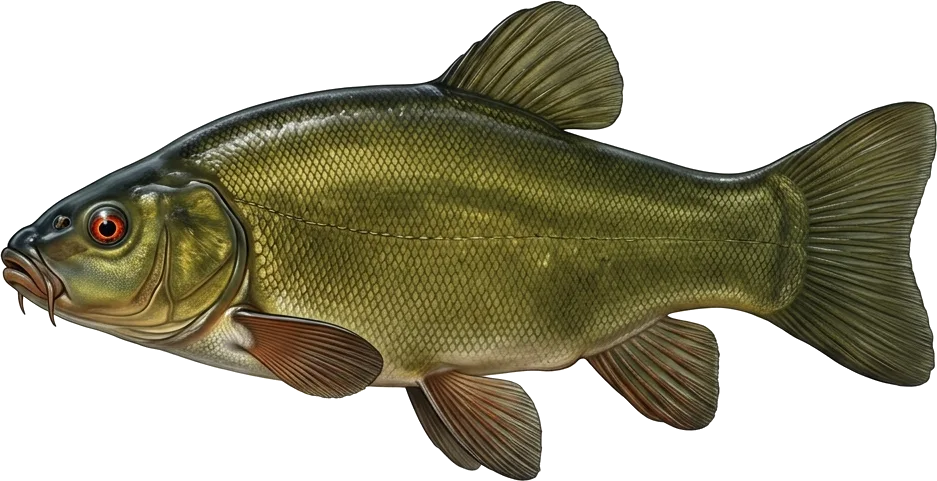
Tench (Tinca tinca, or doctor fish) is a benthic freshwater fish in the family Tincidae native to densely weeded ponds, oxbow lakes, and sluggish river backwaters of Eurasia. The species is characterized by thick skin with tiny embedded scales, antibacterial mucus, two sensory barbels, and weight up to 7 kg. Anglers target tench in lily pockets using worm rigs.
Tench is the benchmark of stealth and deliberation. Success requires patience (strike only on a sustained lift or decisive slide), heavy gear, and specialized scent: cottage cheese washed with sand creates an enticing lactic cloud, while crushed garlic on worms cuts through heavy peat odors.
- ✅ You want to master pinpoint tench angling in lily pad pockets using match poles and side-nod rigs.
- ✅ You want to reliably tell tench bubble trails apart from bream and crucian silt disturbances.
- ✅ You seek proven tench groundbait formulas featuring cottage cheese, crushed hemp, and garlic.
- ✅ You want to understand tench sexual dimorphism (spoon-shaped pelvic fins of males).
- ✅ You want to master tench foraging mechanics and weed extraction in 'Volga 2026'.
Ichthyology & Adaptations: Biological Profile of Tinca tinca
The tench (*Tinca tinca*) is the sole member of the family Tincidae, engineered to thrive in hypoxic, heavily silted waters:
Tench epidermis secretes a dense coat of bioactive mucus rich in lysozyme and antimicrobial peptides, preventing fungal infections and tissue rot in stagnant anaerobic mud.
Male tench are readily distinguished by massive, spoon-curved pelvic fins with a heavily thickened second ray reaching beyond the vent; females possess small flat triangular fins.
Tench survive oxygen drops down to an extreme 0.3 mg/L. During summer drought or freezing winter, they burrow up to 50cm deep into peat silt, entering protective torpor.
Vivid ruby-red eyes filter diffused light through dense macrophyte canopies, while a pair of small tactile mouth barbels probes for chironomid larvae within thick bottom silt.
Tench vs Crucian Carp vs Wild Carp: Identification Keys
Comparative analysis of three bottom-dwelling cypriniform species:
- Skin & Scales: MICROSCOPIC cycloid scales embedded deeply beneath heavy mucus.
- Fins: completely rounded and fleshy, LACKING serrated spine rays.
- Eyes: small, intense ruby-red or blood-orange.
- Barbels: exactly ONE PAIR of tiny barbels in mouth corners.
- Habitat: heavily weeded lily bays, peat oxbows, and stagnant silt reaches.
- Barbels: ENTIRELY ABSENT.
- Scales: large, firm, burnished golden-copper, 31–36 in lateral line.
- Fins: serrated stiff spine present in dorsal and anal fins.
- Body: exceptionally deep, near-circular profile, laterally compressed.
- Habitat: peat bogs, stagnant forest ponds with severe hypoxia.
- Barbels: TWO PAIRS of barbels (4 total: 2 upper lip, 2 long corner barbels).
- Fins: powerful serrated bone saw spine in dorsal fin.
- Body: streamlined, muscular, thick golden-bronze large scales.
- Size: reaches 20–30+ kg, high-speed open current freight train.
- Habitat: river channel troughs, sunken timber with moving flow.
Mechanics of the Deliberate Tench Bite
Finding food, tench tilts over the bait, gently mouthing the worm tail or curd pellet. The float quivers with faint concentric rings, lifts 5–10mm, and settles back into stillness.
This tasting sequence can endure 1 to 5 minutes. The fish rolls food against pharyngeal teeth, testing texture and scent. Striking prematurely pulls bare steel from a half-open mouth.
The true strike window arrives when tench swallows the bait whole and moves off: the float either tips flat on its side (dropper lifted) or glides smoothly downward toward the lily stems.
Seasonal Habitats & Weedbed Staging for Tench
Tench movements are strictly governed by water warming and macrophyte growth cycles:
Spring (May): As water warms to +12...+15°C, tench rouse from winter dormancy, staging in shallows (0.5–1.2m) along sunlit reed edges. Pre-spawn foraging peaks during daytime on lively worm bunches.
Summer (June – August): Prime season. Tench inhabit dense water-lily beds and pondweed (1.0–2.5m). Feeding is strictly confined to twilight hours: 04:30–08:30 at dawn and the golden hour before sunset.
Autumn (September – October): Dying weeds sink. Tench shift to deeper drop-offs bordering decaying lily root beds (2.0–3.5m). Foraging shifts to midday sunshine before tapering off.
Winter (November – April): Enters deep winter torpor, burrowing half a meter into peat silt. Thick mucus envelops the fish in a protective cocoon. Ice-fishing captures are extraordinarily rare.
Tench Baits: Garlic Redworms, Curd & Leeches
1. Natural Animal Baits (Prime Choice)
A wriggling bunch of red dung worms; large lobworm; black river leech; redworm-maggot cocktail. Leeches represent supreme selective baits for big tench, immune to nuisance silver fish.
2. Plant Offerings & Curd Pastes
Cottage cheese dough (fresh curd kneaded with semolina and honey); sweetcorn; steamed pearl barley with aniseed. Dairy casein protein is an authentic Volga secret weapon for tench.
3. Attractors: Garlic, Honey & Roasted Hemp
Tench favor pungent natural extracts: fresh crushed garlic, flower honey, caraway, dill, and dark roasted hempseed. Garlic dip cuts cleanly through foul anaerobic peat odors.
4. Secret Cottage Cheese Groundbaiting Method
Mix 500g curd, 1kg dark toasted breadcrumb, and 1kg river sand. Deposit 3–4 tennis-sized balls in a weed pocket at dawn. The white bed attracts tench visually and through lactic acid fermentation.
Weedbed Tackle: Side-Nod Pole, Powerful Whip & Method Feeder
Wrestling tench out of dense vegetation requires heavy-duty terminal rigs:
Side-Nod Vertical Jigging Pole (6–7m)
Rigid 6.0–7.0m carbon pole with a high-visibility lateral nod. Direct 0.22–0.25mm mono without leader, heavy dark tungsten teardrop jig (1.5–2.5g). Allows vertical placement in 20x20cm lily holes.
Flat Method Feeder for Silt
10–11ft feeder, lightweight wide-base 20–30g flat method feeder that rests on soft silt without burying. Short 8–10cm braided hooklink (15 lb) with a popped-up sweetcorn hair rig.
Heavy Weedbed Match Whip (5–6m)
Robust 5.0–6.0m match whip with lifting power. Mainline 0.20–0.22mm direct to a forged thick-wire hook #8–10, 1.5g peacock quill bottom-attached float.
Debunking Common Tench Myths
Fact: Geosmin mud odor resides purely in the epidermal slime of aged fish. Scalding in hot water, scraping the slime, and soaking in salted milk for 30 minutes yields sweet, succulent meat.
Fact: In lily beds, delicate lines snap on the first dive! Tench are completely unfazed by 0.20–0.22mm mono resting camouflaged across dark bottom silt.
Fact: Tench are dedicated phytophils. They avoid barren sand and current, adhering exclusively to sheltered bays choked with water lilies and pondweed.
Scientific Research on Tinca tinca
'The tench is a fish of silt, mud, and dense aquatic vegetation... Extremely phlegmatic, it moves sluggishly, spending its days in weed-choked shallows... The bite is peculiar: it mouths and tests the bait for minutes, trembling the float repeatedly before finally sliding it away.'
'Biochemical screening of Tinca tinca epidermal mucus reveals high titers of lysozyme and cationic antimicrobial peptides that inhibit saprolegniasis fungal proliferation. The species withstands acute hypoxia down to 0.3 mg/L O₂ by burrowing deeply into benthic detritus.'
'Tinca tinca: maximum documented mass 7.5 kg, total length up to 70 cm. Conspicuous sexual dimorphism: males develop enlarged spoon-shaped pelvic fins with a robust thickened second branched ray extending past the vent. Single-row pharyngeal teeth (4–5).'
4 Weedbed Tactical Strategies for Tench
Lower a dark jig with redworms vertically into 30cm lily pockets. The side nod lifts smoothly when the tench sucks in the bait.
Mix 500g cottage cheese with sand and carpet your swim at dawn. The white feed bed holds the tench pack right through midday.
Thread 2 redworms, lock with a white maggot, and dip in fresh garlic juice. The potent scent overcomes heavy silt odors.
Rig direct 0.22mm mono without weak links. On the strike, lift forcefully to skate the tench across lily pads before it dives.
Seasonal Matrix: Depths, Optimal Times, Baits & Rigs
| Season | Peak Feeding Time | Depth Zone | Top Baits | Tackle System |
|---|---|---|---|---|
| Spring (May) | 09:00 – 15:00 (Warm hours) | 0.8 – 1.5 m (New reed edges) | Worm bunch, bloodworm, leech | 5m Whip, side-nod pole |
| Summer (June – August) | 04:30 – 08:30 & 19:30 – 22:00 | 1.2 – 2.5 m (Lily pad windows) | Garlic worm, curd, sweetcorn | 7m Side-nod, flat method feeder |
| Autumn (Sept – Oct) | 11:00 – 15:30 (Calm sunny days) | 2.0 – 3.5 m (Dying weed breaks) | Large lobworm, bloodworms | Bottom float rod, light feeder |
| Winter (Ice Fishing) | Dormancy (No feeding) | 2.5 – 4.5 m (Buried in deep silt) | Rare accidental thaw catches | Winter bottom rig |
Angling Diagnostic: Identify What's Impeding Your Tench Success
Select the symptoms you are experiencing for instant technical adjustments:
Tench in 'Volga 2026' Simulator
In 'Volga 2026', tench is simulated with slow, deliberate bite mechanics and heavy low-gear weedbed torque. Weight range spans 0.25 to 3.6 kg. Inhabiting dense backwaters, it rewards patience and heavy terminal gear.
Key in-game locations: 'Reed Lagoon', 'Lily Cove', 'Quiet Monastery', 'Old Riverbed'.
Tench is featured in questlines ('Bronze Master of the Cove', 'Secrets of the Lilies', 'Curd Delicacy'), unlocking heavy side-nod rigs and match whips.
Frequently Asked Questions About Tench
Why is tench called the 'doctor fish' in folklore?
Tench mucus is rich in antimicrobial peptides that prevent infection in anaerobic mud. Centuries-old angling folklore claims wounded pike and perch rub against tench to heal injuries.
How do you distinguish male from female tench?
By pelvic fin anatomy: males have massive, spoon-shaped fins reaching past the vent with a thickened 2nd ray. Females have smaller, flat triangular fins.
How do you distinguish tench bubble trails from bream or crucian bubbles?
Tench generate a neat, narrow moving trail of tiny pinhead bubbles traveling along the weedline. Bream and crucian produce broad, chaotic fields of large gas bubbles.
What is the single best summer bait for tench?
A cluster of lively redworms scented with crushed garlic or anise. Redworm-maggot cocktails and fresh cottage cheese paste are equally deadly.
Do tench feed through winter ice?
In winter, tench enter deep torpor buried in peat silt and do not forage. Ice captures are extremely rare flukes occurring only during long sunny thaws.
Authoritative Ichthyological Sources & Literature: FishBase — Tinca tinca (Linnaeus, 1758) Species Summary · IUCN Red List of Threatened Species — Tinca tinca · Л. П. Сабанеев — «Жизнь и ловля пресноводных рыб: Линь» (Викитека) · Институт биологии внутренних вод им. И. Д. Папанина РАН (ИБВВ РАН)
Prepared by the Volga 2026 Editorial Board in strict adherence to aquatic biology and sport angling standards. Volga 2026 Editorial Methodology.