Ichthyology & Nocturnal Bottom Ledgering · Volga 2026 Encyclopedia
European Eel
Anguilla anguilla (Linnaeus, 1758)
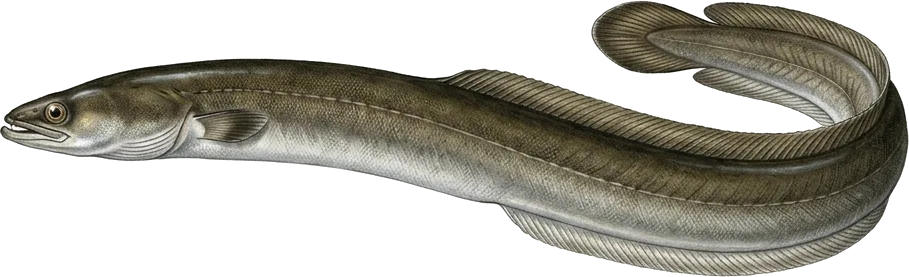
European Eel European eel (Anguilla anguilla) is a catadromous, snake-like teleost fish of the family Anguillidae migrating thousands of miles to spawn in the Sargasso Sea. The species features a continuous ribbon fin, slimy skin capable of cutaneous air-breathing, and weight reaching 4 kg. Anglers target nocturnal eels using weighted bottom ledger rigs baited with nightcrawlers and small baitfish.
Eel requires nocturnal patience and specialized handling: running ledger rigs with free-spool line release, heavy lobworm clusters, and suspending landed fish in mid-air over buckets to prevent tail knotting.
- ✅ You want to definitively distinguish European eel from parasitic lampreys and weatherfish.
- ✅ You want to master nocturnal bottom ledgering along silty drop-offs and reed edges from 10 PM to 3:30 AM.
- ✅ You need proven eel baits: jumbo lobworms, fresh fish fillets, live gudgeon, and horse leeches.
- ✅ You want to explore the science of Sargasso Sea catadromy, leptocephalus metamorphosis, and cutaneous respiration.
- ✅ You want to master eel fight mechanics and night quests in 'Volga 2026'.
Ichthyology & Catadromous Adaptations: Biological Profile of Anguilla anguilla
European eel (*Anguilla anguilla*) is an extraordinary catadromous wanderer armed with astonishing survival mechanisms:
Living in freshwater for 6–20 years, it metamorphoses into a 'silver eel' and migrates 4,000 to 7,500 km across the Atlantic to spawn in the Sargasso Sea thermocline (150–400m depth) and die. Modern otolith microstructural analyses have established that leptocephali drift on the Gulf Stream back to Europe takes 9 to 12–18 months, refuting the obsolete 3-year hypothesis.
Eel skin is densely vascularized and coated in thick mucus. In cool, humid air, cutaneous respiration accounts for up to 50–60% of total oxygen uptake (established by A. Krogh and Berg & Steen). This enables short overland crawls across dewy grass for up to 100–150 meters between adjacent waters, while tales of kilometer-long treks are debunked folklore.
Dorsal, caudal, and anal fins merge into a continuous ribbon. When threatened, intense muscular undulations allow it to tie its body into a tight knot (knot-tying rotational maneuver), pushing off substrate or line to generate immense mechanical leverage.
Eel olfactory sensitivity ranks among the keenest in the vertebrate world. Chemoreceptors in its olfactory rosettes detect dissolved amino acids down to dilutions of 1:2.85×10¹⁸ (Teichmann olfactometry tests), allowing the fish to track buried baits through muddy sediments in pitch darkness.
European Eel vs River Lamprey vs Weatherfish: Serpentine Guide
Comparative anatomical guide for three elongated serpentine freshwater species:
- Jaws: TRUE BONY JAWS lined with fine sharp teeth.
- Gills: standard gill slits protected under opercular flaps (single pair).
- Fins: pectoral fins present; dorsal and anal merged with tail.
- Skin: microscopic scales beneath dense protective mucus.
- Size: reaches 1.5–3.5 kg (lengths to 1.2–1.5m).
- Jaws: COMPLETELY ABSENT (circular suction disc armed with horny teeth).
- Gills: SEVEN GILL PORES on each flank ('seven-eyes').
- Paired fins: ENTIRELY ABSENT (no pectoral fins).
- Skeleton: cartilaginous (no true bones).
- Size: 25–40 cm (50–150g).
- Barbels: TEN SENSORY BARBELS surrounding mouth.
- Fins: caudal fin SEPARATE, rounded (not merged with dorsal).
- Coloration: yellow-brown with prominent dark longitudinal stripes.
- Respiration: supplementary intestinal aerial breathing.
- Size: 15–25 cm.
Mechanics of the Night Take & Serpentine Knot Countermeasures
Locating bait via scent plumes, eel hovers and methodically draws the lobworm into its jaws. On the ledger, this produces a sequence of light rhythmic bell taps followed by a smooth, continuous line pull (free-spooling 1–2 meters).
On the strike, eel generates heavy reverse caudal torque, attempting to anchor its tail into weeds. Pump forcefully without pauses. Keep landed eels suspended airborne—the instant its tail touches bank or boat deck, it knots furiously around the trace!
Seasonal Habitats: Silty Lagoons, Channels & Dark Nights
Eel is a strictly nocturnal thermophilic predator active from May to October:
🌱 Spring (Warming Shallows): Awakens at +12–14°C. Forages across 1.2–2.5m silty flats near reed margins. Peak action: 10:30 PM to 2:00 AM on lobworms and redworm bunches.
☀️ Summer (Peak Night Circuit): Patrols drop-offs stepping from 2 to 4–6 meters and inlet mouths. Peak feeding explodes during muggy, stormy nights with warm drizzle (10:00 PM–3:30 AM).
🍂 Autumn (Silver Eel Downstream Run): Silvering eels begin downstream migration. Targeted in 4.0–8.0m deep current channels on livebait and fish strips until water chills below +8°C.
❄️ Winter (Silt Torpor): Burrows 40–80cm deep into soft riverbed silt in total winter dormancy. Feeding ceases completely.
Eel Baits: Jumbo Lobworms, Livebaits, Fish Strips & Leeches
1. Top Animal Baits
Jumbo juicy lobworm (hooked concertina-style); small livebaits (gudgeon, bleak, ruffe); fresh herring/roach fillet strips (1x4cm); large horse leeches.
2. Plant Baits (Not Viable)
European eel is an obligate carnivorous predator and benthos forager. Plant baits (bread, corn, boilies) are ineffective.
3. Scent Stimulants
Pure cod liver oil, fresh fish blood, crushed worm essence. Eels track baits exclusively along dissolved olfactory trails.
4. Chopped Worm Spot Carpet
Mix 300g of finely chopped redworms with river loam and carpet a silty drop-off at dusk. The worm scent holds roaming eels for hours.
Tackle: Night Ledgers, Running Sinker Rigs & Soft Hooklinks
Eel angling demands reliable running ledger setups resistant to intense friction and twisting:
Ledger Rod 3.0–3.6m (40–90g)
Feeder or progressive carp rod with sensitive tip. Baitrunner reel allowing completely unhindered line pay-out during the opening take.
Free-Running 40–60g Sinker Rig
0.30–0.35mm smooth monofilament mainline, rubber shock bead, and a high-grade barrel swivel to eliminate line twisting.
Supple Braid Hooklink & Forged Hook
30–40cm hooklink of 15 lb supple braid or 0.28mm fluorocarbon paired with a long-shank forged hook #4–6 for clean unhooking.
Debunking Common European Eel Myths
Fact: Ancient folklore myth. Eels do travel across dewy grass between lakes, but hunt strictly for slugs, worms, and small fish, never eating plants.
Fact: Raw eel blood contains ichthyotoxins that are toxic if entered into the bloodstream. Cooking or smoking neutralizes the protein completely.
Fact: All European eels spawn exclusively in the deep abyssal waters of the Sargasso Sea. Freshwater serves solely as a growth habitat.
Fact: The European eel is a strictly solitary, territorial predator with no pack-hunting behavior (aggregations occur only during downstream migration runs). Overland movements across dewy grass are limited to 100–150 meters between adjacent waters; longer distances lead to fatal desiccation.
Fact: Johannes Schmidt's 1920s three-year drift hypothesis was disproven by modern otolith daily increment analyses proving migration takes 9–12 (up to 18) months. Furthermore, 2017 Current Biology studies confirmed eels utilize an innate geomagnetic compass based on biogenic magnetite.
Scientific Research on Anguilla anguilla
'The eel ranks among the most remarkable of fishes... Living in muddy rivers and lakes, it conceals itself by day and hunts by night, undertaking grand oceanic voyages to reproduce.'
'Anguilla anguilla undergoes complex metamorphosis (leptocephalus — glass eel — yellow eel — silver eel). The species exhibits extraordinary osmoregulatory plasticity and cutaneous respiratory capacity.'
'Anguilla anguilla: maximum recorded lifespan exceeding 80 years (in captivity), weight 3.8–4.0 kg. Catadromous navigation spans 4,000 to 7,500 km guided by verified geomagnetic compass orientation and hydrochemical gradients.'
4 Tactical Nocturnal Strategies for European Eel
Set a 50g running ledger on a 2.5–4.0m drop-off. Engage baitrunner—the eel must take 1–2m of line unhindered before striking.
Thread a jumbo lobworm onto a long-shank hook, leaving only the tail free. The eel engulfs the bait with zero hesitation.
On the strike, pump the eel up without pausing. Any slack allows the fish to wrap its tail around sunken snags or weeds.
When landed, suspend the eel airborne over a tall bucket or lidded keepnet. Prevent tail contact with ground to avoid unmanageable knots.
Seasonal Matrix: Depths, Optimal Times, Baits & Rigs
| Season | Peak Feeding Time | Depth Zone | Top Baits | Tackle System |
|---|---|---|---|---|
| Spring (May – June) | 22:30 – 02:00 (Warm nights) | 1.2 – 2.5 m (Silty flats) | Redworm bunches, lobworm | Running ledger rod |
| Summer (July – August) | 22:00 – 03:30 (Muggy storm nights) | 2.0 – 5.0 m (Reed drop-offs) | Jumbo lobworm, live gudgeon, leech | Baitrunner ledger, 0.35mm mono |
| Autumn (Sept – Oct) | 20:30 – 01:00 (Pre-frost nights) | 3.5 – 8.0 m (Channel migration runs) | Fish strips (roach, herring), worm | Heavy ledger with braided snell |
| Winter (Ice Season) | Torpor (Feeding halts) | Buried 40–80cm in deep silt | No angling (Deep winter torpor) | Dormant closed season |
Angling Diagnostic: Identify What's Impeding Your European Eel Catch
Select the symptoms you are experiencing for instant technical adjustments:
European Eel in 'Volga 2026' Simulator
In 'Volga 2026', European eel is simulated with authentic nocturnal activity curves, cautious free-spool ledger takes, and tail-wrap fight mechanics. Weight range spans 0.4 to 3.2 kg. Dwells in deep silty backwaters and channels.
Key in-game locations: 'Quiet Monastery', 'Lily Cove', 'Island Reach', 'Old Riverbed'.
European eel is featured in nocturnal tournament quests ('Midnight Wanderer', 'Sargasso Mystery', 'Serpentine Knot'), unlocking specialized baitrunner ledger setups.
Try Catching Specimen European Eel in Volga 2026 Simulator →
Frequently Asked Questions About European Eel
Where does the European eel spawn and how does its migration work?
All European eels spawn in the Sargasso Sea thermocline at 150–400m depth. After 6–20 years in freshwater, silver eels migrate 4,000 to 7,500 km across the Atlantic, spawn, and die. Transparent leptocephali larvae drift on the Gulf Stream back to Europe in 9 to 12 months (verified by modern otolith daily increment analyses), refuting the obsolete 3-year hypothesis.
Is it true that eels can breathe air and travel overland?
Yes, within strict biological limits. In cool, moist air, cutaneous respiration across densely vascularized skin supplies up to 50–60% of total oxygen needs as gills collapse. This enables nocturnal overland crawls across dewy grass for up to 100–150 meters between adjacent waters. Kilometer-long overland journeys are debunked angler myths.
How do you distinguish European eel from river lamprey?
Key differences: 1) Jaws: eel has true jaws with teeth; lamprey has a jawless round suction disc; 2) Gills: eel has standard opercular gill slits; lamprey has 7 distinct round gill pores on each flank.
What is the single best bait for nocturnal eel fishing?
A jumbo juicy lobworm threaded onto a long-shank hook, live gudgeon, or fresh fish fillet strips (herring, roach).
Is raw eel blood toxic?
Yes, raw eel blood contains ichthyotoxins that can cause poisoning if introduced into bloodstream. Cooking, baking, or hot-smoking breaks down the toxic protein completely.
Authoritative Ichthyological Sources & Literature: FishBase — Anguilla anguilla Biological Summary · Science Advances — Cresci et al. (2017): Magnetic compass in glass eels · Current Biology — Naisbett-Jones et al. (2017): Magnetic map navigation in European eel · Berg & Steen (1965) — Physiological mechanisms for aerial respiration in the eel · IUCN Red List of Threatened Species — Anguilla anguilla · Л. П. Сабанеев — «Жизнь и ловля пресноводных рыб: Угорь» (Викитека) · Институт биологии внутренних вод им. И. Д. Папанина РАН (ИБВВ РАН)
Prepared by the Volga 2026 Editorial Board in strict adherence to aquatic biology and sport angling standards. Volga 2026 Editorial Methodology.