Deep-Water Morphotaxon Biology & Specimen Night Feeder Tactics · Volga 2026 Encyclopedia
Blue Bream
Abramis brama («синий лещ» — игровая легенда, тёмноспинная форма леща)
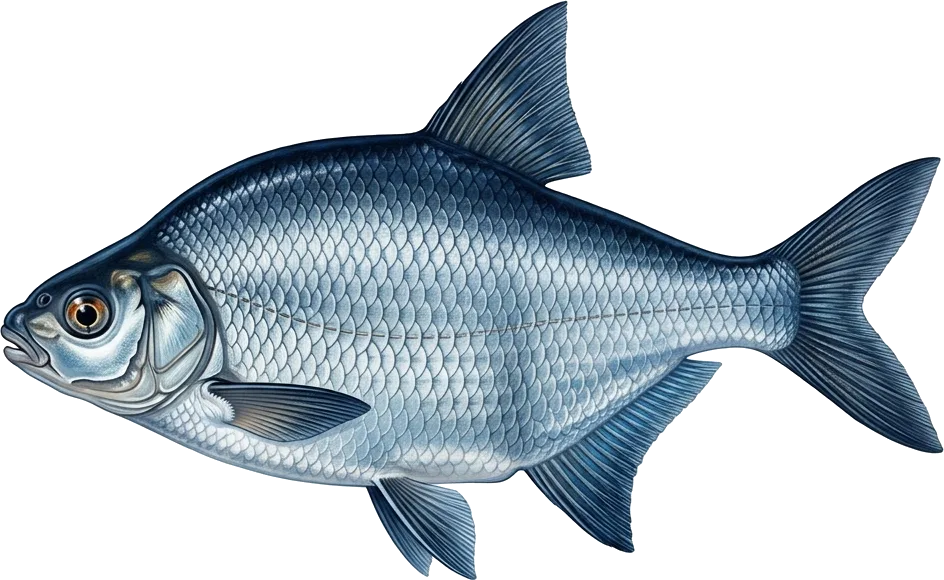
Blue Bream Blue bream morph (Abramis brama morpha caerulea) is a deep-water benthic variant of common bream (Cyprinidae) dwelling in oxygenated bottom troughs exceeding 15 meters depth. The morph features a distinctive steel-blue dorsal hue, heavy lipid reserves, and weight up to 7 kg. Anglers target this deep-water titan using heavy distance feeder tackle baited with bloodworm-maggot cocktails.
Blue bream demands long-range night feeder tackle: 3.9–4.2m Extra-Heavy blank (120–150g rating), isotope quivertip clip, 80–100cm 0.14–0.16mm fluorocarbon hooklink, fine-wire #10–12 hook, and baits featuring steamed peas with pea mastyrka or a juicy bloodworm-maggot cocktail.
- ✅ You want to definitively differentiate blue bream (*Abramis brama morpha caerulea*, to 6.8kg) from slender sichel (*Ballerus ballerus*, to 800g) and bronze bream.
- ✅ You want to master midnight reservoir feeder tactics: marker-lead structure mapping, clipping up, and heavy pea groundbait carpet deployment.
- ✅ You need proven baits: traditional Volga pea mastyrka paste, steamed sweet peas, 8mm Halibut pellets, and garlic dips.
- ✅ You want to explore retractable mouth-tube suction mechanics, quivertip lift-bite kinematics, and nocturnal temperature stratification.
- ✅ You want to master blue bream mechanics and midnight reservoir quests in 'Volga 2026'.
Ichthyology & Abyssal Reservoir Adaptations: Profile of Abramis brama morpha caerulea
Blue bream (*Abramis brama morpha caerulea*) is a rare deep-water reservoir ecotype of the common bream:
Year-round residence in 8–14m sunless abyssal trenches alters guanine crystal alignment in scales, producing deep iridescent navy-blue, steel, and sapphire tones across the dorsal ridge.
The mouth extends 3–5cm downward as a cylindrical suction pipe. Vacuuming bottom mud down to 10cm, it sieves large chironomid larvae (bloodworms) and pea clams (Pisidium) through gill rakers.
By day, schools rest dormant in 12–16m deep abyss holes. Precisely at midnight, the giants ascend onto gentle 7.5–9.5m mussel shelves, feeding aggressively for a tight 3–4 hour window before dawn.
Body depth approaches nearly half its total length. The muscular disc provides hydrodynamic stability in reservoir deep currents and immense leverage during the fight.
Blue Bream vs Common Bronze Bream vs Zope/Sichel: Identification Guide
Comparative anatomical guide for three deep-bodied cyprinid species:
- Back: STEEL-BLUE, dark sapphire-graphite tone.
- Body: VERY DEEP, massive, circular plate shape.
- Habitats: deep 8–14m reservoir drop-offs and abyss holes.
- Feeding time: STRICTLY MIDNIGHT (11 PM – 4 AM) and dawn.
- Size: 1.5–6.8+ kg (lengths to 65 cm).
- Back: olive-brown, greenish-grey.
- Flanks: golden-bronze, warm copper sheen.
- Habitats: rivers, channels, bays (3–7m depths).
- Feeding time: morning, dusk, overcast afternoons.
- Size: 1.0–4.5 kg.
- Body: COMPRESSED, SLENDER, elongated (not circular).
- Anal fin: EXTREMELY LONG (35–44 branched rays).
- Mouth: upturned, oblique (pelagic plankton filter).
- Habitats: mid-water pelagic zones, open reaches.
- Size: small (200–800g, rare to 1kg).
Mechanics of the Midnight Quivertip Lift Bite & Fight Control
Ascending onto a 9m mussel ledge at night, the blue bream encounters a pea-carpeted bait spot baited with pea mastyrka and a juicy bloodworm cluster. Hovering head-down at a 60-degree tilt, it inhales the bait through its suction tube and levels horizontally. The feeder lead lifts off the bottom, causing the bent quivertip and isotope to slowly straighten flat ('the lift').
Strike immediately as the quivertip unbends with a broad, sweeping motion. During the retrieve, the blue bream turns its broad disc broadside to the current, generating intense water resistance. Never muscle the fish: let it break the surface to gulp air, instantly paralyzing its swim bladder reflex and gliding passively into the wide landing net!
Seasonal Habitats: Deep Reservoir Drop-Offs & Pit Approaches
Blue bream is an obligate deep-water resident of large reservoirs and deep river reaches:
🌱 Spring (Pre & Post-Spawning Runs): Moves along steep 4.0–7.0m shore drop-offs. Highly receptive to lobworms and bloodworm bouquets.
☀️ Summer (Peak Midnight Feeder Season): Sulks in 12–15m holes by day, ascending onto 8.0–10.0m ledges at midnight. Top baits: steamed peas and pea mastyrka.
🍂 Autumn (Deep Pre-Winter Aggregations): Gathers in massive wintering shoals in 9.0–14.0m trenches. Feeds on heavy 120g feeder setups baited with maggots and pellets.
❄️ Winter (Under-Ice Lift Fishing): Targeted on 8.0–12.0m plateau depths using winter float rigs with lift bite detection and luminous jigs baited with bloodworms.
Blue Bream Baits: Pea Mastyrka, Steamed Sugar Peas, Halibut Pellets & Lobworms
1. Natural Animal Baits
Juicy dendrobaena worm tipped with a white maggot; dense bouquet of 8–12 large bloodworms on a fine-wire hook.
2. Traditional Pea Mastyrka & Steamed Peas
Boiled split-pea porridge kneaded with semolina into pliable mastyrka paste; whole soft steamed green peas infused with anise or garlic.
3. Halibut Pellets & Spicy Aromas
6–8mm Marine Halibut pellets mounted on bait bands; concentrated garlic, coriander, dill, and sweet caramel flavor dips.
4. Heavy Inert Groundbait with Crushed Peas & Molasses
Dark heavy coarse-ground mix (Bream Black / Feeder River), crushed boiled peas (30% volume), steamed millet, flaked oats, and black cane molasses.
Tackle: 3.9–4.2m Extra-Heavy Feeder Rods, Size 5000 Reels & 0.14–0.16mm Hooklinks
Midnight ledgering on 9m shelves requires long-range casting power paired with delicate bite registration:
Extra-Heavy Feeder 3.9–4.2m (120–150g Rating, Progressive Action)
Long carbon casting rod punching 90–120g heavy feeders 60–80 meters, featuring a supple 2.0–2.5 oz quivertip equipped for isotope night clips.
Size 4500–5500 Feeder Reel with Long Cast Spool
Power winch spooled with PE #0.8–1.0 braid (15–20 lb) and a tapered 0.28–0.32mm mono shock leader for powerful nocturnal casting.
Running Feeder Rig with 80–100cm 0.14–0.16mm Hooklink
Frictionless free-running rig, 10cm 0.8mm feeder gum shock link protecting fine hooklinks, and forged Gamakatsu LS-2210 / Owner #10–12 hooks.
Debunking Common Blue Bream Myths
Fact: In Volga lore, blue bream denotes the rare deep-water steel-blue morph of common bream (*Abramis brama morpha caerulea*) reaching 6.8kg, not the small slender zope.
Fact: The largest 3.5 to 6kg specimen bream ascend onto feeding ledges strictly at midnight (12:00 to 3:30 AM) under total darkness!
Fact: Wary bream refuses thick leaders. Deploy thin 0.14–0.16mm fluorocarbon with a feeder gum shock section to absorb heavy headshakes!
Scientific Research on Abramis brama morpha caerulea
'The bream reaches enormous proportions in deep reservoirs and lower Volga reaches... Ancient specimen bream dwelling in the abyss possess a distinct dark bluish-steel back and immense body width.'
'Abramis brama morpha caerulea is a deep-water reservoir ecomorph. Scale spectrophotometry demonstrates elevated interference guanine layer density, producing steel-blue iridescence in low-light environments beyond 8m.'
'Abramis brama: maximum recorded weight exceeds 6.5–7.0kg, length 75cm. The jaws possess high kinetic protrusion, generating up to 15 kPa negative pressure during benthic suction.'
4 Tactical Midnight Feeder Strategies for Blue Bream
Map out the 8.5–9.5m mussel shelf with a marker lead before dark. Clip the mainline and lay down an initial carpet of 10 large pea-loaded feeders.
Mold a hazelnut-sized ball of pea mastyrka onto the hook shank with the point exposed, tipping with 2–3 bloodworms for irresistible sensory appeal.
Keep eyes locked on the isotope. As soon as the tip straightens flat by 2–3 cm ('bream lifted the sinker'), execute a firm, sweeping hookset!
Guiding the 5kg bream near shore, smoothly lift its snout out of the water. Gulping air, the giant instantly rolls flat and glides into the landing net!
Seasonal Matrix: Depths, Optimal Times, Baits & Rigs
| Season | Peak Feeding Time | Depth Zone | Top Baits | Tackle System |
|---|---|---|---|---|
| Spring (Spawning Migrations) | 22:00 – 03:00 & 05:00 – 08:30 | 4.0 – 7.0 m (Steep shore ledges) | Bloodworm cluster, dendrobaena, maggot | 3.9m Medium feeder (to 90g), 0.14mm |
| Summer (Midnight Ledges) | 23:30 – 03:30 (Dead of night) & dawn | 8.0 – 10.5 m (Mussel reservoir drop-offs) | Pea mastyrka, steamed peas, pellets | 4.2m Extra-Heavy (to 130g), isotope |
| Autumn (Deep Aggregations) | 10:00 – 15:30 (Overcast midday) | 9.0 – 14.0 m (Winter pit approaches) | Bloodworms, garlic maggots, 6mm pellets | 4.2m Heavy feeder with 120g basket |
| Winter (Under-Ice Lifts) | 21:00 – 02:00 (Night tent) & 08:30 – 13:00 | 8.0 – 12.0 m (Deep river plateau) | Bloodworms on luminous winter jigs | Winter float rod with lift detection |
Angling Diagnostic: Identify What's Impeding Your Blue Bream Catch
Select the symptoms you are experiencing for instant technical adjustments:
Blue Bream in 'Volga 2026' Simulator
In 'Volga 2026', blue bream is simulated as a rare abyssal midnight giant ('a rare dark-backed bream on the night ledge') featuring authentic quivertip lift physics, deep reservoir ledge preference (8–12m), steamed peas, mastyrka, pellets, and worm baits. Weight spectrum spans 700g to 6.8 kg. Inhabits deep reservoirs, channel drop-offs, and misty backwaters.
Key in-game locations: 'Deep Pool', 'Volga Expanses', 'Karst Chasm', 'Old Riverbed'.
Blue bream crowns the elite midnight feeder questline ('Midnight Leviathan of the Ledges', 'Secret of the Luminous Quivertip', '6.5kg Bream Disc Challenge'), unlocking Extra-Heavy 4.2m feeder blanks and artisan flavored mastyrka kits.
Frequently Asked Questions About Blue Bream
How does blue bream differ from the slender zope/sichel (Ballerus ballerus)?
Zope (*Ballerus ballerus*) is a small (to 800g) slender fish with an extremely long anal fin (44 rays) and upturned mouth. Blue bream is a deep-water morph of common bream (*Abramis brama morpha caerulea*) reaching 6.8kg with an enormous disc body and downward suction tube.
Why does blue bream have a dark steel-blue back?
This is an optical adaptation to dwelling at 8–14m depths under diffuse blue-green light. Guanine crystals in scales reorient, creating rich sapphire-steel iridescence.
Why does bream produce 'lift' bites?
When feeding, bream tilts head-down at 60°. Inhaling the bait, it levels horizontally, lifting the feeder lead off the bottom and causing the flexed quivertip to straighten flat.
What is the single best plant bait for blue bream?
Pea mastyrka (simmered split peas kneaded with semolina) and soft whole steamed sugar peas infused with anise or garlic dip.
What maximum weight can a blue bream attain?
Inside deep Volga reservoirs, blue bream reaches 6.5–6.8 kg at lengths exceeding 65 cm, representing the crowning pinnacle of specimen night feeder angling.
Authoritative Ichthyological Sources & Literature: FishBase — Abramis brama Biological Summary · IUCN Red List of Threatened Species — Abramis brama · Л. П. Сабанеев — «Жизнь и ловля пресноводных рыб: Лещ» (Викитека) · Институт биологии внутренних вод им. И. Д. Папанина РАН (ИБВВ РАН)
Prepared by the Volga 2026 Editorial Board in strict adherence to aquatic biology and sport angling standards. Volga 2026 Editorial Methodology.