Ichthyology & Match Angling · Volga 2026 Encyclopedia
Silver Bream (White Bream)
Blicca bjoerkna (Linnaeus, 1758)
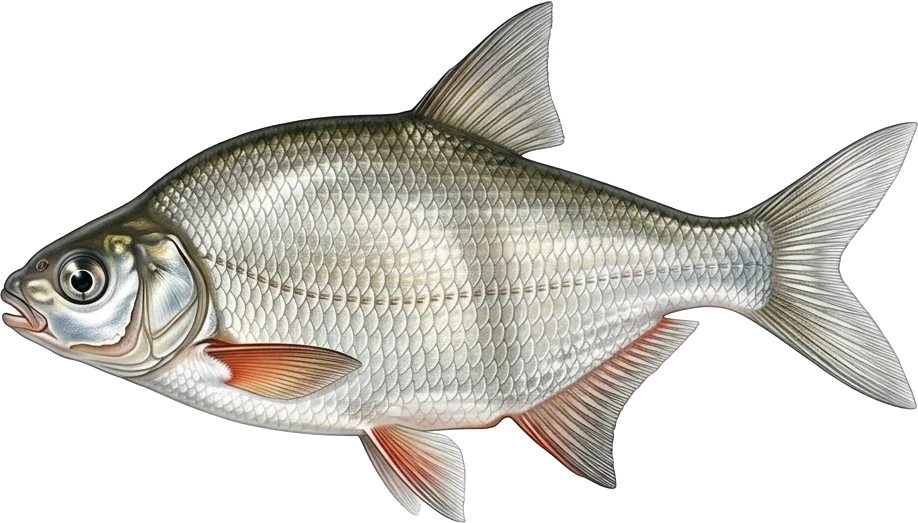
Silver Bream (White Bream) Silver bream (Blicca bjoerkna, or white bream) is a shoaling cyprinid fish found in lowland rivers, backwaters, and reservoirs of Europe. The species is diagnostically identified by biserial 2.5-5.2 pharyngeal teeth, reddish pectoral and pelvic fin bases, 43–48 lateral line scales, and weight up to 1.3 kg. It responds well to maggots and worms on light feeder rigs.
Silver bream is the ultimate speed-training quarry. Success relies on compact wire hooks (#16–18), shortened hooklengths for crisp bite registration, and moderately nutritious groundbait that generates a steady aromatic scent trail without overfeeding.
- ✅ You want to definitively distinguish silver bream from common bream skimmers and blue bream.
- ✅ You want to master high-tempo 'fish-a-minute' sport angling with whip and light picker rigs.
- ✅ You are frustrated by rapid false rattles and want to perfectly calibrate hook size and hooklength length.
- ✅ You want to target specimen silver bream (300–800 g) in deep river channels and through winter ice.
- ✅ You want to explore shoal dynamics and bait response in the 'Volga 2026' simulator.
Ichthyology & Adaptations: Biological Profile of Blicca bjoerkna
Silver bream (*Blicca bjoerkna*) is a versatile benthivore equipped with unique dental architecture and sensory systems:
Unlike common bream with single-row teeth (5-5), silver bream feature two staggered rows of pharyngeal teeth (2.5-5.2). This grants superior crushing power over tough caddis casings, small zebra mussels, and amphipod carapaces.
The eye diameter of silver bream is 1.4–1.6 times larger relative to head length than that of common bream. This delivers exceptional visual hunting efficiency in muddy river currents, deep holes (6–10m), and nocturnal feeds.
Silver bream form immense, tightly packed shoals of uniform age cohorts. High intraspecific competition compels individuals to snatch sinking food instantly, generating explosive, lightning-fast bite signatures.
Silver bream maintain active metabolic feeding rates even at winter water temperatures of +1–3°C, continuing to feed vigorously through midwinter when other cyprinids enter torpor.
Silver Bream vs Skimmer vs White-Eye Bream Identification
Key visual and anatomical markers to definitively identify your catch:
- Fins: bases of pectoral and pelvic fins are ALWAYS distinctly pink/reddish.
- Scales: large, reflective chrome silver (43–48 along lateral line).
- Mouth: short, terminal, DOES NOT form an elongated suction tube.
- Eyes: conspicuously large, bulging, silvery-white.
- Pharyngeal teeth: arranged in TWO staggered rows (2.5-5.2).
- Fins: ALL fins are strictly grey or dusky blackish (no red/pink tones!).
- Scales: fine, closely rooted (50–60 along lateral line).
- Mouth: easily telescopes into a downward-facing suction tube.
- Eyes: proportionally smaller relative to head dimensions.
- Pharyngeal teeth: arranged in a SINGLE row (5-5).
- Eyes: exceptionally large with brilliant white iris covering 1/3 of head.
- Anal fin: extremely long (35–41 branched rays).
- Mouth: strictly inferior, crescent-shaped for fast river gravel feeding.
- Snout: blunt, thick, overhanging the mouth opening.
- Habitat: exclusively flowing rivers with oxygenated water.
Biomechanics of the Rapid Quiver Strike: Taming the Rattle
Silver bream attack on the move, gripping the bait and immediately turning back toward the safety of the school. On a quivertip, this manifests as a furious rapid rattle (3–5 sharp shakes in quick succession); on a float, it registers as a snappy plunge and directional sideways skate.
Because of its modest mouth aperture, silver bream often nip the trailing end of a maggot or worm without taking the hook point. Striking on the first micro-shake often pulls the bait away. The remedy is using short-shank size 16–18 wire hooks and threading maggots tightly or clipping the tails.
Seasonal Habitats & Migrations: Locating Silver Bream Year-Round
Silver bream frequent moderate currents over sand-clay and shell substrates at depths between 2 and 8 meters:
🌱 Spring (Spawning Runs): When water reaches +12–16°C, silver bream pack tightly, moving to rocky riffles, clay bluffs, and river mouths (1.5–3.5m depth). Spawning occurs loudly in shallow bays. Biting peaks on bloodworm and caddis all day long.
☀️ Summer (Current Seams & Night Action): Shoals disperse across 3–6m river reaches, favoring flow seams and eddy lines behind points and islands. Superb sport is found at dusk and through the night on maggots and pearl barley.
🍂 Autumn (Deep Ledges): Schools concentrate heavily along 5–8m channel contours. Crystal-clear water demands finesse rigs with 0.09–0.10mm line and dark groundbait laced with joker bloodworm.
❄️ Winter (Ice Fishing Powerhouse): Silver bream is one of the most reliable ice-fishing targets. Holding in 4–8m flowing channels, it bites consistently on tungsten jigs and winter float rigs throughout midwinter.
Silver Bream Menu: Proven Baits, Maggots & High-Pace Groundbaits
1. Natural Animal Baits (High-Tempo Gold)
Maggots (1–2 maggots, red/white combo); bloodworm (2–3 larvae on fine wire hook #16–18); small piece of redworm; caddis larva in spring.
2. Grains & Plant Offerings (Summer)
Steamed pearl barley (tender, infused with anise or garlic); sticky semolina boltushka; tender small sweetcorn kernels; pea mastyrka.
3. Scent Profiles & Feeding Stimulants
Coriander, vanilla, caramel, hemp oil (summer); garlic, fennel, aniseed, and bloodworm extract (spring, autumn, and ice).
4. High-Cadence Groundbait Mechanics
Mixes should be medium-ground, golden-brown, and moderately active. Adding roasted crushed hemp and toasted breadcrumbs maintains a steady attractive scent plume in river currents.
Tackle & Specialized Rigs for Silver Bream
Targeting silver bream requires lightweight, rapid-response tackle systems:
Speed Whip & Bolognese Pole
5–7m match whip with carbon flick tip. Mainline 0.10–0.12mm, hooklength 0.08–0.09mm (15–25cm length). 1.0–2.5g body-up float with 1.5mm antenna. Shotting: streamlined multi-dropper chain.
Light Picker & High-Speed Feeder
2.7–3.3m picker rod (up to 35–45g) with soft 0.5 oz glass tip. Running rig or asymmetric loop. 40–60cm hooklength (0.10–0.11mm), short-shank hook #16–18 (Gamakatsu 1310 / Owner 50921).
Winter Tungsten Ice Rig
Lightweight balalaika ice rod with 8–10cm Lavsan quill. Monofilament 0.08–0.10mm. Tungsten teardrop or 'uralka' jigs in silver, copper, or black nickel tipped with 1–2 bloodworms.
Debunking Common Myths About Silver Bream
Fact: It is a distinct species (*Blicca bjoerkna*) with two-row pharyngeal teeth, oversized eyes, and reddish fin bases. Specimen adults reach 600–900 grams.
Fact: In sport match fishing, speed-catching silver bream is a celebrated discipline, allowing tournament anglers to land over 60 fish per hour.
Fact: Silver bream remain actively feeding all winter in channel currents, proving one of the most reliable cold-weather quarries.
Scientific Authority: Research on Blicca bjoerkna
'The silver bream abounds in all European rivers and lakes... It roams in dense shoals, hence its Russian name 'Gustera' (dense), feeding constantly as it travels across swims.'
'The double-row pharyngeal tooth structure of Blicca bjoerkna enables efficient exploitation of diverse trophic niches: from zooplankton to molluscs, reducing direct competition with sympatric Abramis brama.'
'Blicca bjoerkna: fecundity up to 100,000 eggs. Thermal optimum 15–24°C; tolerates low winter dissolved oxygen concentrations significantly better than most cyprinids.'
4 Practical Tactical Strategies for Silver Bream
Recast your light picker every 30–45 seconds regardless of a bite. The arriving feeder sustains an irresistible cloud, compelling fish to attack the bait instantly.
When silver bream nip trailing ends, thread one maggot up the hook shank, exposing only the hook point. The fish cannot tear the bait free and is hooked on the first attempt.
Target water behind points and islands where main current meets a slow back-eddy. Silver bream hold in the slack, intercepting food swept downstream.
Lift the tungsten jig 40cm above the mud, then lower it in 5cm steps with delicate micro-quivers. 90% of winter takes occur during this slow downward glide.
Seasonal Matrix: Depths, Optimal Times, Baits & Rigs
| Season | Peak Feeding Time | Depth Zone | Top Baits | Tackle System |
|---|---|---|---|---|
| Spring (May) | 07:00 – 18:00 (All day) | 1.5 – 3.5 m (Clay bluffs, bays) | Bloodworm, maggot, caddis | 6m Whip, picker (0.10mm) |
| Summer (June – August) | 19:00 – 01:00 (Dusk & Night) | 3.0 – 6.0 m (Eddies, gravel bars) | Maggots (red & white), barley | Picker 3.0m (45cm link) |
| Autumn (Sept – Nov) | 10:00 – 16:00 (Stable weather) | 4.5 – 8.0 m (Channel drop-offs) | Bloodworm (2–3 pcs), pinkie | Light feeder (0.09mm link) |
| Winter (Ice Fishing) | 09:00 – 15:30 (Moderate frost) | 3.5 – 7.5 m (Flowing channel holes) | Single bloodworm on tungsten jig | Balalaika with 8cm Lavsan quill |
Angling Diagnostic: Identify What's Impeding Your Silver Bream Success
Select the symptoms you are experiencing for instant technical adjustments:
Silver Bream in 'Volga 2026' Simulator
In 'Volga 2026', silver bream is simulated with high shoal velocity. Weight range spans 0.1 to 1.2 kg (trophy specimen). The species features rapid strike signatures requiring precise hookset timing.
Key in-game locations: 'Old Quay', 'Tram Bend', 'River Riffle', 'Island Reach', 'Reed Lagoon'.
Silver bream is featured in speed-fishing tournament quests ('Volga Pace', 'Silver Scales', 'Drift Secrets'), testing angler reaction time and tempo.
Try Catching Specimen Silver Bream in Volga 2026 Simulator →
Frequently Asked Questions About Silver Bream
How do you distinguish silver bream from young common bream skimmers?
The primary indicator is fin coloration: silver bream ALWAYS has pink or reddish pectoral/pelvic fin bases, while skimmer fins are uniformly dusky grey. Silver bream also has larger scales, noticeably bigger eyes, and a non-telescoping mouth.
What is the best hookbait for high-speed silver bream angling?
The top speed bait is a duo of one red and one white maggot. Maggots are resilient on the hook, allowing you to land 3–5 fish on the same offering without re-baiting.
Why does silver bream cause rapid rattling quivertip bites?
Silver bream strike on the move under pack competition and immediately turn. If the hook is oversized or the snell too long, the fish nips the loose bait tail, creating rapid rattles without taking the hook.
What time of day yields the best summer silver bream action?
In summer, the prime window is evening twilight (7:30 PM to 10:00 PM) and early dawn. At night, shoals frequently patrol shallow sandy bars alongside feeding bream.
At what depths do winter silver bream hold under the ice?
Under winter ice, silver bream reliably hold in 4.0–7.5m depths along moderate current channels, sandy-silt flats, and gentle drop-offs.
Authoritative Ichthyological Sources & Literature: FishBase — Blicca bjoerkna Biological Summary · ИБВВ РАН — Биология и экология карповых рыб Волжского бассейна · Л. П. Сабанеев — «Жизнь и ловля пресноводных рыб»
Prepared by the Volga 2026 Editorial Board in strict adherence to aquatic biology and sport angling standards. Volga 2026 Editorial Methodology.