Centrarchid Biology & Ultra-Light Littoral Float Angling · Volga 2026 Encyclopedia
Pumpkinseed
Lepomis gibbosus (Linnaeus, 1758)
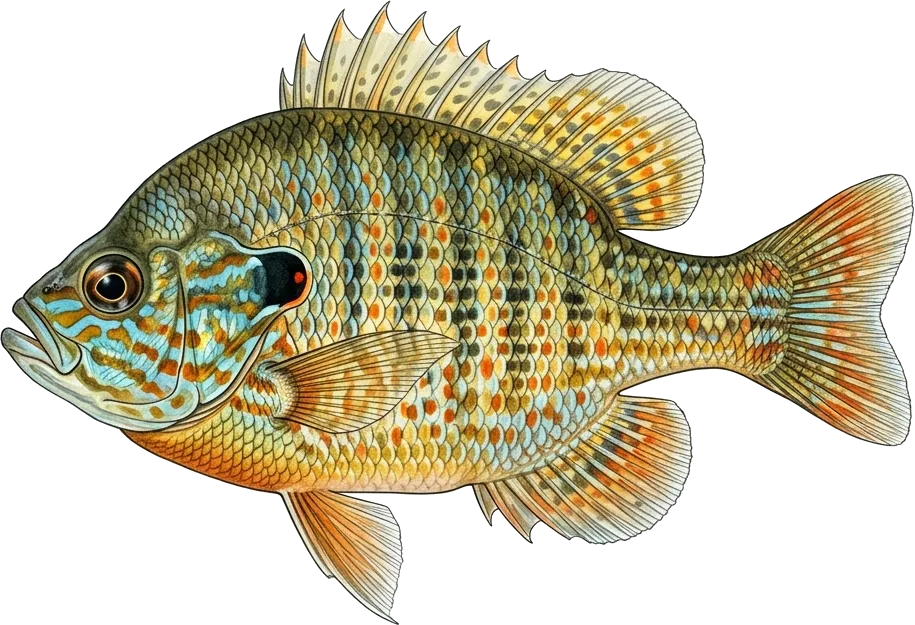
Pumpkinseed sunfish (Lepomis gibbosus) is a colorful freshwater centrarchid fish native to North America and naturalized across European slow-water rivers and lakes. The species features a disc-shaped frame with iridescent turquoise spots, a bright red-edged opercular ear flap, and weight up to 450 g. Anglers catch sunfish with micro-jigs, ultralight lures, and float rigs baited with maggots.
Pumpkinseed demands ultra-finesse gear: 3.5–4.5m whip or Bolognese rod, 0.10–0.12mm mono mainline, featherweight 0.5–1.0g float, fine-wire Kamasan B511 #16–18 hook, and tiny baits: a 5mm segment of redworm or a single pink maggot.
- ✅ You want to definitively understand Lepomis gibbosus biology: opercular ear flap coloration, pharyngeal grinders, and male parental nest care.
- ✅ You want to master high-speed visual sight-fishing on shallow sunlit lily pads and weed margins.
- ✅ You need anti-theft micro-baits: 5mm worm segments, single maggots, bloodworms on #18 hooks, and 0.3g tungsten micro-jigs.
- ✅ You want to explore territorial instincts: why nesting sunfish attack lures of any size and how to protect spawning sites.
- ✅ You want to master pumpkinseed mechanics and warm-pond quests in 'Volga 2026'.
Ichthyology & Littoral Territorial Adaptations: Profile of Lepomis gibbosus
Pumpkinseed sunfish (*Lepomis gibbosus*) is a brightly pigmented centrarchid adapted to sunlit littoral ecosystems:
The opercular flap extends into a velvety black ear bordered posteriorly by a vivid ruby-red or orange crescent. Functions as a species marker and aggressive territorial display trigger.
A tall, laterally compressed circular disc frame is clad in golden-olive scales dotted with orange flecks. Cheeks and opercles are adorned with iridescent neon-turquoise vermiculations.
In May–June, males sweep clean 20–40cm circular saucer depressions in sandy shallows (0.3–1.0m). The male guards eggs round-the-clock, fearlessly striking any encroaching fish or fishing lure.
The pharyngeal bones bear broad, pavement-like molar teeth. Pumpkinseed easily crushes small freshwater snails (Physa, Planorbis) and caddis cases, grazing weedbeds clean.
Pumpkinseed vs Bluegill vs Eurasian Perch: Identification Guide
Comparative anatomical guide for sunfishes vs European perch:
- Ear flap: JET-BLACK WITH BRIGHT SCARLET/ORANGE rim.
- Cheeks: wavy NEON-TURQUOISE iridescent stripes.
- Body: circular flat disc freckled with orange spots.
- Teeth: pavement-like pharyngeal molars for snails.
- Size: 10–22 cm (50–350g).
- Ear flap: SOLID JET-BLACK (completely lacking red rim).
- Chin & throat: deep cobalt-blue or violet.
- Dorsal fin: distinct dark blotch on rear soft rays.
- Body: dark olive-blue with vertical dark bars.
- Size: 15–30 cm (150–600g).
- Body: elongated, moderately deep (not disc-like).
- Color: green with 5–8 BOLD VERTICAL BLACK BARS.
- Fins: bright crimson pelvic and anal fins.
- Opercle: SHARP SERRATED SPINE (lacks ear flap).
- Size: 20–45 cm (200g – 2.0+ kg).
Mechanics of the Lightning Bait-Nipping Strike & Fight
Holding along a waterlily edge at 0.8m depth on a sunlit afternoon, the pumpkinseed spots the sinking bait. Accelerating instantaneously, the sunfish seizes the offering by the tip and darts into weeds. The 0.8g float vanishes underwater on a steep diagonal in the fraction of a second ('sinking like a hatchet').
Strike immediately with a wrist snap the instant the float dives. On the hook, the pumpkinseed turns its broad disc broadside, spinning in rapid spiral circles ('the dinner-plate hydrodynamic effect'), delivering surprisingly energetic, spirited resistance on 0.10mm mono!
Seasonal Habitats: Lily Beds, Sand Flats & Warm Ponds
Pumpkinseed is an obligate warm-water diurnal resident of littoral sunlit shallows:
🌱 Spring (Spawning Season): Males clear saucer nests on sandy/gravel shallows (0.3–1.0m). Fearlessly strikes any micro-lure entering nest bounds.
☀️ Summer (Peak Sunlit Season): Shoals cruise waterlily gaps, coontail beds, and dock footings (0.5–1.8m). Peak feeding: bright sunny midday (11:00 AM – 5:00 PM).
🍂 Autumn (Weed Decay Migration): Drops into 1.8–3.5m deeper edge pockets and sunken brush. Takes bloodworms and micro-tungsten jigs.
❄️ Winter (Deep Basin Refugia): Overwinters in deep pond basins. On open warm-water industrial outfalls, it stays active year-round on winter ice jigs.
Pumpkinseed Baits: Micro-Worm Bits, Maggots, Bloodworms & 0.3g Tungsten Jigs
1. Natural Micro-Baits (Top Choice)
Tiny 4–5mm segment of redworm; single pink or white maggot threaded centrally; 1–2 bloodworms; small caddis larva.
2. Garlic Dough & Micro-Bread Pellets
Match-head sized sphere of white bread crumb; firm semolina paste infused with garlic powder and anise.
3. Micro-Tungsten Jigs & Finesse Nymphs
0.2–0.5g gold or black tungsten micro-jigs tipped with artificial scented Berkley Bloodworm or micro-foam beads.
4. Clouding Groundbait with Powdered Milk
Light blend of fine breadcrumbs, powdered milk, and sand. Creates an inviting suspended column of milky cloud in the upper water column.
Tackle: 4.0m Whip, 0.10mm Mono, 0.8g Float & #18 Fine-Wire Hooks
Targeting nimble pumpkinseeds requires ultra-light and responsive finesse tackle:
3.5–4.5m Carbon Whip / Telescopic Pole (Weight under 120g)
Featherweight ringless carbon whip delivering pinpoint drops into tight weed pockets with instantaneous wrist-flick hooksets.
0.10–0.12mm Monofilament Direct Mainline
Supple clear mono rigged direct to hook. Eliminating knots and swivels keeps the presentation weightless and invisible.
0.5–0.8g Needle Float + Kamasan B511 #16–18 Hook
Miniature sensitive needle float shotted with #10–12 micro-droppers, paired with a fine-wire micro-barbed hook.
Debunking Common Pumpkinseed Myths
Fact: Pumpkinseed is a small snail-grazing benthivore (under 350g). It feeds primarily on snails and larvae, posing zero threat to adult fish.
Fact: Pumpkinseed bears a vivid scarlet margin on its ear flap and turquoise cheek stripes; bluegill has an all-black ear and bluish hues.
Fact: Pumpkinseed thrives under ice in temperate climates, successfully naturalized in warm bays of the Volga and Don basins.
Scientific Research on Lepomis gibbosus
'The sunfish is the most adorned of all freshwater fishes... Males exhibit marvelous courage, constructing round saucer nests and driving away intruders.'
'Lepomis gibbosus exhibits acute male parental care. The male maintains water flow over the clutch via pectoral fanning (up to 120 bpm), preventing siltation of eggs.'
'Lepomis gibbosus: maximum recorded weight 380–450g, length 25cm, lifespan 8–10 years. Withstands thermal warming up to +32°C and hypoxia down to 1.5 mg/L O2.'
4 Tactical Micro-Float Strategies for Pumpkinseed Sunfish
Thread a tiny 4mm worm segment onto a #18 hook. Drop into an open weed pocket—the strike occurs within 3 seconds with 100% hookup efficiency.
Never hesitate! Execute a sharp wrist flick the split second the needle float dips on a steep diagonal beneath the film.
Wear polarized sunglasses. Spot the pale circular sand depressions (40–70cm depth) and hover your micro-jig along the nest edge.
Toss a pinch of breadcrumb-powdered milk mix. The suspended milky cloud pulls a school of sunfish directly under your rod tip.
Seasonal Matrix: Depths, Optimal Times, Baits & Rigs
| Season | Peak Feeding Time | Depth Zone | Top Baits | Tackle System |
|---|---|---|---|---|
| Spring (Nesting Season) | 10:00 – 18:00 (All sunny day) | 0.3 – 1.0 m (Shallow sand nests) | 4mm worm bit, single maggot, joker | 4.0m Whip, 0.5g float, #18 hook |
| Summer (Lily Pad Canopy) | 11:00 – 17:30 (Midday heat peak) | 0.5 – 1.8 m (Lily pad windows) | Pink maggot, worm bit, 0.3g jig | Ultralight whip, 0.10mm mono |
| Autumn (Deep Edge Pockets) | 12:00 – 16:00 (Warm calm midday) | 1.8 – 3.5 m (Deep weed margins) | Bloodworm on tungsten micro-jig | Bolognese rod with 1.0g float |
| Winter (Pond Basins & Outfalls) | 11:30 – 15:00 (Warm outfalls) | 2.5 – 5.0 m (Warm benthic layers) | Bloodworm on winter ice jig | Winter rod with supple mylar nodder |
Angling Diagnostic: Identify What's Impeding Your Pumpkinseed Catch
Select the symptoms you are experiencing for instant technical adjustments:
Pumpkinseed in 'Volga 2026' Simulator
In 'Volga 2026', pumpkinseed is simulated as a bold, dazzling bait thief ('a small, bright bait thief') featuring lightning-fast float dives, affinity for warm weedy ponds and lily bays, micro-worms, maggots, and surface flies. Weight spectrum spans 30 to 350 g. Inhabits ponds, weed-choked backwaters, and sunlit shallows.
Key in-game locations: 'Weedy Bay', 'Industrial Canal', 'Harbor Pier', 'Volga Expanses'.
Pumpkinseed unlocks the ultralight float questline ('Emerald Tsar of the Shallows', 'Secret of the Bait Thief', 'Precision Lily Pad Master'), unlocking Whip Finesse pole blanks and artisan needle float collections.
Frequently Asked Questions About Pumpkinseed
How did the pumpkinseed sunfish originate in Russian waterways?
Pumpkinseed (*Lepomis gibbosus*) was introduced from North America into Europe as an ornamental aquarium and pond species. Highly adaptable, it successfully naturalized in ponds and warm rivers across southern and central Russia.
How does pumpkinseed differ from bluegill sunfish (Lepomis macrochirus)?
Pumpkinseed possesses a bright scarlet crescent on its black ear flap and turquoise cheek stripes. Bluegill features a solid jet-black ear flap with a cobalt-blue throat.
Why is the pumpkinseed dubbed a 'bait thief'?
With its tiny mouth and lightning-fast agility, it deftly nips off worm ends and maggots from oversized hooks without getting hooked, leaving anglers with bare hooks.
What is the benchmark tackle for pumpkinseed?
A 4.0m lightweight whip with 0.10mm mono, a 0.5–0.8g needle float, and a Kamasan B511 #16–18 hook baited with a tiny 4mm worm segment.
What maximum weight can a pumpkinseed reach?
Pumpkinseed grows to 250–350g (rarely to 400g) at lengths of 18–22 cm, remaining a miniature yet astonishingly beautiful sport trophy.
Authoritative Ichthyological Sources & Literature: FishBase — Lepomis gibbosus Biological Summary · IUCN Red List of Threatened Species — Lepomis gibbosus · Л. С. Берг — «Рыбы пресных вод СССР и сопредельных стран» (ЗИН РАН) · Институт биологии внутренних вод им. И. Д. Папанина РАН (ИБВВ РАН)
Prepared by the Volga 2026 Editorial Board in strict adherence to aquatic biology and sport angling standards. Volga 2026 Editorial Methodology.