Ictalurid Catfish Biology & Nocturnal Benthic Scavenger Tactics · Volga 2026 Encyclopedia
Brown Bullhead
Ameiurus nebulosus (Lesueur, 1819)
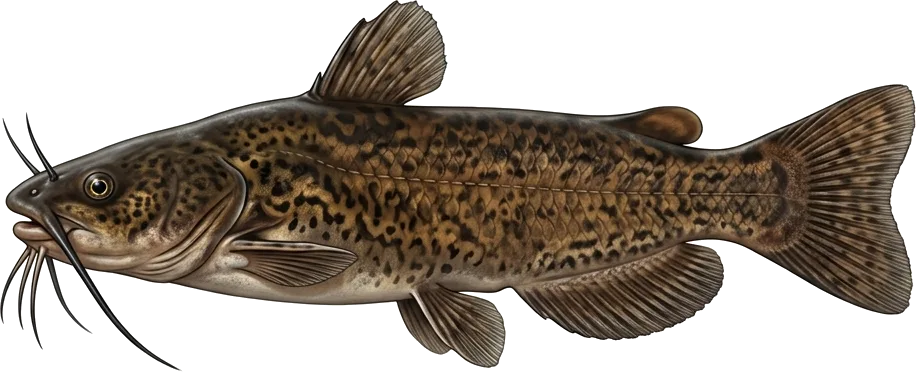
Brown Bullhead Brown bullhead (Ameiurus nebulosus) is a hardy benthic freshwater catfish of the family Ictaluridae introduced from North America into European waterways. The species is identified by eight sensory barbels, sharp serrated pectoral spines capable of delivering mild venom, an adipose fin, and weight up to 2.5 kg. Anglers catch bullhead on simple bottom rigs baited with nightcrawlers.
Brown bullhead demands robust tackle: 2.7–3.3m picker/feeder rod (20–60g rating), 0.22–0.25mm abrasion mono, Long Shank forged hooks #4–6 to ease unhooking, surgical forceps/disgorger, and pungent animal baits (chicken liver, dendrobaena, raw shrimp).
- ✅ You want to definitively differentiate brown bullhead (*Ameiurus nebulosus*, 8 barbels, adipose fin) from European wels (*Silurus glanis*, 6 barbels, no adipose).
- ✅ You want to master nocturnal ledgering and feeder tactics using high-scent natural baits.
- ✅ You need proven baits: fresh chicken/beef liver, juicy dendrobaena worms, peeled shrimp tails, and fish strips.
- ✅ You want essential safety rules: proper hand grips to avoid painful punctures from venomous serrated pectoral fin spines.
- ✅ You want to master brown bullhead mechanics and night pond quests in 'Volga 2026'.
Ichthyology & Nocturnal Scavenging Adaptations: Profile of Ameiurus nebulosus
Brown bullhead (*Ameiurus nebulosus*) is a rugged benthic survivor of the North American catfish family Ictaluridae:
Features 8 barbels: 2 long maxillary, 2 nasal, and 4 chin whiskers. The entire body surface is packed with hundreds of thousands of taste buds, allowing it to pinpoint scented food in pitch-black, muddy water.
The dorsal and both pectoral fins bear rigid, sharp spines with distinct backward-curved serrations. Glandular tissue at the spine base secretes a mild venom causing painful, throbbing inflammation upon skin puncture.
Thick, scaleless skin is heavily vascularized and blanketed in mucus. Capable of cutaneous and atmospheric respiration, it survives extreme hypoxia below 1 mg/L O2, burrowing into damp mud during droughts.
Consumes worms, snails, midge larvae, small fish, carrion, and plant matter. Detecting bait, it inhales the offering deep into its stomach in one gulp without hesitant nibbling.
Brown Bullhead vs Black Bullhead vs European Wels: Identification Guide
Comparative anatomical guide for three distinct siluriform species:
- Barbels: STRICTLY 8 BARBELS (dark chin whiskers).
- Spines: PECTORAL SPINES HEAVILY SERRATED on rear edge.
- Fins: ADIPOSE FIN PRESENT.
- Color: olive-brown, mottled with dark blotches.
- Size: 20–35 cm (weight 200g – 1.8+ kg).
- Barbels: 8 barbels (jet black or dark grey).
- Spines: PECTORAL SPINES SMOOTH (serrations nearly absent).
- Tail: pale crescent bar at caudal fin base.
- Color: solid uniform dark grey or black, unspotted.
- Size: 15–30 cm (150g – 1.2 kg).
- Barbels: ONLY 6 BARBELS (2 long upper, 4 short chin whiskers).
- Adipose fin: COMPLETELY ABSENT.
- Anal fin: EXTREMELY LONG, merging near the tail.
- Size: COLOSSAL (to 50–100+ kg, lengths to 2.5m).
- Family: Siluridae (true wels catfishes).
Mechanics of the Deep-Swallow Take & Safe Hook Extraction
Foraging across a warm silty bay at night, the bullhead detects the scent trail of fresh chicken liver from 20 meters. Closing in, the fish flares its mouth and vacuums the bait in one motion. The ledger bell erupts into frantic jangling: the bullhead never drops the bait, instantly inhaling the hook deep down into its gullet.
To prevent gut-hooking, deploy Long Shank forged hooks #4–6 and strike promptly upon the first rhythmic rod taps. Always keep surgical Kocher forceps or a deep disgorger at hand. When handling, grip the dorsal flank firmly, locking the sharp pectoral spines forward between your thumb and forefinger!
Seasonal Habitats: Silty Backwaters, Ponds & Warm Industrial Outfalls
Brown bullhead thrives in warm water, feeding actively from mid-spring through late autumn:
🌱 Spring (Shallow Warming Flats): Moves onto shallow 0.8–2.0m sunlit bays and reed beds. Feeds actively during warm afternoons on worms.
☀️ Summer (Peak Night Ledger Season): Forages over soft silty beds near timber and reeds (1.5–3.5m). Peak feeding window: 10:00 PM to 3:30 AM under total darkness.
🍂 Autumn (Deep Silt & Warm Outfalls): Packs into 2.5–5.0m deeper channel basins and thermal power plant outfalls. Top baits: chicken liver and cutbait.
❄️ Winter (Dormancy & Thermal Refugia): Burrows into bottom silt for winter dormancy. However, inside warm-water cooling channels (+14...+20°C), it bites continuously year-round!
Brown Bullhead Baits: Chicken Liver, Dendrobaena Worms, Raw Shrimp & Garlic Dips
1. High-Scent Offal & Clam Baits (Top Choice)
Fresh chicken or beef liver (2x2cm chunks); cluster of 4–6 juicy dendrobaena worms; raw peeled shrimp tail; fresh fish fillet strip.
2. Garlic Dough & Stink Pastes
Dense semolina-flour dough packed with powdered garlic and fishmeal; 8–10mm Marine Halibut pellets soaked in liquid liver booster.
3. Pungent Catfish Attractants
Concentrated garlic oil, pure cod liver oil, dried blood extract, and Liver Dip. Bullhead tracks these olfactory plumes from dozens of meters away.
4. Scented Carpet Feed with Chopped Liver
Dark heavy feeder mix blended with minced chicken liver (20%), chopped worms, and micro fishmeal pellets.
Tackle: 2.7–3.0m Picker Rods (20–60g), 0.22mm Mono & Long Shank Hooks
Targeting aggressive nocturnal bullheads demands simple, sturdy, and safe ledger gear:
Picker / Light Feeder 2.7–3.0m (20–60g Rating, Medium-Fast)
Compact carbon blank with a sensitive 1.0–1.5 oz tip. Ideal for close-quarters night casting at 15–30m distances.
Size 3000 Spinning Reel Spooled with 0.22–0.25mm Mono
Reliable winch loaded with abrasion-resistant monofilament, providing shock absorption against snags and reed edges.
Paternoster Rig + Long Shank Forged Hooks #4–6
25–40g flat sinker or open cage feeder, 30–40cm 0.18–0.20mm mono hooklink, and forged Long Shank hook for effortless extraction with forceps.
Debunking Common Brown Bullhead Myths
Fact: Brown bullhead is a dwarf species. Its maximum weight rarely exceeds 1.5–1.8 kg at lengths of 35–40 cm.
Fact: The venom is mild. Punctures cause stinging local throbbing and swelling that subsides within hours after antiseptic treatment.
Fact: Bullhead is unpretentious. The best and cheapest bait is ordinary grocery-store chicken liver or garden earthworms.
Scientific Research on Ameiurus nebulosus
'The bullhead catfish is distinguished by incredible tenacity and greed... Introduced from North America, it thrives in warm ponds and backwaters, voraciously taking worms and offal at night.'
'Ameiurus nebulosus possesses extreme whole-body taste bud density (up to 25 papillae/mm²). This sensory array enables triangulation of amino acid gradients (glycine, alanine) beyond 15 meters in still water.'
'Ameiurus nebulosus: maximum recorded weight 2.0–2.4kg, length 45cm, lifespan 9 years. Pectoral fins feature a ball-and-socket locking mechanism locking spines erect perpendicularly.'
4 Tactical Nocturnal Scavenger Strategies for Brown Bullhead
Wrap a liver chunk in fine nylon mesh and mount on a Long Shank #4 hook. The bait bleeds an intense scent trail while resisting small fish nibbles.
Keep surgical forceps pinned to your vest. When the hook is engulfed deeply, clamp the shank and roll the bend free in 5 seconds without harm.
Lock the bullhead from behind the head: brace your thumb and index finger against the rear faces of the pectoral spines, pushing them safely forward.
Cast your ledger 2–3 meters off the reed line at 1.5m depth at midnight. Bullheads emerge from vegetation onto open silt flats in tight packs.
Seasonal Matrix: Depths, Optimal Times, Baits & Rigs
| Season | Peak Feeding Time | Depth Zone | Top Baits | Tackle System |
|---|---|---|---|---|
| Spring (Warming Shallows) | 14:00 – 19:30 & 21:00 – 23:30 | 0.8 – 2.0 m (Shallow warming bays) | Dendrobaena cluster, bloodworm, shrimp | Float rod or 2.7m light picker |
| Summer (Midnight Silt Beds) | 22:00 – 03:30 (Dead of night) & dawn | 1.5 – 3.5 m (Silty reed bays) | Chicken liver in nylon, garlic worms | Ledger with bell, Long Shank hook |
| Autumn (Deep Holes & Warm Outfalls) | 18:00 – 23:00 (Dusk into night) | 2.5 – 5.0 m (Warm power plant channels) | Beef liver, fish strip, Halibut | Medium feeder with 40g cage |
| Winter (Thermal Discharges) | 12:00 – 16:30 (On warm outfalls) | 3.0 – 6.0 m (Warm +16°C zones) | Chicken liver, bloodworm cocktail | Picker with 0.22mm mono |
Angling Diagnostic: Identify What's Impeding Your Brown Bullhead Catch
Select the symptoms you are experiencing for instant technical adjustments:
Brown Bullhead in 'Volga 2026' Simulator
In 'Volga 2026', brown bullhead is simulated as an aggressive nocturnal benthic scavenger ('a greedy night bottom feeder') featuring sharp fin spines, scent-trail targeting, chicken liver, worms, and raw shrimp baits. Weight spectrum spans 80g to 1.8 kg. Inhabits warm ponds, silty backwaters, cooling canals, and reed bays.
Key in-game locations: 'Weedy Bay', 'Industrial Canal', 'Old Riverbed', 'Volga Expanses'.
Brown bullhead crowns the nocturnal ledger questline ('Greedy Night Scavenger', 'Secret of the Liver Bait', 'Warm Canal Catfish Duel'), unlocking Light Picker rods and artisan garlic dip kits.
Try Catching Brown Bullhead on Liver in Volga 2026 Simulator →
Frequently Asked Questions About Brown Bullhead
How did the brown bullhead originate in Russian rivers and ponds?
Brown bullhead (*Ameiurus nebulosus*) was introduced from North America into Europe in the late 19th century. Due to extreme hardiness, it successfully colonized warm ponds, canals, and backwaters across the Volga basin.
Are punctures from bullhead spines dangerous?
The spines feature serrations and mild venom glands. Punctures produce painful throbbing and local swelling; cleanse with hot water and apply antiseptic immediately.
What is the single most effective bait for brown bullhead?
Fresh chicken liver chunks (wrapped in nylon mesh) and a cluster of dendrobaena earthworms infused with crushed garlic.
How does brown bullhead differ from the common European wels catfish?
Brown bullhead has 8 barbels (wels has 6), possesses an adipose fin (wels lacks one), a short anal fin, and max size around 1.8 kg (wels grows to 100 kg).
What maximum weight can a brown bullhead attain?
Inside Russian waters, brown bullhead grows to 1.5–1.8 kg (lengths up to 35–40 cm), providing popular and dependable night ledger sport.
Authoritative Ichthyological Sources & Literature: FishBase — Ameiurus nebulosus Biological Summary · IUCN Red List of Threatened Species — Ameiurus nebulosus · Л. С. Берг — «Рыбы пресных вод СССР и сопредельных стран» (ЗИН РАН) · Институт биологии внутренних вод им. И. Д. Папанина РАН (ИБВВ РАН)
Prepared by the Volga 2026 Editorial Board in strict adherence to aquatic biology and sport angling standards. Volga 2026 Editorial Methodology.