Ichthyology & Surface Angling · Volga 2026 Encyclopedia
Common Rudd
Scardinius erythrophthalmus (Linnaeus, 1758)
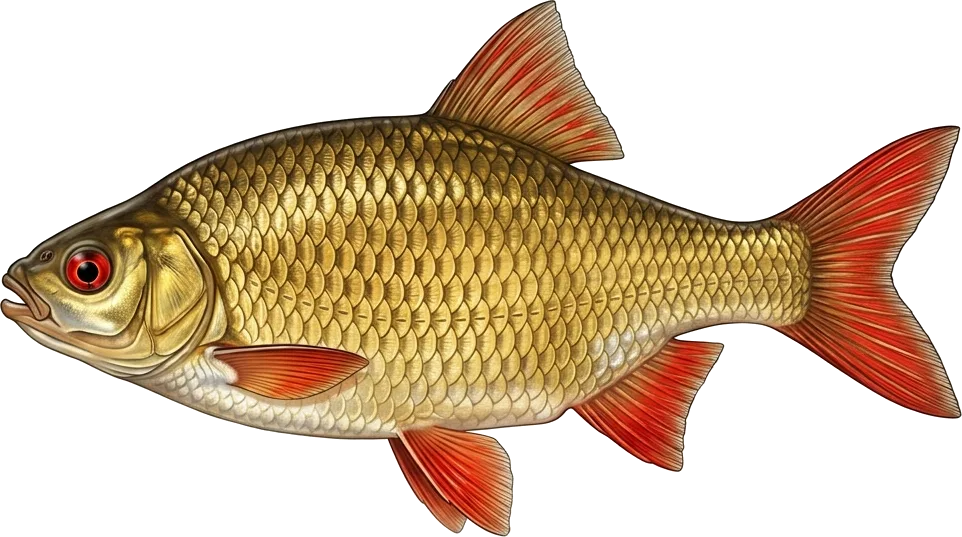
Common Rudd Common rudd (Scardinius erythrophthalmus) is an omnivorous cyprinid fish native to heavily vegetated lakes, backwaters, and slow-moving rivers of Europe. The species is characterized by vivid scarlet fins, golden-brass scales, biserial serrated 3.5-5.3 pharyngeal teeth, and weight up to 2 kg. Anglers target rudd in surface weedbeds using float tackle, bread crust, insects, and dry flies.
Common rudd is a strictly upper-layer weed inhabitant that rarely feeds on the riverbed. Triumph requires ultra-light unweighted quill floats, top-water presentation (10–40cm depth), and decisive steering away from lily roots.
- ✅ You want to definitively distinguish rudd from roach and ide by dorsal fin alignment and mouth angle.
- ✅ You want to master targeting specimen rudd (400–1000g) in dense lily fields and reed beds.
- ✅ You need proven finesse setups: self-weighted wagglers, dry fly patterns, and micro-spoons.
- ✅ You want to unlock unique baits: damselfly larvae, grasshoppers, sweetcorn, and crusty bread flake.
- ✅ You want to master rudd behavior and casting tactics in the 'Volga 2026' simulator.
Ichthyology & Surface Adaptations: Biological Profile of Scardinius erythrophthalmus
Common rudd (*Scardinius erythrophthalmus*) is a thermophilic, weed-loving cyprinid anatomically adapted for life within dense aquatic vegetation:
The dorsal fin originates conspicuously behind the vertical line of the pelvic fin bases. Shifting the center of hydrodynamic lift backward facilitates agile surface maneuvering and explosive upward lunges.
Jaws angle sharply upward at ~60 degrees. This enables rudd to pluck falling insects, larvae, and filamentous algae from the underside of lily leaves without having to roll its body.
Pharyngeal teeth are arrayed in two rows featuring finely serrated cutting edges. This unique dental adaptation allows rudd to slice and grind tough waterweeds, hornwort, and pondweed leaves.
Rudd thrive in warm water (+18–26°C) and bright sunshine. During blazing midday heat when other species seek deep shade, rudd bask in surface lily clearings in active feeding schools.
Rudd vs Roach vs Ide: Identification Field Guide
Comparative anatomical guide for three golden-finned cyprinids:
- Dorsal fin: begins CONSPICUOUSLY BEHIND pelvic fin base.
- Mouth: sharply upturned / superior orientation.
- Eyes: golden-orange with a red spot on the upper iris rim.
- Fins: vivid blazing scarlet on all lower fins.
- Scales: golden-brass hue, heavy, large (40–42 along lateral line).
- Dorsal fin: begins DIRECTLY ABOVE pelvic fin base.
- Mouth: terminal or semi-inferior (points straight or slightly downward).
- Eyes: brilliant red / blood-orange around full iris circumference.
- Fins: orange-red (less intense than rudd).
- Scales: bright chrome silver with olive sheen (40–45 along lateral line).
- Body: heavier, chunkier profile with fine scales (55–61 along lateral line).
- Eyes: greenish-yellow with dark upper dot.
- Fins: crimson pelvic and anal fins; dorsal and caudal are dusky grey.
- Mouth: terminal, oblique, noticeably wider gape.
- Size: specimen adults reach 3–5 kg in weight.
Biomechanics of the Rapid Surface Take
Cruising just below the surface film, rudd spot falling prey against the sky. Detecting a grasshopper, bread crust, or artificial dry fly, the fish launches a rapid upward ambush at a 45–60 degree angle, inhaling the bait on the descent.
Float bites are visual poetry: the float doesn't quiver or lift, but cleanly plunges with a subtle splash and skates sideways toward the nearest lily pad. An immediate sweeping strike is mandatory within the first second to avoid snags!
Seasonal Habitats & Weed Pockets: Where to Find Rudd Year-Round
The seasonal cycle of rudd is inextricably tied to weedbed growth and water temperature:
🌱 Spring (May Spawning): Late spawner, requiring water temperatures of +16–18°C. Shoals gather in 0.5–1.5m shallow bays over old weed beds. Post-spawn fish feed hungrily on insect larvae and worms along new reed edges.
☀️ Summer (Peak Season): Rudd stage in clear pockets among water lilies, spatterdock, and hornwort (0.8–2.0m depth). Prime hours span bright sunny afternoons (11:00–16:00) and warm dusk. Phenomenal sport on floating crusts, grasshoppers, and micro-spinners.
🍂 Autumn (Weed Die-Off): As lilies decay and water cools, rudd descend to 2.5–4.5m drop-offs adjacent to dying weedlines, shifting strictly to insect larvae and bloodworms.
❄️ Winter (Ice Nymphing): On first ice, rudd roam 1.5–3.0m reed fringes. Midwinter brings reduced activity, but sunny thaws spark surface feeding on tungsten beadheads tipped with bloodworm.
Rudd Baits: Surface Insects, Floating Bread & Micro-Lures
1. Insects & Live Offerings
Live grasshoppers hooked through the thorax without weight; damselflies and larvae; houseflies; maggots (1–2 on fine wire); redworms in spring and autumn.
2. Floating Bread Crust & Grains
Fresh white bread crust (pinched loosely to float buoyant on top); tender sweetcorn; steamed pearl barley; sticky semolina boltushka.
3. Artificial Micro-Lures & Flies
Dry flies (Red Tag, Black Ant, Foam Beetle); micro-spoons (0.8–2.0g) in gold and copper; micro-grubs and silicone nymphs on 0.3–0.8g tungsten jigs.
4. Slow-Sinking Surface Groundbait
Groundbait must be lightweight and fluffy, creating a slow-sinking suspension cloud in the top 50cm. Base: finely milled breadcrumbs, milk powder, oat flour, and floating crushed pellets.
Tackle & Specialized Rigs for Common Rudd
Targeting rudd in tight weed gaps requires finesse presentation paired with backbone for hit-and-hold steering:
Unweighted Surface Pole Rig
5–6m fast-action match whip. Mainline 0.12–0.14mm, fluorocarbon leader 0.10–0.11mm (20–30cm). Ultra-light natural goose quill or 0.5–1.0g crystal float. Zero shot or a single #10 micro-dropper near the float base.
Floating Sbirolino / Bombarda
3.6–4.0m match rod. 5–10g floating transparent sbirolino, long 1.5–2.0m fluorocarbon leader (0.12mm) tipped with hook #12–14 for long-distance presentation of grasshoppers across flats.
Ultralight & Micro-Jig Spinning
1.8–2.1m rod rated 0.2–2g (Extra Ultralight). Braid PE #0.15–0.2 with 0.10mm leader. Micro-spoons (0.9–1.5g) or 0.3–0.6g tungsten jigs tipped with scented artificial bloodworms.
Fly Fishing 2/3 Weight
2–3wt fly rod, floating WF line, 9ft tapered leader with 0.10mm tippet. Dry flies (Red Tag, Klinkhamer, Foam Beetles) for sensational surface takes.
Debunking Common Myths About Common Rudd
Fact: It is a distinct biological genus (*Scardinius*) featuring serrated double-row teeth, a posterior dorsal fin, and a superior mouth.
Fact: Bottom groundbait is ignored by surface rudd and attracts skimmers. Rudd require a slow-sinking top-water dust cloud.
Fact: Rudd are intensely thermophilic. Prime feeding occurs during blazing midday sunshine (12:00–16:00) when weedbeds warm up.
Scientific Research on Scardinius erythrophthalmus
'The rudd ranks among the most beautiful fishes in our waters... It dwells strictly in quiet oxbows, lagoons, and lakes overgrown with lilies and reeds, feeding on both plants and insects.'
'Morphological specialization of the cranial and dental apparatus in Scardinius erythrophthalmus enables efficient digestion of macrophytes (Potamogeton, Ceratophyllum), carving an ecological niche in macrophyte-dense biotopes.'
'Scardinius erythrophthalmus: fecundity up to 230,000 eggs. Thermal optimum 18–26°C. Double-row dental formula 3.5-5.3 with serrated crowns.'
4 Tactical Strategies for Weedbed Rudd
Spot 30–50cm openings in solid lily carpets. Drop an unweighted offering dead center into the hole, keeping line under subtle tension.
Drift 3–4 crust decoys downwind to excite the shoal. Gently cast your hooklink with buoyant crust straight into the feeding swirl.
Retrieve a 1.0–1.5g spoon across the top 20cm above submerged weed tops with erratic twitches. Golden flashes trigger aggressive takes.
Present a classic Red Tag fly along reed fringes. Rudd aggressively slurp down the scarlet wool tag with an audible surface pop.
Seasonal Matrix: Depths, Optimal Times, Baits & Rigs
| Season | Peak Feeding Time | Depth Zone | Top Baits | Tackle System |
|---|---|---|---|---|
| Spring (May) | 10:00 – 17:00 (Shallow warming) | 0.5 – 1.5 m (Reed borders, bays) | Bloodworm, maggot, damselfly nymph | 5m Whip with ultra-light float |
| Summer (June – August) | 11:00 – 16:00 (Midday sunshine) | 0.1 – 0.8 m (Lily pockets & surface film) | Grasshopper, bread crust, dry flies, spoons | Unweighted whip, sbirolino, fly #2/3 |
| Autumn (Sept – Oct) | 11:30 – 15:30 (Calm sunny days) | 1.5 – 3.5 m (Edge of dying weedbeds) | Maggot, bloodworm, redworm | Ultralight spinning, light float rod |
| Winter (Ice Fishing) | 10:00 – 14:30 (Sunny winter thaws) | 1.5 – 2.5 m (Near reed islands) | Bloodworm on gold tungsten beadhead | Ice rod with delicate Lavsan quill |
Angling Diagnostic: Identify What's Impeding Your Rudd Success
Select the symptoms you are experiencing for instant technical adjustments:
Common Rudd in 'Volga 2026' Simulator
In 'Volga 2026', common rudd is simulated with authentic surface schooling dynamics. Weight spectrum spans 0.06 to 1.4 kg. The species inhabits heavily vegetated zones and rewards pinpoint casting into tight lily pockets.
Key in-game locations: 'Reed Lagoon', 'Old Quay', 'Quiet Monastery', 'Lily Cove'.
Rudd is featured in vegetation questlines ('Gold of the Lilies', 'Surface Fever', 'Pocket Master'), unlocking tournament dry flies and custom quill floats.
Frequently Asked Questions About Common Rudd
How do you distinguish common rudd from common roach?
The primary anatomical marker is dorsal fin alignment: rudd's dorsal fin begins noticeably BEHIND pelvic fin bases, while roach's begins directly above them. Rudd also has an upturned mouth and golden-orange eyes (roach has blood-red eyes).
What is the best summer bait for specimen rudd?
In summer, the top baits are unweighted live grasshoppers and buoyant white bread crusts. For spinning, 1.0–1.5g gold-plated micro-spoons are unbeatable.
What is the best time of day for catching rudd?
Rudd are intensely thermophilic. Feeding peaks during bright midday hours (11:30 AM to 4:30 PM) when warm sunlight heats up the weedbeds.
Why is an instant hookset critical when rudd bites?
Rudd hold inches from weed cover and bolt into thick lily stems immediately after seizing prey. A 2-second delay almost always results in snags around tough root stalks.
Can you catch rudd through winter ice?
Yes, on first ice and during sunny thaws, rudd feed actively in 1.5–2.5m depths along reed beds, eagerly taking small beadhead jigs tipped with bloodworm.
Authoritative Ichthyological Sources & Literature: FishBase — Scardinius erythrophthalmus Biological Summary · IUCN Red List of Threatened Species — Scardinius erythrophthalmus · Л. П. Сабанеев — «Жизнь и ловля пресноводных рыб: Краснопёрка» (Викитека) · Институт биологии внутренних вод им. И. Д. Папанина РАН (ИБВВ РАН)
Prepared by the Volga 2026 Editorial Board in strict adherence to aquatic biology and sport angling standards. Volga 2026 Editorial Methodology.