Ichthyology & Aristocratic River Feeder Angling · Volga 2026 Encyclopedia
Sterlet
Acipenser ruthenus (Linnaeus, 1758)
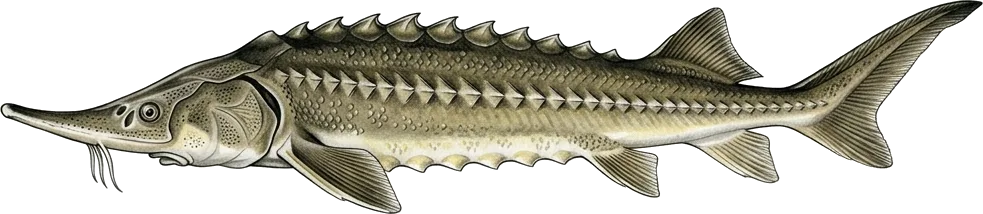
Sterlet (Acipenser ruthenus) is a non-anadromous potamodromous sturgeon of the family Acipenseridae native to Eurasian rivers of the Black, Caspian, and Baltic basins. The species is recognized by 56–71 dense lateral scutes, fimbriated sensory barbels, ventral protrusible mouth, and weight up to 16 kg. Caught on designated fisheries using sensitive feeder tackle baited with worms.
Sterlet demands finesse and respectful handling: supple 0.16–0.18mm hooklengths, fresh redworm bunches or mayfly larvae, targeting oxygenated gravel shoals, and strict adherence to conservation guidelines.
- ✅ You want to definitively distinguish sterlet from Russian sturgeon, ship sturgeon, and stellate sturgeon by fimbriated barbels and scute counts (56–71).
- ✅ You want to master river feeder tactics over heavy current on sand-and-gravel Volga bluffs.
- ✅ You need proven baits: garlic-dipped lively redworms, burrowing mayfly larvae, caddis, and bloodworms.
- ✅ You want to explore sturgeon science: cartilaginous notochord, bone-free skeleton, heterocercal tail, and tubular mouth.
- ✅ You want to master sterlet feeder mechanics and gravel runs in 'Volga 2026'.
Ichthyology & Adaptations: Biological Profile of Acipenser ruthenus
Sterlet (*Acipenser ruthenus*) is an ancient freshwater chondrostean relict featuring distinct morphology:
Armor consists of 5 rows of sharp enamel-like scutes: 1 dorsal (12–17 hooked scutes), 2 lateral (56–71 dense small scutes), and 2 ventral rows (10–19 scutes).
Four barbels on the underside of the snout are covered in delicate sensory fringes. This is the definitive species marker: Russian and stellate sturgeon possess completely smooth barbels!
The toothless ventral mouth extends downward as a fleshy tubular funnel. Sweeping gravel with fringed barbels, it vacuums mayfly larvae and bloodworms directly from stone crevices.
Lacking true bone vertebrae, it relies on a flexible cartilaginous notochord. The heterocercal shark-like tail forces the streamlined body downward, holding bottom in torrential flow.
Sterlet vs Russian Sturgeon vs Stellate Sturgeon: Acipenserid Guide
Comparative anatomical guide for three legendary Volga sturgeons:
- Barbels: FIMBRIATED (covered in fine sensory fringes).
- Lateral scutes: 56–71 SMALL SCUTES (densely packed).
- Snout: narrow, pointed, sharply triangular.
- Habitat: strictly resident river dweller (never enters sea).
- Size: 0.5–2.5 kg (rarely to 5 kg).
- Barbels: SMOOTH, unfringed, positioned close to snout tip.
- Lateral scutes: 24–44 LARGE widely-spaced scutes.
- Snout: short, broad, bluntly rounded.
- Size: 10–35+ kg (lengths to 2.0m).
- Status: strictly protected in Red Data Book.
- Snout: EXTREMELY ELONGATED, sword-like blade (up to 60% head length).
- Barbels: short, smooth, unfringed.
- Lateral scutes: 30–50 star-shaped scutes.
- Body: slender, elongated, graceful.
- Size: 5–20 kg.
Mechanics of the Feeder Quivertip Take
Cruising upcurrent along gravel bluffs, sterlet continuously scans stones with fringed barbels. Locating a redworm cluster, it projects its mouth funnel and vacuums the bait. On the feeder quivertip, this registers as two or three subtle rhythmic twitches ('sterlet nod') followed by a smooth, steady bend.
Strike the moment trembling turns into a sustained pull. During the fight, sterlet executes rapid, spring-like full-body undulations attempting to pin itself to gravel. On light 0.16mm snells, reel drag must yield smoothly to every surge!
Seasonal Habitats: Gravel Breaks, River Bluffs & Spawning Runs
Sterlet is an obligate rheophilic species bound to current-swept sand and gravel bars:
🌱 Spring (Current Spawning & Mayfly Hatch): Spawns at +12–15°C over torrential gravel ridges (4.0–8.0m depth). Post-spawn shoals invade 2.0–3.5m sandy flats gorging on burrowing mayfly larvae.
☀️ Summer (Peak Feeder Season): Stages along sand spit drop-offs and river bluffs in 3.5–7.0m brisk current. Peaks at twilight (7:30–10:30 PM) and dawn (4:00–7:30 AM).
🍂 Autumn (Deep Staging): As water cools, shoals condense and drop into 8.0–14.0m deep river holes, feeding only during warm midday hours on worm-bloodworm cocktails.
❄️ Winter (Wintering Pits): Clusters tightly in 10.0–20.0m wintering holes in semi-torpor. Feeding ceases entirely (strictly protected).
Sterlet Baits: Redworms, Mayfly Larvae, Caddis & Bloodworms
1. Top Animal Baits
Cluster of 3–5 lively redworms pierced multiple times; burrowing mayfly nymphs (padalitsa); caddis larvae; fat bloodworm bunches; small river clam meat.
2. Plant Baits (Ineffective)
Sterlet is an obligate zoobenthic forager. Plant offerings (corn, dough, barley) are completely ignored.
3. Fast-Water Attractors
Garlic (unbeaten #1), thyme, dry blood albumin, krill extract. Pungent garlic easily cuts through heavy river current.
4. Heavy River Loam Groundbait
50% heavy river clay/loam, dark breadcrumbs, boiled hemp, 20% chopped redworms, and fine bloodworms. The mix must bind firmly to resist heavy wash-out.
Tackle: Heavy River Feeder (3.6–3.9m) & Finesse Terminal Snells
Targeting sterlet in heavy river flow requires stiff casting backbones paired with sensitive quivertips:
Heavy River Feeder 3.6–3.9m (80–120g)
High-modulus carbon blank with sensitive 2.0–3.0 oz carbon quivertips. Size 4000–5000 reel loaded with thin PE #0.8–1.0 braid to cut water resistance.
Asymmetric Loop or Paternoster Rig
70–100g claw feeder with bottom spikes. 0.16–0.18mm fluorocarbon snell (60–90cm length) allowing the redworm bunch to flutter naturally downflow.
Forged Chinu / Crystal Hooks #8–10
Fine-wire forged high-carbon hooks with short shanks and micro-barbs, tailored for threading full bunches of active redworms.
Debunking Common Sterlet Myths
Fact: Sterlet is the sole strictly freshwater resident acipenserid, spending its entire life cycle in river channels without entering marine waters.
Fact: Sterlet scutes are sharp and armor-like but completely non-venomous, serving purely as mechanical armor against predators.
Fact: The cartilaginous notochord (viziga) is completely non-toxic and historically revered as an exquisite gourmet filling for Russian royal pies.
Scientific Research on Acipenser ruthenus
'The sterlet ranks among the most precious of fishes... Inhabiting strictly fast-flowing rivers over sand and gravel beds, it feeds on insect larvae and worms, celebrated for its royal flavor.'
'Acipenser ruthenus is a resident rheophile bearing the highest lateral scute count (56–71) among Volga sturgeons. Fimbriated barbels ensure superior chemoreception in turbulent flow.'
'Acipenser ruthenus: maximum recorded weight over 16kg, length 125cm, lifespan 30 years. Listed on the IUCN Red List and Russian Red Data Book in endangered sub-basins.'
4 Tactical River Feeder Strategies for Sterlet
Locate the transition from soft sand to river gravel in 3.5–5.0m depths. Clip up and deposit claw feeders baited with garlic redworms.
Hook 4 lively redworms through mid-bodies and dip in fresh garlic juice. The scent plume attracts sterlet upcurrent from over 100 meters.
Deploy an 80cm snell of 0.16mm fluorocarbon. The worm bunch flutters naturally in bottom flow without artificial stiffness.
Grip sterlet with wet hands by the caudal peduncle, avoiding sharp dorsal scutes. Release juvenile specimens unharmed immediately.
Seasonal Matrix: Depths, Optimal Times, Baits & Rigs
| Season | Peak Feeding Time | Depth Zone | Top Baits | Tackle System |
|---|---|---|---|---|
| Spring (May – June) | 05:00 – 09:30 & 17:00 – 20:30 | 2.0 – 4.0 m (Sandbars, mayfly hatch) | Mayfly nymphs, redworm bunch | Extra-Heavy feeder, 0.16mm snell |
| Summer (July – August) | 19:30 – 23:00 & 04:00 – 07:30 (Twilight) | 3.5 – 7.0 m (Gravel bluff breaks) | Garlic redworm, bloodworm, caddis | 3.9m Feeder (100g), claw cage |
| Autumn (Sept – Oct) | 11:00 – 15:30 (Warm midday) | 6.0 – 12.0 m (Channel deeps) | Bloodworm bunch, redworm | 120g Heavy feeder, thin braid |
| Winter (Ice Season) | Torpor (Feeding halts) | 10.0 – 20.0 m (Wintering pits) | Protected in wintering sanctuaries | Protected closed season |
Angling Diagnostic: Identify What's Impeding Your Sterlet Catch
Select the symptoms you are experiencing for instant technical adjustments:
Sterlet in 'Volga 2026' Simulator
In 'Volga 2026', sterlet is simulated with signature trembling quivertip takes, fast-water habitat affinity, and spring-like fight undulations. Weight range spans 0.3 to 3.5 kg (trophies reaching 5.0 kg). Dwells along sand-and-gravel river bluffs.
Key in-game locations: 'Stony Headland', 'Deep Fairway', 'Island Reach', 'Old Dam'.
Sterlet crowns royal questlines ('Royal Fish of the Volga', 'Secret of Fringed Barbels', 'Golden Bluff'), unlocking elite Extra-Heavy river feeders and garlic dips.
Frequently Asked Questions About Sterlet
Why is sterlet celebrated as the 'Royal Fish' in Russian history?
Sterlet was historically delivered live in specialized river barges directly to the banquets of Russian Tsars. Its boneless tender flesh (cartilaginous notochord) was hailed as the peak of royal gastronomy.
How do you distinguish sterlet from juvenile Russian sturgeon?
Key differences: 1) Barbels: sterlet barbels bear delicate fringes; Russian sturgeon barbels are completely smooth; 2) Lateral scutes: sterlet has 56–71 dense small scutes; Russian sturgeon has 24–44 large, widely separated scutes.
What is the single most effective bait for sterlet?
A bunch of 3–5 active redworms dipped in fresh garlic juice, as well as burrowing mayfly nymphs during seasonal hatches.
Does sterlet have true bones?
No. Sterlet is a chondrostean fish without true bone vertebrae or ribs—the spine is replaced by an elastic cartilaginous notochord (viziga), making the flesh 100% bone-free.
Does sterlet migrate into the sea like other sturgeons?
No. Sterlet is the sole resident freshwater acipenserid, spending its entire life cycle strictly in river channels without ever entering marine waters.
Authoritative Ichthyological Sources & Literature: FishBase — Acipenser ruthenus Biological Summary · IUCN Red List of Threatened Species — Acipenser ruthenus · Л. П. Сабанеев — «Жизнь и ловля пресноводных рыб: Стерлядь» (Викитека) · Институт биологии внутренних вод им. И. Д. Папанина РАН (ИБВВ РАН)
Prepared by the Volga 2026 Editorial Board in strict adherence to aquatic biology and sport angling standards. Volga 2026 Editorial Methodology.