Pelagic Cyprinid Ecology & Finesse Feeder Angling · Volga 2026 Encyclopedia
Blue Bream
Ballerus ballerus (Linnaeus, 1758)
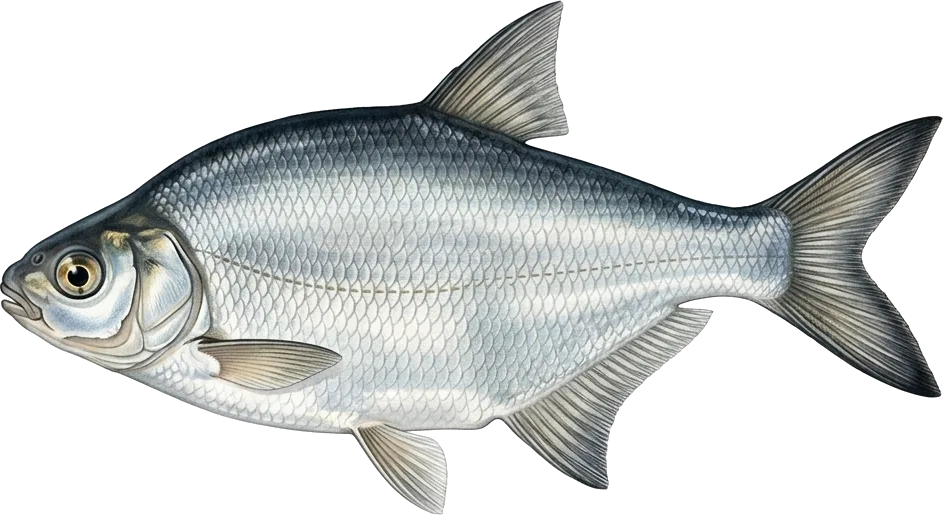
Blue Bream Zope (Ballerus ballerus, or blue bream) is a schooling pelagic cyprinid fish native to large lowland river channels and reservoirs of Europe. The species is characterized by an exceptionally long anal fin with 35–44 branched rays, a pointed snout, bluish-gray back, and weight up to 1.2 kg. Caught on medium-range feeder tackle and float rigs baited with bloodworms.
Blue bream demands tournament feeder finesse: Light/Medium rods with 0.5–1.0 oz quivertips, 90–120cm hooklinks (0.10–0.12mm), clouding groundbaits laced with bloodworms, and fine-wire #16–18 hooks baited with a bloodworm and single pinkie.
- ✅ You want to definitively distinguish blue bream from common bream, silver bream, and white-eye bream by its record 35–44 anal ray count.
- ✅ You want to master mid-water feeder tactics utilizing long 1.0–1.5m slow-falling hooklinks in reservoir basins.
- ✅ You need proven baits: single bloodworm tipped with pinkie, boiled hemp seeds, mini maggots, and anise-scented dough.
- ✅ You want to explore the science of 30–40 plankton-filtering gill rakers, steely-blue pigmentation, and pelagic schooling.
- ✅ You want to master blue bream feeder mechanics and reservoir quests in 'Volga 2026'.
Ichthyology & Adaptations: Biological Profile of Ballerus ballerus
Blue bream (*Ballerus ballerus*) is a specialized pelagic cyprinid displaying distinctive morphological adaptations:
The anal fin is exceptionally long and ribbon-like, containing 35–44 branched rays. This is the definitive species marker: common bream has at most 29 rays; silver bream has at most 24.
The back displays a distinct dark steely-blue or indigo metallic sheen. Scales are very fine and densely set (66–75 along the lateral line), sharply contrasting with coarse-scaled silver bream.
Unlike the downward protractile tube of common bream, blue bream has an oblique mouth pointing upward. This allows it to effortlessly snatch hovering zooplankton and drifting food particles in mid-water.
Branchial arches carry 30–40 long, fine gill rakers forming a dense sieve. Blue bream actively filters open water across reservoirs, retaining cladocerans (Daphnia, Leptodora).
Blue Bream vs Common Bream vs Silver Bream: Abramid Guide
Comparative anatomical guide for three flat-bodied cyprinid species:
- Anal fin: RECORD LENGTH (35–44 branched rays).
- Mouth: oblique, pointing upward (semi-superior).
- Coloration: steely-blue sheen on back, silvery sides.
- Scales: FINE (66–75 scales along lateral line).
- Size: 25–40 cm (300–800g, rarely to 1.2 kg).
- Anal fin: moderately long (24–29 rays).
- Mouth: strictly SUBTERMINAL, extending into a long vacuum tube.
- Coloration: golden-bronze in adult specimens.
- Scales: coarse (51–60 scales along lateral line).
- Size: 1.0–4.5+ kg.
- Anal fin: short (19–24 rays).
- Fins: pectoral and pelvic fins feature VIVID RED-ORANGE bases.
- Eyes: ENORMOUS, bulging silvery globes.
- Scales: very coarse and large (43–48 scales).
- Size: 15–28 cm (150–500g).
Mechanics of the Delicate Feeder Take & Long Hooklink Tactics
Foraging in benthic and suspended strata over silty fairway shelves, blue bream spots the slow-fluttering bloodworm on a 1.2m hooklink. Gently vacuuming the bait mid-fall, it pulls. On the sensitive 0.75 oz quivertip, this manifests as a high-frequency trembling vibration ('tip buzz') followed by a smooth bend.
Set the hook smoothly on the first sustained pull. During the retrieve, blue bream fights spiritedly with wide circular arcs in mid-water, flashing its blue-steely flank. A progressive Light/Medium blank easily cushions all surges on delicate 0.10mm hooklengths!
Seasonal Habitats: Reservoir Flats, Channel Shelves & Mud Beds
Blue bream thrives in vast reservoir expanses and gentle river currents:
🌱 Spring (Shallow Spawning & Foraging): Spawns in late May at +14...+18°C across shallow weed beds (1.0–2.5m). Post-spawn schools disperse onto 3.0–5.0m silty flats to feed heavily.
☀️ Summer (Peak Reservoir Feeder Season): Stages along 5.0–10.0m channel drop-offs and wide open flats. Peaks at dawn (5:00–9:00 AM) and evening twilight (6:30–9:30 PM).
🍂 Autumn (Deep Hole Staging): Consolidates into massive dense shoals, dropping into 9.0–16.0m fairway trenches. Feeds during warm midday hours on bloodworm clusters.
❄️ Winter (Ice Season): Winters in 10.0–18.0m deep silty pits. Caught through ice on delicate float rigs baited with bloodworms and smooth-action beadhead micro-trebles.
Blue Bream Baits: Bloodworms, Pinkies, Roasted Hemp & Clouding Mixes
1. Top Natural Baits
1–2 lively bloodworms on fine-wire hooks; cocktail: 1 bloodworm + 1 white pinkie maggot; small sliver of tender redworm; caddis larva.
2. Plant Offerings
Boiled hemp seeds (threaded single on hook #18); soft anise-scented semolina dough; breadcrumb-dusted pearl barley.
3. Attractors & Flavors
Anise, coriander, caramel, roasted hemp extract, copra-melasse. Light sweet-spicy aromas pull suspended blue bream shoals reliably.
4. Active Clouding Feeder Program
Fine-ground pale breadcrumbs, 20% copra-melasse for active lifting, 15% crushed hemp, and 100g fine bloodworms topped up in each feeder cast.
Tackle: Light/Medium Feeder (3.6m), Finesse Quivertips & 0.10mm Hooklinks
Targeting blue bream demands delicate feeder tackle tuned for subtle mid-water takes:
Light/Medium Feeder 3.3–3.6m (30–60g)
Progressive graphite blank with sensitive 0.5–1.0 oz carbon quivertips. Size 3000–4000 reel loaded with thin PE #0.6 braid and mono shockleader.
Paternoster (Gardner) or Free-Running Rig
25–45g open-end plastic cage feeder with wings for rapid ascent, releasing an active cloud on the drop.
90–130cm Fluorocarbon Hooklink (0.10–0.12mm)
Extra-long supple hooklink ensuring a natural slow-falling drift, armed with fine-wire Owner Sode/Chika hooks #16–18.
Debunking Common Blue Bream Myths
Fact: Blue bream (*Ballerus ballerus*) is a distinct biological species featuring a record anal fin (up to 44 rays vs 29 in bream) and an oblique mouth.
Fact: Blue bream is a pelagic planktivore feeding eagerly on slow-falling single bloodworms drifted on 1.2m long hooklinks.
Fact: Dried and cured blue bream is prized higher than bream among gourmets due to its high fat content (8–10%) and sweet, delicate flavor.
Scientific Research on Ballerus ballerus
'The blue bream ranks among the most widespread fishes of Volga reservoirs... It is distinguished from common bream by an extraordinarily long anal fin, blue back, and oblique mouth.'
'Ballerus ballerus holds a dominant niche among pelagic benthos-planktivores in Volga cascade reservoirs. Gill raker density (30–40) allows efficient harvesting of lacustrine zooplankton.'
'Ballerus ballerus: maximum recorded weight 1.5kg, length 45cm, lifespan 12 years. Anal fin contains 35–44 branched rays, providing smooth stabilization in pelagic strata.'
4 Tactical Reservoir Feeder Strategies for Blue Bream
Rig a 1.2m supple 0.10mm fluorocarbon hooklink. The offering flutters down slowly after the feeder lands, triggering mid-water strikes on the drop.
Add dry crushed roasted hemp to each cage. Floating particles ascend through the water column, steering hovering blue bream down toward the hook.
Thread 1 bloodworm locked in place by a tiny white pinkie maggot on hook #18. The pinkie prevents bait tear-off on 50m distance casts.
Recast every 90–120 seconds. A continuous shower of descending particles keeps the schooling pod locked onto your feed zone.
Seasonal Matrix: Depths, Optimal Times, Baits & Rigs
| Season | Peak Feeding Time | Depth Zone | Top Baits | Tackle System |
|---|---|---|---|---|
| Spring (May – June) | 06:00 – 12:00 & 16:30 – 20:30 | 2.5 – 5.0 m (Silty sand flats) | Bloodworm cluster, maggots, hemp | Light 3.6m feeder, 0.10mm snell |
| Summer (July – August) | 05:00 – 09:30 & 18:30 – 21:30 (Dawn/Dusk) | 5.0 – 9.0 m (Reservoir drop-offs) | 1 bloodworm + 1 pinkie, anise dough | Medium 3.6m feeder, 35g cage |
| Autumn (Sept – Oct) | 10:00 – 16:00 (Warm midday) | 8.0 – 14.0 m (Deep fairway holes) | Pure fat bloodworms (2–3 larvae) | Medium-Heavy feeder, 1.0 oz tip |
| Winter (Ice Season) | 09:30 – 15:30 (Steady ice takes) | 9.0 – 16.0 m (Silty winter deeps) | Bloodworm on micro tungsten jig | Winter ice float/jig rod, 0.09mm |
Angling Diagnostic: Identify What's Impeding Your Blue Bream Catch
Select the symptoms you are experiencing for instant technical adjustments:
Blue Bream in 'Volga 2026' Simulator
In 'Volga 2026', blue bream is simulated with authentic reservoir mid-water suspension kinematics, delicate 0.10mm long-hooklink takes, and competitive schooling feeding rhythms. Weight spectrum spans 150 to 950 g. Inhabits wide reservoir glides and fairway drop-offs.
Key in-game locations: 'Volga Expanses', 'Island Reach', 'Old Riverbed', 'Quiet Monastery'.
Blue bream features in feeder tournament questlines ('Blue-Finned Reservoir Sailer', 'Secret of the Giant Anal Fin', '0.10mm Feeder Master'), unlocking 0.5 oz ultra-sensitive quivertips and Light feeder rods.
Frequently Asked Questions About Blue Bream
How do you distinguish blue bream from common bream and silver bream?
Key differences: 1) Anal fin: record length of 35–44 branched rays (vs 24–29 in bream and 19–24 in silver bream); 2) Mouth: oblique semi-superior mouth (bream has a downward protractile tube); 3) Color: steely-blue dorsal sheen and fine scales (66–75 rows).
Why is an extra-long 100–120cm hooklink necessary for blue bream?
Blue bream is a pelagic planktivore with an upturned mouth. It prefers intercepting baits during their slow, natural descent through mid-water rather than feeding hard on the silt.
What is the single best bait for blue bream?
A cocktail of 1 fresh bloodworm and 1 white pinkie maggot on a fine-wire #18 hook, ring-hooked bloodworms, and boiled hemp seeds.
What does blue bream feed on in large reservoirs?
The primary diet consists of pelagic zooplankton (Daphnia, Bosmina, Leptodora) filtered through 30–40 dense gill rakers, supplemented by chironomid larvae (bloodworms) and small clams.
Where do blue bream typically station in lakes and rivers?
Blue bream prefers wide open reservoir flats and gentle river glides at 5.0–10.0m depths over soft silty-sand substrate, avoiding boiling whitewater rapids and choked shallows.
Authoritative Ichthyological Sources & Literature: FishBase — Ballerus ballerus Biological Summary · IUCN Red List of Threatened Species — Ballerus ballerus · Л. П. Сабанеев — «Жизнь и ловля пресноводных рыб: Синец» (Викитека) · Институт биологии внутренних вод им. И. Д. Папанина РАН (ИБВВ РАН)
Prepared by the Volga 2026 Editorial Board in strict adherence to aquatic biology and sport angling standards. Volga 2026 Editorial Methodology.