Ichthyology & Feeder Mastery · Volga 2026 Encyclopedia
Common Bream
Abramis brama (Linnaeus, 1758)
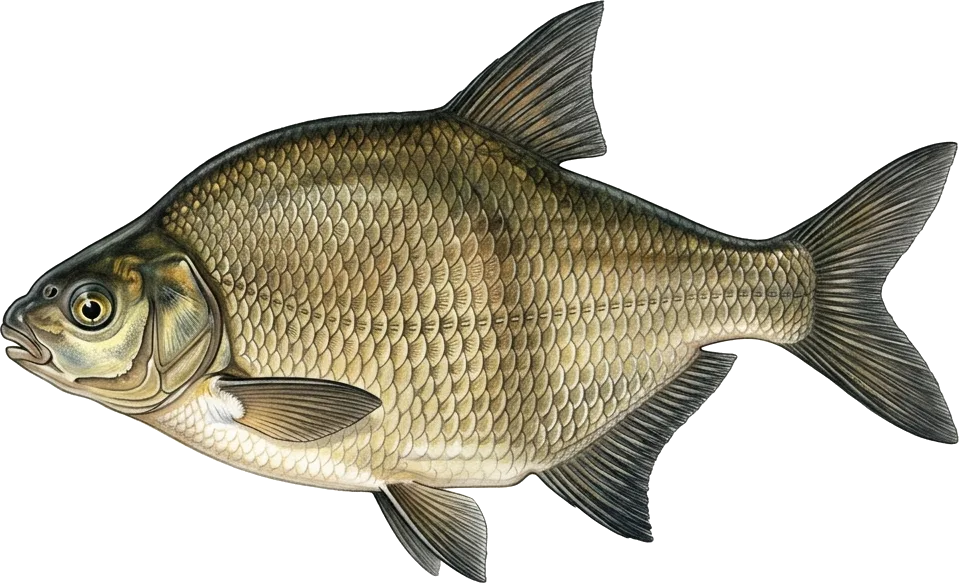
Common Bream Common bream (Abramis brama) is a deep-bodied benthic cyprinid fish native to European rivers, lakes, and lowland reservoirs. The species is recognized by a laterally compressed silver-bronze body, a highly protrusible suction-tube mouth for benthic feeding, single-row 5-5 pharyngeal teeth, and weight up to 8 kg. Anglers target bream with quivertip feeder tackle and float rigs.
Specimen bream are conservative, cautious giants. They despise light active groundbait and erratic bait movement. Anchoring a shoal requires a dense table of inert nutritious grains, long hooklengths buffered with feeder gum, and immense patience on the pauses.
- ✅ You want to systematically target heavy specimen bronze bream (1.5–3.5 kg) while filtering out aggressive skimmers.
- ✅ You want to master the biomechanics of the protrusible suction snout and the classic float lift-bite.
- ✅ You need proven recipes for heavy, inert groundbaits loaded with millet, boiled peas, molasses, and pastoncino.
- ✅ You want to accurately locate benthic feeding tables, channel ledges, and zebra mussel beds on large reservoirs.
- ✅ You want to master night feeder tactics and winter ice angling dynamics in the 'Volga 2026' simulator.
Ichthyology & Adaptations: Biological Profile of Abramis brama
Common bream (*Abramis brama*) is a highly specialized benthic benthivore. Its anatomical architecture is finely adapted for sifting deep silt beds and navigating large river basins:
Elastic cranial ligaments allow bream to extend their jaws downward into a 3–5cm tubular suction snout. This enables the fish to vacuum deep silt deposits, inhaling bloodworms and tubifex buried up to 10cm beneath the mud surface.
Feeding bream move across swims in dense coordinated packs, plowing through benthic mud. This sediment disturbance releases characteristic trails of fine methane and gas bubbles to the surface—an unmistakable sign of an active school.
The deep, laterally compressed bronze flank acts as a powerful hydrofoil against heavy river currents. Its sheer vertical girth prevents mature bream from being swallowed by most pike and zander.
Sensory nasal pits contain thousands of specialized chemoreceptors tuned to amino acids, sugars, betaine, and molasses over long distances. Bream exhibit a pronounced affinity for sweet caramel, vanilla, and bakery aromas.
Bream vs Silver Bream vs Blue Bream: Identification Guide
These three cyprinids frequently share river channels but demand distinctly different tactics. Comparative markers:
- Mouth: extends downward into a long tubular suction snout.
- Color: mature adults are deep bronze-gold; fine tightly set scales.
- Fins: entirely dark grey or blackish (never red or pink at the base!).
- Anal fin: moderately long (24–30 branched rays).
- Eyes: proportionally small compared to broad head size.
- Mouth: short, terminal, unable to form a downward suction tube.
- Fins: bases of pectoral and pelvic fins are ALWAYS distinctly pinkish-red.
- Scales: noticeably larger than bream (43–48 along lateral line), bright chrome silver.
- Eyes: prominently large, bulging, silvery-white.
- Size: rarely exceeds 400–600 grams in weight.
- Mouth: sharply upturned / superior for surface and mid-water plankton feeding.
- Body: razor-thin laterally compressed profile with bluish dorsal sheen.
- Anal fin: extremely elongated (35–44 branched rays).
- Scales: fine, shiny, easily dislodged.
- Behavior: cruises mid-water current layers, never rooting in deep mud.
Anatomy of the Classic Lift Bite: Why Bream Lay Floats Flat
When grazing on the riverbed, the deep-bodied bream tilts downward at a 45–60 degree angle, plunging its snout into the sediment. Inhaling the bait along with the anchor dropper shot, the fish straightens horizontally into cruising position, lifting the lead off the substrate.
Relieved of the dropper shot's ballast, the float rises smoothly out of the water and topples flat onto the surface film ('lift bite'). In feeder fishing, this registers as a slack-line dropback where the bent quivertip springs straight. This is the golden instant for a firm, sweeping hookset!
Seasonal Habitats & Migrations: Locating Bream Throughout the Year
Bream migrations strictly follow thermal cycles, dissolved oxygen boundaries, and benthic forage blooms:
🌱 Spring (Pre-Spawn & Post-Spawn Feed): As water warms to +10–14°C, bream emerge from deep wintering holes onto extensive flats (2.5–4.5m depth). The post-spawn feeding frenzy lasts two weeks, during which shoals forage aggressively on bloodworm and worms across warming flats.
☀️ Summer (Night Feeder Prime): In warm months, specimen bream hold deep (6–10m) beneath the thermocline by day. At dusk, shoals ascend to upper channel breaks, shell bars, and 3.5–5.5m flats, feeding intensely throughout the dark hours.
🍂 Autumn (Deep Wintering Staging): Cooling, transparent water triggers bream to gather into massive shoals staging along 7–12m deep channel ledges and wintering holes. Groundbait must be dark, minimally scented, and packed with live joker bloodworm.
❄️ Winter (Ice Angling & Dropbacks): On first and last ice, shoals roam 5–8m channel plateaus. In midwinter oxygen lulls, they hold in flowing deeps. Anglers use dual-arm spreader rigs ('koromyslo') and vertical multi-hook nymph chains.
Bream Menu: Proven Baits, Grains, Attractants & Groundbait Table
1. Natural Animal Baits (Core Diet)
A plump bunch of 5–8 bloodworms hooked through the collar; classic cocktail of 3 bloodworms and 1 red/white maggot; juicy bunch of redworms capped with a maggot; spring caddis larvae.
2. Grains, Corn & Large Particle Holds
Sweet canned corn (1–2 soft kernels); simmered whole marrowfat peas; steamed pearl barley infused with garlic or anise; pea-semolina mastyrka dough; 4–6mm halibut pellets on hair rigs.
3. Liquid Scents & Attractor Profiles
Molasses (beet syrup—the backbone of bream groundbait), caramel, chocolate, speculoos biscuit, vanilla, coriander (warm water); garlic, fennel, aniseed, betaine, and worm extract (cold water).
4. Groundbait Consistency & Benthic Blanket
Bream mixes must be heavy, rich brown or golden, tacky, and thoroughly dampened in 3 stages so feeders deliver intact to the riverbed without clouding mid-water. Blend in 30–50% heavy cooked grains (millet, crushed peas).
Tackle & Specialized Rigs for Common Bream
Tackling specimen bream in deep channels and currents requires dedicated distance tackle:
River & Reservoir Feeder Setup
3.6–3.9m Medium-Heavy rod (70–120g rating). PE #0.6–0.8 braid with 0.25mm mono shockleader and 0.6–0.8mm feeder gum buffer. Running rig or asymmetric loop. 60–100cm hooklengths (0.11–0.14mm), wide-gape hooks #12–16.
Pole & Bolognese River Rig
7–8m whip or 6–7m Bolognese rod. 2.5–6.0g float with thick hollow antenna (2.5–3.5mm) supporting a dragging bait. Bulk olivette (85%) with heavy anchor dropper (15%) resting on bottom to ensure unmistakable lift bites.
Winter Ice Spreader & Dual-Joint Float Rig
Winter ice rig with a dual-joint float submerged 1–2cm below the hole surface to prevent freezing. Wire spreader ('koromyslo') holding two 0.10–0.12mm snells for perfect twin-bloodworm presentation on silty bottoms.
Debunking Common Myths About Common Bream
Fact: Generic mixes are too lightweight, drifting downstream and inviting nuisance bleak. Specimen bream demand dense, inert groundbaits loaded with 30–50% large particles (millet, crushed peas, corn).
Fact: Over zebra mussel bars, 0.08mm line is instantly severed by shell edges during heavy headshakes. The optimal balance is supple 0.12–0.14mm monofilament paired with feeder gum shock absorption.
Fact: During midsummer heat, trophy feeding peaks in deep darkness (01:00–03:30 AM) and during midday hydro-dam flow surges (12:00–14:00) when fresh current stirs benthic food.
Scientific Authority: Research on Abramis brama
'The bream is a denizen of deep, tranquil, sand-and-silt reaches... Bream shoals emerge to feed at dusk and night with astonishing punctuality, navigating constant underwater highways along channel contours.'
'In Middle and Lower Volga reservoirs, Abramis brama accounts for 45–60% of total benthic fish biomass. Seasonal feeding dynamics correlate directly with Chironomidae midge larvae and oligochete densities in silt beds.'
'Abramis brama: lifespan up to 20–25 years, maximum length 82cm. Features highly kinetic jaw mechanics generating intense localized hydrodynamic suction during sediment ingestion.'
4 Practical Tactical Strategies for Specimen Bream
Drag a marker lead to locate the transition where soft silt gives way to resonant crunchy zebra mussel beds at the base of a channel slope—the prime bream highway.
Deliver 10–15 large feeding cages packed with boiled millet, corn, and chopped worm before clipping on your hooklength. A bream shoal devours feed rapidly; a rich banquet is mandatory.
From 11 PM to 4 AM, clip up on the upper shelf (3.5–5m) rather than the deep day hole (8–10m). Trophy bream migrate into shallower shelves at night where water is warmer.
Thread 4–6 bloodworms capped with a single white maggot. Apply a quick spray of caramel or garlic dip to the bait immediately before casting.
Seasonal Matrix: Depths, Optimal Times, Baits & Rigs
| Season | Peak Feeding Time | Depth Zone | Top Baits | Tackle System |
|---|---|---|---|---|
| Spring (May) | 06:00 – 11:00 & 16:00 – 20:00 | 2.5 – 4.5 m (Flats & bays) | Bunch of bloodworms, worm & maggot | Medium Feeder 3.6m, whip 8m |
| Summer (June – August) | 23:30 – 04:00 (Night) & Dam flow peak | 4.0 – 8.0 m (Channel ledges & tables) | Sweetcorn, simmered peas, cocktail | Heavy Feeder 3.9m (80–100g cage) |
| Autumn (Sept – Nov) | 10:00 – 15:30 (Midday warmth) | 6.5 – 11.0 m (Deep holes & ledges) | Pure bloodworm bunch, small redworm | Feeder with long 90cm link (0.11mm) |
| Winter (Ice Fishing) | 08:30 – 14:00 & Night ice 21:00–01:00 | 5.5 – 10.0 m (Flowing channel flats) | Bloodworm on spreader, chertik nymph | Ice spreader rig with dual-joint float |
Angling Diagnostic: Identify What's Impeding Your Bream Success
Select the symptoms you are experiencing for instant technical adjustments:
Common Bream in 'Volga 2026' Simulator
In 'Volga 2026', common bream is simulated with realistic benthic telemetry and hydrodynamics. Weight spectrum ranges from 0.3 to 4.5 kg (trophy bronze bream). Bream demand precise feeder accuracy on channel contours and split-second recognition of dropback bites.
Key in-game locations: 'Deep Fairway', 'Tram Bend', 'Old Quay', 'Quiet Monastery', 'Island Reach'.
Bream is the centerpiece of the master feeder questline ('Bronze of the Channel', 'Night Watch', 'Master of the Volga Deeps'), awarding tournament-grade feeder rods and reels.
Frequently Asked Questions About Common Bream
How do you tell mature common bream apart from large silver bream?
Key markers: bream has uniform dark/blackish fins, fine scales, and a mouth that telescopes into a downward suction snout. Silver bream always has distinctly pink/reddish pectoral and pelvic fin bases, noticeably larger scales, and huge bulging silvery eyes.
Why does bream lift the float flat onto the surface during a bite?
When feeding, bream tilts downward at a 45–60 degree angle. Inhaling the bait, it straightens horizontally and lifts the anchor dropper lead off the mud. Relieved of this weight, the float shoots upward and topples flat on the surface.
What is the best basic groundbait mix to hold bream in river current?
Core recipe: 1kg heavy river bream mix, 300g cooked fluffy millet, 200g crushed biscuit, 150ml sugar-beet molasses, and 100g sweetcorn. The mix must be heavy, sticky, and inert, resting dead on the bottom without mid-water clouds.
Why is feeder gum essential when feeder fishing for bream?
Zero-stretch braided mainline transfers violent headshakes directly to the hook, risking torn mouth tissue or snapping fine 0.10–0.12mm snells. A 10–15cm feeder gum link absorbs heavy thrashing, ensuring specimen fish stay hooked.
What time of day yields the biggest summer bream?
In summer, the most productive window is night fishing from 11:30 PM to 4:00 AM over 3.5–5.5m shell plateaus. A second dependable peak occurs during midday dam release surges (12:00–14:30) when heavy flow activates benthic feeding.
Authoritative Ichthyological Sources & Literature: FishBase — Abramis brama Biological Summary · ИБВВ РАН — Биология и популяционная динамика леща Волжского бассейна · Л. П. Сабанеев — «Жизнь и ловля пресноводных рыб»
Prepared by the Volga 2026 Editorial Board in strict adherence to aquatic biology and sport angling standards. Volga 2026 Editorial Methodology.