Sciaenid Biology & Heavy Benthic Jigging Tactics · Volga 2026 Encyclopedia
Freshwater Drum
Aplodinotus grunniens (Rafinesque, 1819)
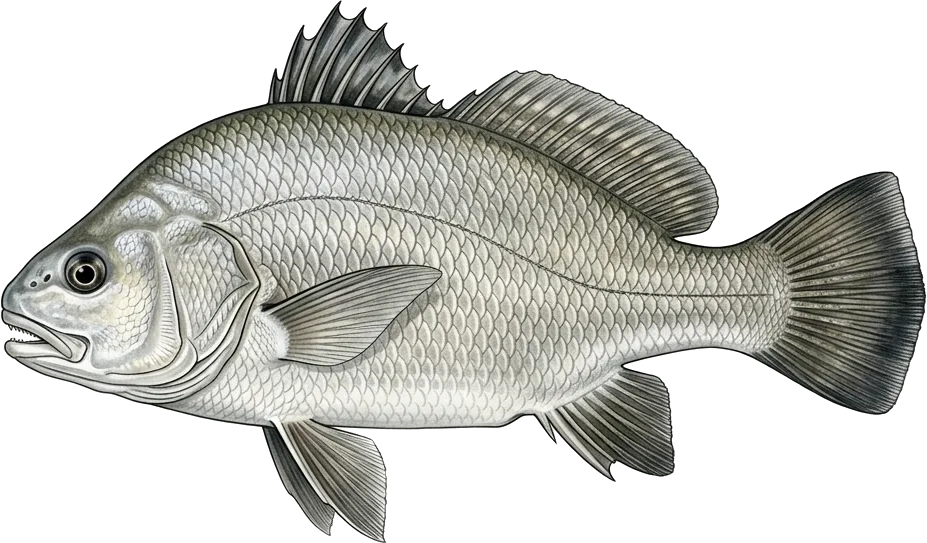
Freshwater Drum Freshwater drum (Aplodinotus grunniens, or gaspergou) is a bottom-feeding teleost fish of the croaker family (Sciaenidae) native to large river channels and lakes. The species is renowned for acoustic grunting sounds produced via sonic muscles vibrating against the swim bladder, giant porcelain-like otoliths, and weight up to 20 kg. Anglers catch drum using bottom jigs and crayfish baits.
Freshwater drum demands heavy, highly resonant tackle: 2.4–2.7m Heavy Ex-Fast spinning rod (15–50g rating), 0.16–0.18mm braided mainline with 0.35–0.40mm fluorocarbon leader, 18–35g jigheads with soft plastic craws/creature baits, or heavy ledgers baited with fresh unionid clam meat and crayfish tails.
- ✅ You want to definitively understand Aplodinotus grunniens bioacoustics and anatomy: sonic muscles, porcelain 'lucky stone' otoliths, and molar mills.
- ✅ You want to master dusk and midnight heavy benthic jigging over deep shell beds swept by strong river currents.
- ✅ You need top lures and baits: silicone craws/creatures, fresh river clam meat, juicy crayfish tails, giant nightcrawlers, and raw shrimp.
- ✅ You want to master fight physics: why drum delivers rhythmic acoustic head-thumps and how to prevent line abrasion over razor mussel edges.
- ✅ You want to master freshwater drum mechanics and deep-harbor quests in 'Volga 2026'.
Ichthyology & Bioacoustic Adaptations: Profile of Aplodinotus grunniens
Freshwater drum (*Aplodinotus grunniens*) is the sole strictly freshwater member of the croaker family Sciaenidae in the Northern Hemisphere:
Males possess specialized sonic muscles flanking the swim bladder. Contracting at 100–300 Hz, they vibrate the heavy resonant bladder, generating loud purring, croaking, or drumming acoustic pulses audible underwater for hundreds of meters.
The inner ear capsules house the largest auditory stones among freshwater fish—sagittal otoliths of dense calcium carbonate bearing a natural 'L'-shaped groove. They enable exquisite bioacoustic orientation in turbid deep water.
Lower pharyngeal bones are fused into a heavy triangular plate paved with dozens of smooth cobblestone molars. Exerting massive compressive leverage, it pulverizes thick bivalve clam shells (Corbicula, Dreissena).
A distinct anatomical signature: the lateral line sensory canal does not terminate at the caudal peduncle, but extends across central fin rays to the very posterior margin of the tail, detecting micro-currents.
Freshwater Drum vs Black Croaker vs Zander: Identification Guide
Comparative anatomical guide for sciaenids vs percids:
- Dorsal fin: SINGLE, continuous with deep notch (10 spines, 29–32 rays).
- Lateral line: EXTENDS THROUGH ENTIRE CAUDAL FIN to edge.
- Acoustics: drums loudly with swim bladder sonic muscles.
- Teeth: cobblestone pharyngeal crushers (canines absent).
- Size: 35–70 cm (weight 1.0–7.2+ kg).
- Color: DEEP BRONZE-BLACK with metallic gold sheen.
- Pelvic fins: jet-black with stark snow-white leading edge.
- Habitat: STRICTLY MARINE (rock reefs, breakwaters, sea caves).
- Size: 30–50 cm (0.8–3.5 kg).
- Range: Black Sea, Mediterranean.
- Jaws: MASSIVE SHARP CANINES on upper and lower jaws.
- Dorsal fin: TWO COMPLETELY SEPARATED dorsal fins.
- Eyes: large phosphorescent tapetum lucidum eyes.
- Diet: obligate piscivore (minnows, bleak, gobies).
- Size: 40–90 cm (1.5–12.0+ kg).
Mechanics of the Heavy Benthic Jig Strike & Acoustic Head-Thump Fight
During bottom-hopping jig retrieves with a silicone craw over 7–10m deep mussel ledges, the drum pins the bait to the bottom with massive crushing suction ('feeling like a sudden solid log snag'). Split seconds later, a violent heavy thump reverberates into your wrist. The hookset must be authoritative to drive through the bony roof of the mouth.
From the onset of the battle, the drum hugs the bottom, delivering heavy, rhythmic low-frequency head-thumps ('thump... thump... thump') that cause the rod tip to pump in heavy acoustic oscillations. The fish deliberately grinds the leader across jagged Dreissena shells, making a heavy 0.35–0.40mm fluorocarbon leader vital!
Seasonal Habitats: Channel Drop-Offs, Deep Harbor Quays & Shell Ledges
Freshwater drum strictly adheres to deep, hard-bottomed riverbeds encrusted with mollusk colonies:
🌱 Spring (Pre-Spawning Ledges): Ascends onto warming 4.0–7.0m channel margins. Actively grazes bivalve beds in evening dusk.
☀️ Summer (Peak Night Jigging Season): Patrols deep 6.0–11.0m mussel plateaus near breakwaters and shipping channels from 9:30 PM to 3:00 AM under strong current.
🍂 Autumn (Deep Canyon Troughs): Packs into the deepest 8.0–14.0m river channels. Smashes heavy 28–40g jigs paired with large craw trailers.
❄️ Winter (Deep Riverbed Basins): Overwinters in 10–18m deep channel pits with moderate flow. Occasionally caught on heavy vertical balance jigs and zander vibration lures.
Freshwater Drum Baits: Silicone Craws, Clam Meat, Crayfish Tails & Heavy Jigs
1. Natural Mollusk & Crayfish Baits
Fresh juicy unionid river clam meat; peeled whole crayfish tail; cluster of giant nightcrawlers; peeled raw shrimp tail.
2. Silicone Craws & Creature Baits
3–4 inch silicone crayfish imitations (Keitech Crazy Flapper, Savage Gear 3D Craw) in natural dark shades (Green Pumpkin, Dark Craw, Motor Oil).
3. Heavy Football Jigs & Sinking Vibration Lures
20–35g Football Jig heads with wide-gap forged hooks, compact casting spoons, and 24–32g sinking vibration lures with internal metal sound rattles.
4. Heavy Shell Carpet Feed with Crayfish Booster
Heavy clay-bound river mix loaded with 40% crushed unionid clams, fishmeal, and pure liquid Crayfish extract.
Tackle: Ex-Fast 15–50g Jig Blank, 4000 Reel, 0.18mm Braid & 0.35–0.40mm Leader
Taming heavy drum on deep river ledges swept by strong current requires resonant, powerhouse tackle:
Jig Spinning Blank 2.4–2.7m (15–50g Rating, Extra-Fast)
High-modulus carbon rod with reinforced backbone and highly sensitive tubular tip, transmitting mussel textures and dull acoustic strikes straight to hand.
Heavy-Duty Size 4000 Metal-Body Spinning Reel
Winch reel with high-torque gear set (5.0:1 ratio) and multi-disc carbon drag exerting 9–12kg of stopping power.
4-Strand Braid PE #1.2–1.5 + 1.5m 0.35–0.40mm Fluorocarbon Leader
Dense, abrasion-resistant 4-carrier braid paired with a long, tough fluorocarbon leader to survive jagged mussel-shelf friction.
Debunking Common Freshwater Drum Myths
Fact: *Aplodinotus grunniens* is the only strictly freshwater sciaenid in the Northern Hemisphere, spending its entire life cycle in river basins.
Fact: The booming sound is generated by specialized sonic muscles vibrating against the resonant swim bladder walls.
Fact: Drum is a nocturnal benthic predator/malacophage, feeding at peak intensity after dark on jigs, clams, and crayfish.
Scientific Research on Aplodinotus grunniens
'The river drum is a most remarkable fish of deep waters... Its dull drumming reverberates into boats, while the dense porcelain stones from its head have long been worn as lucky talismans.'
'Aplodinotus grunniens possesses a specialized bilateral sonic muscle complex. Contractions generate acoustic pulses with dominant frequencies of 120–280 Hz and source levels up to 135 dB re 1 µPa.'
'Aplodinotus grunniens: maximum recorded weight 16.0–24.5kg (averaging up to 7.2kg in standard basins), length 95cm, lifespan exceeding 30–70 years determined via otolith annuli.'
4 Tactical Deep-Benthic Strategies for Freshwater Drum
Crawl a silicone craw on a Football jig in short 10cm drags with 5-second dead-stick pauses. Drum pins the stationary lure right on the shells!
Tie 1.5m of heavy fluorocarbon using a Mahin Knot. During the fight and acoustic head-thumps, the line easily withstands razor-sharp Dreissena edges.
Cast a heavy ledger baited with whole unionid clam meat onto 8–10m shell ledges at midnight. Drum schools forage actively under dark cover.
On the first solid weight or heavy thump, execute a powerful full-blank hookset to drive the hook point past tough bony jaw cartilage.
Seasonal Matrix: Depths, Optimal Times, Baits & Rigs
| Season | Peak Feeding Time | Depth Zone | Top Baits | Tackle System |
|---|---|---|---|---|
| Spring (Pre-Spawning Shelves) | 19:00 – 23:30 & 04:30 – 07:30 | 4.0 – 7.0 m (Warming shell ledges) | Clam meat, nightcrawler, soft craw | Heavy 2.4m rod, 20–28g jig |
| Summer (Night Harbor & Deep Channels) | 21:30 – 03:00 (Peak dark hours) | 6.0 – 11.0 m (Channel drops & piers) | Crayfish tail, Crazy Flapper, shrimp | Ex-Fast jig rod, #1.5 braid, 0.38mm leader |
| Autumn (Deep Channel Canyons) | 11:00 – 16:30 (Overcast) & dusk | 8.0 – 14.0 m (Deepest river trenches) | 28g heavy vibe, 4" creature craw | 15–50g Jig kit with size 4000 winch |
| Winter (Basin Inactivity) | 12:00 – 15:00 (Sporadic bites) | 10.0 – 18.0 m (Winter channel pits) | 25g balance jig, vertical vibe | Stiff winter vertical ice rod |
Angling Diagnostic: Identify What's Impeding Your Freshwater Drum Catch
Select the symptoms you are experiencing for instant technical adjustments:
Freshwater Drum in 'Volga 2026' Simulator
In 'Volga 2026', freshwater drum is simulated as a deep benthic trophy sciaenid with unique 'dull rod-thumping' fight dynamics ('thumps the rod blank dully on the fight'), bottom-knock tag physics, clam, shrimp, and heavy jigging tactics over deep current and harbor revetments. Weight spectrum spans 400g to 7.2 kg. Inhabits deep harbors, channel drop-offs, and breakwaters.
Key in-game locations: 'Sea Breakwater', 'Harbor Pier', 'Deep Pool', 'Volga Expanses'.
Freshwater drum crowns the deep jigging questline ('Sonic Channel Rhythm', 'Secret of the Lucky Otoliths', '7kg Shell Ledge Duel'), unlocking Jig Master Heavy blanks and artisan Craw Pro silicone packs.
Try Catching Freshwater Drum on Jigs in Volga 2026 Simulator →
Frequently Asked Questions About Freshwater Drum
Why is the fish named 'drum' and how does it generate sounds?
Male drums possess specialized sonic muscles attached to the swim bladder. Contracting rapidly (up to 300 bpm), they vibrate the bladder like a resonator, producing loud, hollow acoustic thumps.
What are the famous 'lucky stones' of the freshwater drum?
These are sagittal otoliths—giant porcelain-white inner-ear hearing stones bearing a natural 'L'-shaped groove, traditionally kept by anglers as lucky charms.
What is the single best artificial lure for freshwater drum?
A 3–3.5 inch silicone craw (Keitech Crazy Flapper) rigged on a 20–30g Football Jig head, crawled slowly across hard mussel beds.
Why does the drum possess powerful cobblestone pharyngeal molars?
Drums feed on thick-shelled bivalves (unionid clams, Dreissena). Heavy pharyngeal molars crush the shells with immense force, granting access to the nutrient-rich meat.
What maximum weight can a freshwater drum reach?
In large river systems, freshwater drum reaches 6.0–7.2+ kg (with world records exceeding 15–20 kg) at lengths of 75–90 cm, representing a supreme deep-benthic sport fish.
Authoritative Ichthyological Sources & Literature: FishBase — Aplodinotus grunniens Biological Summary · IUCN Red List of Threatened Species — Aplodinotus grunniens · Л. С. Берг — «Рыбы пресных вод СССР и сопредельных стран» (ЗИН РАН) · Институт биологии внутренних вод им. И. Д. Папанина РАН (ИБВВ РАН)
Prepared by the Volga 2026 Editorial Board in strict adherence to aquatic biology and sport angling standards. Volga 2026 Editorial Methodology.