Ichthyology & Classic Bottom Angling · Volga 2026 Encyclopedia
Gudgeon
Gobio gobio (Linnaeus, 1758)
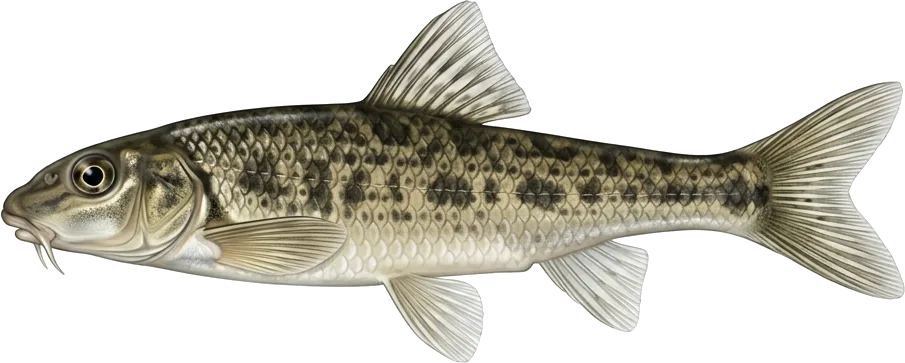
Gudgeon (Gobio gobio) is a small benthic rheophilic fish of the family Gobionidae inhabiting shallow gravel riffles and clear streams across Eurasia. The species is distinguished by two sensory mouth barbels, biserial pharyngeal teeth, a cylindrical streamlined body, and length up to 20 cm at 150 g. Caught on sensitive light float tackle using small redworms and bloodworms.
Gudgeon are strictly benthic foragers that ignore baits suspended even 10cm above bottom. Success demands bottom-dragging shotting, size 18–22 micro-hooks, and periodic foot-shuffling to create enticing sand plumes.
- ✅ You want to catch gudgeon in rapid dozens for match points or premium livebait.
- ✅ You want to master the classic sand-stirring method in shallow running water.
- ✅ You need the exact float rig calibration for seamless bottom-dragging trotting.
- ✅ You want to reliably distinguish common gudgeon from whitefin gudgeon and stone loach.
- ✅ You want to master gudgeon behavior and livebait gathering in 'Volga 2026'.
Ichthyology & Adaptations: Biological Profile of Gobio gobio
The gudgeon (*Gobio gobio*) is a specialized rheophilic bottom dweller in the family Gobionidae, engineered for life on turbulent sand-gravel riffles:
A pair of tactile barbels in the mouth corners is densely covered in chemoreceptive taste buds. Gudgeon probe sediment, instantly locating burrowed midge larvae even in total darkness.
A flat ventral profile and horizontally splayed pectoral fins act like downforce hydrofoils. Strong river currents push the fish downward against the sand rather than washing it downstream.
Any substrate disturbance caused by feeding bream or wading anglers triggers an immediate foraging rush from up to 20–30m downstream to exploit exposed benthic prey.
A yellowish-green dorsal flank patterned with 6–12 dark lateral blotches renders the gudgeon virtually invisible against gravel and sand from predatory birds and pike above.
Common Gudgeon vs Whitefin Gudgeon vs Stone Loach
Three similar barbel-bearing bottom-dwelling species co-occur across Volga sandbars and gravel reaches:
- Barbels: exactly 1 pair of short barbels (do not reach posterior eye margin).
- Fins: dorsal and caudal fins distinctly marked with dark rows of speckles.
- Scales: large and firm, 40–45 along the complete lateral line.
- Body: cylindrical, yellowish-green sheen with 6–12 dark flank blotches.
- Habitat: small to medium rivers, clean gravel and sandbars with flowing current.
- Barbels: markedly longer (reaching or extending beyond posterior edge of eye).
- Fins: dorsal and caudal fins completely clear and unspotted (translucent white).
- Color: distinctly paler and more silvery, slightly more deep-bodied.
- Scales: 40–44 in lateral line; dorsal scales often exhibit slight longitudinal keels.
- Habitat: deeper sandy runs and mainstem river channels (Volga, Oka, Kama).
- Barbels: SIX barbels around mouth (4 on snout tip, 2 at mouth corners).
- Family: Nemacheilidae (loach family, not a cyprinid/gobionid).
- Scales: microscopic, embedded in skin; body feels smooth and slimy.
- Caudal fin: square or gently rounded (unlike gudgeon's forked tail).
- Color: mottled marble camouflage adapted for stones and coarse gravel.
Biomechanics of the Rapid Benthic Take
Detecting bait with its barbels, gudgeon protrudes its inferior mouth, engulfs the larva or worm fragment, and hugs the bottom. On a float rig, this registers as an abrupt dive followed by a rapid sideways or upstream dart.
If the hookbait hovers even 5cm above the riverbed, gudgeon ignores it 95% of the time. The golden rule: the dropper shot (#10 lead shot) and hook must drag across the sand ('in trotting drag'), kicking up tiny sediment puffs.
Strike instantly but delicately from the wrist. The tough cartilaginous mouth ensures a solid hook-up in the lower lip.
Seasonal Habitats & Stream Staging for Gudgeon
Despite its diminutive size, gudgeon performs well-defined seasonal migrations between shallow summer riffles and deep winter sanctuaries:
Early Spring (April – May): As water warms to +10...+14°C, packs move onto shallow gravel bars (0.2–0.6m) for batch spawning in moving current. Foraging is intense and eager on any drifting larvae.
Summer (June – August): Peak season. Shoals graze at 0.3–1.2m depths over clean sand. Under midday sun, they congregate on swift shallows where oxygen levels peak. Wading and sand-stirring produces takes every drift.
Autumn (September – November): With water falling below +8°C, gudgeon vacate riffles, staging in deep sand holes (1.5–3.5m) beneath cut-banks. Feeding centers on warm midday hours.
Winter (December – March): Overwinters in deep running pools (2.5–5.0m) where flowing water prevents hypoxia. Caught through the ice on micro-jigs tipped with stationary bloodworm directly on bottom.
Baits, Attractors & Sand-Plume Tactics
1. Natural Animal Baits (Prime Choice)
Tiny fragment of redworm (3–5mm match-head size); 1–2 small bloodworms hooked through head or threaded; single pinkie maggot. Tough worm pieces withstand 10–15 fast takes.
2. Plant Offerings
Tiny bread pellet or stiff semolina dough. Infrequent, but small bread balls produce takes during peak July heat if live bait is depleted.
3. Natural Attractors
Gudgeon ignore artificial sweet liquids and fear strong chemical dips. The ultimate attractants are natural river sand minerals, crushed bloodworm juice, and chopped worm oils.
4. Sand Groundbaiting Dynamics
Toss balls of local river sand and clay mixed with joker bloodworms, or agitate the substrate with a wading pole every 5–10 minutes. Turbid sand plumes attract fish faster than cereals.
Tackle & Precision Rigs for Gudgeon
Targeting gudgeon is the purest expression of lightweight river trotting:
Lightweight Trotting Whip
3.5–4.5m whip with sensitive flick tip. Mainline 0.10–0.12mm, hooklength 0.08–0.09mm (15cm). 0.5–1.2g float with short antenna. Shotting: olivette with #10 dropper resting on sand.
Micro-Picker for Sandbars
2.4–2.7m rod with ultra-soft 0.5 oz tip. 5–10g spoon sinker, 30cm hooklength (0.09mm) with hook #18. Designed for fast-flowing distant sandbars.
Winter Ice Float & Micro-Jig Rig
Winter ice rod with 0.08mm mono, 1.5mm lead micro-jig tipped with single bloodworm resting on the gravel bed.
Debunking Common Gudgeon Myths
Fact: Gudgeon are strict bioindicators of high dissolved oxygen (above 6–7 mg/L) and pristine water quality. They vanish quickly from polluted or heavily silted waters.
Fact: Gudgeon are strictly benthic foragers. With an inferior mouth, they feed exclusively directly on the riverbed among sand and gravel.
Fact: Wading steps generate an enticing sediment plume that pulls gudgeon from all around straight to your boots to feed.
Scientific Research on Gobio gobio
'The gudgeon inhabits almost all rivers and streams... Its favorite haunts are sandbanks, riffles, and sandy bottoms with fast currents... Angling for gudgeon is remarkably fun and prolific; the best method is stirring the water by wading above the swims and shuffling the sand with your boots.'
'Morpho-ecological research on rheophilic Gobio gobio in the Volga basin underscores the species’ acute sensitivity to oxygen levels (optimal above 7–8 mg/L O₂) and its strict nursery fidelity to shallow sandy reaches rich in chironomid fauna.'
'Gobio gobio: trophic level 3.0 (benthivore). Preys on Chironomidae, Ephemeroptera larvae, and micro-crustaceans. Forms a primary forage base for river predators and a bioindicator of pristine lotic ecosystems.'
4 Practical Tactical Strategies for Gudgeon
Stand upstream on the riffle and periodically shuffle the sand with your boots. Trot your float 3–5m straight down the resulting plume.
Calibrate your rig so the anchor dropper and hook drag across sand at stream speed. Gudgeon intercept the moving bait instantly.
Cut a tiny 3–5mm worm section and thread it onto hook #20. Resilient on the hook, one piece endures 10–15 fast bites.
Rest a micro-jig with single bloodworm dead on the gravel bed of a 3–4m winter pool, adding subtle occasional twitches.
Seasonal Matrix: Depths, Optimal Times, Baits & Rigs
| Season | Peak Feeding Time | Depth Zone | Top Baits | Tackle System |
|---|---|---|---|---|
| Spring (May) | 09:00 – 17:00 (All day) | 0.2 – 0.8 m (Sand shallows) | Bloodworm, worm piece | 4m Whip, bottom-dragging |
| Summer (June – August) | 08:00 – 19:00 (Sunny daytime) | 0.3 – 1.2 m (Riffles, sandbars) | Worm piece, bloodworm, pinkie | Light whip 4m, sand-stirring |
| Autumn (Sept – Oct) | 10:30 – 15:30 (Midday warmth) | 1.5 – 3.5 m (Sand deeps) | Single bloodworm, worm | Whip or micro-picker |
| Winter (Ice Fishing) | 09:30 – 14:30 (Thaws) | 2.5 – 5.0 m (Flowing pools) | Bloodworm on micro-jig | Winter bottom-jig rig |
Angling Diagnostic: Identify What's Impeding Your Gudgeon Catch
Select the symptoms you are experiencing for instant technical adjustments:
Gudgeon in 'Volga 2026' Simulator
In 'Volga 2026', gudgeon is simulated with authentic benthic stream behavior. Weight range spans 0.02 to 0.18 kg. Inhabiting sandbars, it serves as the ultimate livebait for trophy zander and burbot.
Key in-game locations: 'Sand Spit', 'Rocky Riffle', 'Old Quay', 'Island Reach'.
Gudgeon is featured in livebait gathering questlines ('Baitfish Patrol', 'Riffle Secrets', 'Trotting School'), unlocking specialized livebait terminal tackle.
Frequently Asked Questions About Gudgeon
How do you tell common gudgeon apart from whitefin gudgeon?
Common gudgeon (Gobio gobio) has distinct rows of dark spots on its dorsal and caudal fins and short barbels. Whitefin gudgeon (Romanogobio albipinnatus) features completely transparent, spotless fins and longer barbels extending past the eye.
What is the essence of sand-stirring gudgeon angling?
The angler wades into the stream and stirs the sand with boots or a stick. The current carries a silt plume laden with dislodged larvae, drawing gudgeon from downstream right to the hook.
What is the best hookbait for gudgeon?
The top bait is a tiny 3–5mm piece of redworm or 1–2 small bloodworms on hook #20. Worm pieces are resilient, enduring dozens of aggressive takes.
Why is gudgeon considered the premier livebait for zander and burbot?
Gudgeon are natural bottom dwellers. Hooked through the lip on a ledger rig, they pin themselves to the riverbed while fluttering their fins, broadcasting enticing vibrations straight to predators.
Where does gudgeon hold under winter ice?
In winter, gudgeon vacate freezing shallows, staging in 2.5–5.0m flowing gravel-sand pools with moving oxygenated current.
Authoritative Ichthyological Sources & Literature: FishBase — Gobio gobio (Linnaeus, 1758) Species Summary · IUCN Red List of Threatened Species — Gobio gobio · Л. П. Сабанеев — «Жизнь и ловля пресноводных рыб: Пескарь» (Викитека) · Институт биологии внутренних вод им. И. Д. Папанина РАН (ИБВВ РАН)
Prepared by the Volga 2026 Editorial Board in strict adherence to aquatic biology and sport angling standards. Volga 2026 Editorial Methodology.