Ichthyology & Angling Practice · Volga 2026 Encyclopedia
Common Roach
Rutilus rutilus (Linnaeus, 1758)
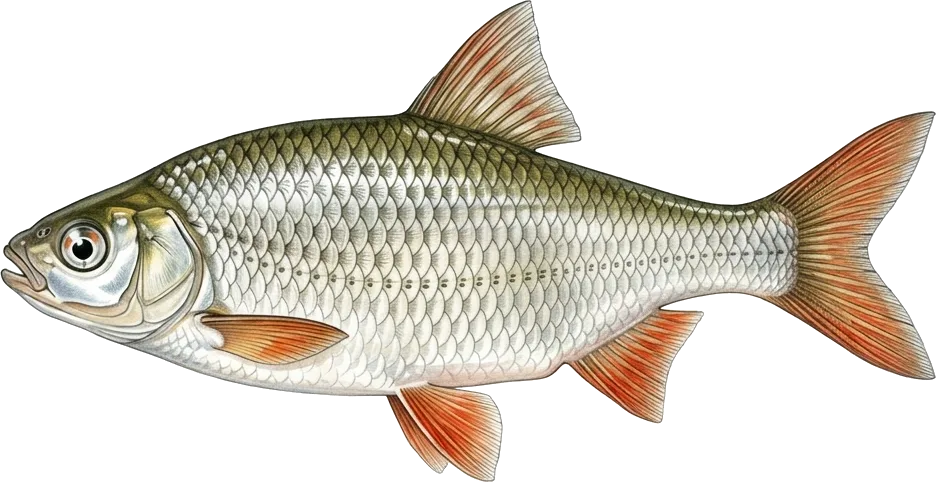
Common Roach Common roach (Rutilus rutilus) is a schooling freshwater and brackish fish of the cyprinid family (Cyprinidae) widespread across European waters. The species is distinguished by an orange-red iris, single-row 5-5 or 6-5 pharyngeal teeth, 39–48 lateral line scales, and maximum weight of 2.5 kg. Caught via light float, feeder, and winter ice jigging.
Roach is far from an 'easy beginner fish'—it is a strict diagnostic test of tackle balance. Catching specimen roach requires mastering bait fall rates, microscopic hook sizing (#16–20), and exact water-column depth targeting.
- ✅ You want to consistently target quality roach (300–800 g) while filtering out aggressive small fry.
- ✅ You are frustrated by false strikes and want to master the biomechanics of rapid suction and bait rejection.
- ✅ You need proven shotting patterns for slow-fall presentation and trotting with delicate hold-back.
- ✅ You want to master seasonal baits: stewed hemp, wheat grains, mastyrka dough, and river silk algae.
- ✅ You want to understand shoal dynamics and float hydrodynamics in the 'Volga 2026' simulator.
Ichthyology & Adaptations: Biological Profile of Rutilus rutilus
Common roach (*Rutilus rutilus*) is an eurythermal schooling cyprinid. Its immense biomass and ecological success across diverse waters rest on four fundamental physiological adaptations:
Single-row pharyngeal teeth (5-6 / 6-5 formula) crush tough shells of zebra mussels (*Dreissena polymorpha*) and aquatic snails, providing the protein density needed to fuel trophy growth up to 1.5 kg.
The orange-red iris with a prominent blood-red upper crescent shields the pupil from surface glare. Retinal cones are finely tuned to green-yellow wavelengths, highlighting micro-food suspended in murky water.
Roach shoals maintain strict vertical hierarchy. Juveniles occupy the upper water column grabbing free-falling particles, while heavy specimen fish (300g+) patrol bottom edges for dense, settled morsels.
When water temperatures exceed +18°C, intestinal enzymes adapt to digest cellulose. Shoals browse filamentous green algae (*Cladophora*) from rocks and wooden pilings, often ignoring conventional worms.
Roach vs Rudd vs Dace: Definitive Visual Identification
Anglers frequently confuse common roach with related cyprinid species. Understanding these anatomical markers ensures accurate identification:
- Mouth: terminal to sub-inferior (feeds from substrate and mid-water).
- Dorsal fin: starts directly in line above the pelvic fin bases.
- Eyes: orange-red iris with distinct red upper crest.
- Scales: bright silver, moderately loose, 40–45 along lateral line.
- Fins: dorsal and caudal greyish-red; pelvic and anal orange-red.
- Mouth: clearly superior / upturned (adapted for surface intake).
- Dorsal fin: positioned noticeably behind the pelvic fin base line.
- Eyes: golden-yellow iris without a red patch.
- Scales: golden-bronze sheen, tightly rooted with dark margins.
- Fins: vivid crimson / blood-red coloration.
- Mouth: strictly inferior / crescent-shaped for bottom grazing.
- Body: slender, torpedo-cylindrical stream profile.
- Eyes: pale yellow iris without red coloration.
- Scales: fine, tightly set with intense silvery shine.
- Fins: muted grey or pale straw-yellow without red tones.
Biomechanics of the Split-Second Strike: Why Roach Strip Hooks
Unlike crucian carp which browse slowly and lift food from the bottom, roach feed under aggressive shoal competition. The fish generates a rapid negative suction pulse lasting just 0.15–0.30 seconds, inhaling the bait with a rush of water.
Once inside the buccal cavity, the morsel is instantly vetted by sensory taste buds. If the roach detects inertia from a heavy float, stiff line (over 0.12mm), or an unnatural hook weight, it violently expels the bait in under 0.2s. On the surface, this manifests as a lightning-fast 1cm float plunge followed by an immediate bounce back.
Seasonal Habitats & Migrations: Where to Find Roach Year-Round
Roach behavior and depth distribution shift drastically depending on water temperature, dissolved oxygen levels, and forage ecology:
🌱 Spring (Pre-spawn runs): In April–May as water reaches +8–12°C, roach assemble into massive shoals moving into shallow reed bays and tributary mouths (0.8–2.0m depth). Spawning tubercles develop and fish feed voraciously on bloodworm, caddis, and maggots.
☀️ Summer (Thermocline & Algae): In warm months, specimen roach hold along deep drop-offs (3–5m) feeding actively during dawn and dusk. In high sun on river currents, shoals rise into mid-water to graze on drifting filamentous algae and seeds.
🍂 Autumn (Deep Water Concentration): September–November. As aquatic weeds die back and water clears, roach retreat to 4–7m channel ledges and shell beds. Ultra-fine hooklengths (0.08mm) and dark, low-feed groundbait with joker bloodworm are essential.
❄️ Winter (Ice Angling Dynamics): On first and last ice, roach feed aggressively in 2–4m shallows near reed margins. In midwinter oxygen lulls, they hold in 5–9m current zones with fresh oxygen flow, responding best to leadless jigs ('devil' and bead-head nymphs) worked at 3–5 Hz.
Roach Menu: Proven Baits, Grains, Attractants & Groundbait Strategy
1. Natural Animal Baits (Cold Water & Spring)
Bloodworm (1–2 small larvae hooked through the dark head collar on size 18–20 wire hooks); single pinkie maggot hooked through the skin tip; caddis larva (shitik)—unbeatable on spring river freshets.
2. Grains & Plant Pastes (Summer & Autumn)
Steamed wheat berries (simmered until the white husk splits); stewed hempseed; sweetcorn; sticky semolina dough (boltushka); river silk algae (*Cladophora*)—a tiny green tuft on fast river riffles.
3. Scent Profiles & Attractants
Coriander (the undisputed champion roach scent), roasted crushed hemp, vanilla, chocolate, caramel (warm water); aniseed, fennel, and liquid bloodworm extract (cold water).
4. Groundbait Mechanics & Cloud Effect
Roach groundbait must be ultra-fine, dark (black or chocolate), and highly active. Including coprah-melasse and toasted hemp creates a buoyant vertical column that triggers competitive feeding without saturating the fish.
Tackle & Rigs: From Match Pole to Winter Bead-Head Jigs
Tackle selection is determined by current velocity, casting distance, and season:
Float Tackle (Whip & Bolognese)
5–7m whip or 6m Bolognese rod with a sensitive flick tip. Mainline 0.10–0.12mm, hooklength 0.08–0.09mm (20–30cm length). Slim-body or pencil float (0.8–2.0g) dotted down. Multi-dropper shotting pattern with size 10 (0.04g) dropper.
Light Feeder (Picker Rig)
2.7–3.3m picker rod (up to 35–45g rating) with 0.5–0.75 oz glass quivertips. Running rig or asymmetric loop with long 70–120cm hooklengths (0.09–0.11mm). The extended length allows the bait to flutter slowly down behind an open-cage feeder.
Winter Ice Jigging (Bead-Head Nymphs)
Ultra-light balalaika ice rod with 10–14cm tapered Lavsan spring quill. Monofilament 0.07–0.09mm. Lures: brass bead-head 'gvozdesharik', triple-hook 'chertik' with white bead. High-frequency cadence (3–5 Hz) with steady lift up to 50cm.
Debunking Common Myths About Common Roach
Fact: While small juveniles bite rashly, mature roach (300g–1kg) are exceptionally wary. They immediately drop baits upon feeling tension on lines exceeding 0.10mm and ignore clumsy, over-buoyant floats.
Fact: Roach have compact digestive tracts and satiate quickly on dense starch. They require light, fizzy particles, crushed hemp, and coprah-melasse that stimulate appetite without filling their stomachs.
Fact: Static bottom baits predominantly attract ruffe. Winter specimen roach cruise 15–50cm above the mud, provoked into feeding by rhythmic high-frequency vibrations of bead-head nymphs.
Scientific Authority: Ichthyological Studies on Rutilus rutilus
'The roach without doubt forms the most numerous fish species across European waterways... It is extraordinarily sensitive to barometric shifts and strictly demands the lightest, most perfectly calibrated tackle.'
'In Volga cascade reservoirs, benthivorous cohorts of Rutilus rutilus shift heavily to Dreissena polymorpha molluscs upon reaching 15–17cm, resulting in pharyngeal tooth hypertrophy and accelerated somatic growth.'
'Rutilus rutilus: trophic level 2.8. Thermal optimum 14–22°C, pH tolerance 5.5–9.0. Exhibits remarkable adaptability in turbid waters supported by a sophisticated chemosensory network and wide-angle lateral vision.'
4 Practical Tactical Strategies for Catching Quality Roach
Space micro-droppers (#9–11) evenly along the lower mainline. The bait glides gracefully down through the water column, triggering predatory strikes during the descent.
On flowing rivers, gently check the float spool with your index finger. Current lifts the hook off the bottom like natural drifting prey, inducing an immediate take.
In July–August, gather fresh filamentous green algae from river rocks. Wrap a small tuft onto a size 14–16 hook and run it 20cm above the riverbed along weed edges.
When nuisance bleak and micro-fry swarm your swim, switch animal baits for stewed wheat or firm pearl barley. Juveniles cannot swallow grains, allowing the bait to reach specimen fish below.
Seasonal Matrix: Depths, Optimal Times, Baits & Rigs
| Season | Peak Feeding Time | Depth Zone | Top Baits | Tackle System |
|---|---|---|---|---|
| Early Spring (April) | 10:00 – 17:00 (Sunlight) | 0.8 – 1.8 m (Shallow bays) | Bloodworm, caddis, pinkie | 5–6m whip (0.10mm) |
| Summer (June – August) | 04:30 – 08:30 & Dusk | 2.5 – 5.0 m (Drop-offs & mid-water) | Wheat, pearl barley, algae, dough | 6m Bolognese, picker (90cm link) |
| Autumn (Sept – Nov) | 11:00 – 16:00 (Stable barometer) | 4.0 – 7.5 m (Channel drop-offs) | Single bloodworm, pinkie, hemp | Light feeder, match pole (0.08mm) |
| Winter (Ice Fishing) | 09:00 – 15:00 (Thaws) | 2.5 – 6.0 m (Flats & flow edges) | Bead-head nymph, bloodworm | Balalaika ice rod with 12cm quill |
Angling Diagnostic: Identify What's Impeding Your Roach Catch
Select the symptoms you are experiencing for instant expert guidance:
Common Roach in 'Volga 2026' Simulator
In 'Volga 2026', common roach is simulated with high ichthyological fidelity. Weights range from 0.05 to 1.6 kg (specimen roach). The fish responds dynamically to float drift, river currents, and proper line diameter calibration.
Key in-game locations: 'Old Quay', 'Tram Bend', 'Reed Lagoon', 'River Riffle'.
Roach is the central species in Old Stepan's introductory quests ('Trotting Basics', 'Delicate Rigging'), teaching the art of finesse angling.
Frequently Asked Questions About Common Roach
How do you distinguish large roach from rudd?
Key markers: roach has a terminal mouth, dorsal fin positioned directly over the pelvic fins, and an orange-red iris. Rudd has an upturned mouth, dorsal fin set noticeably behind the pelvic fins, golden-yellow iris, and crimson-red fins.
What is the optimal line diameter for wary roach?
For pole and Bolognese fishing, standard setup is 0.10–0.12mm mainline with 0.08–0.09mm hooklengths. For feeder fishing, use 0.14–0.16mm mono (or 0.06mm braid with feeder gum) and 0.09–0.11mm hooklengths 80–120cm in length.
Why does roach strip baits while the float barely twitches?
Roach inhales bait within split seconds and expels it instantly upon feeling float resistance. The remedy is using a needle-thin 1.0mm antenna, reducing the dropper shot to 0.04g, and hooking bloodworm strictly by the head tip.
How do you prepare sticky semolina dough (boltushka) that stays on the hook?
Cover 2 tbsp of semolina with cold water just level with the grain, rest for 20 minutes to develop gluten, then whip vigorously with a stick for 7–10 minutes until it forms a glossy, elastic paste that stretches 5–7cm. Apply to the hook tip using a syringe.
At what depths do winter roach hold on large reservoirs?
On first and last ice, target 2.0–3.5m shoreline flats adjacent to old weed beds. In midwinter (Jan–Feb), shoals shift to 4.5–7.0m drop-offs near submerged river channels with active water circulation.
Authoritative Ichthyological Sources & Literature: FishBase — Rutilus rutilus Biological Summary · ИБВВ РАН — Питание и экология бентосоядных рыб Волжского бассейна · Л. П. Сабанеев — «Жизнь и ловля пресноводных рыб»
Prepared by the Volga 2026 Editorial Board in strict adherence to aquatic biology and sport angling standards. Volga 2026 Editorial Methodology.