Pelagic Cyprinid Ichthyology & Surface Sbirulino Angling · Volga 2026 Encyclopedia
Sabrefish (Ziege)
Pelecus cultratus (Linnaeus, 1758)
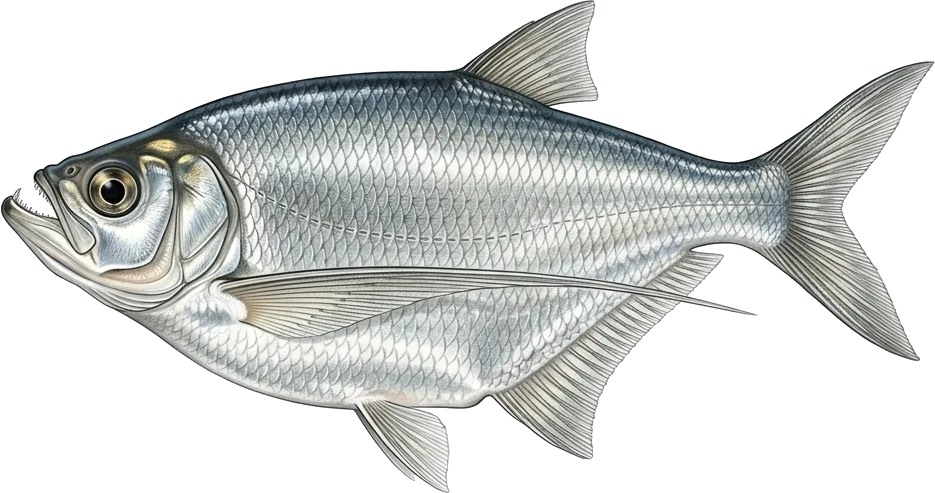
Sabrefish (Ziege) Sabrefish (Pelecus cultratus, or ziege) is an epipelagic cyprinid surface predator native to large lowland rivers, estuaries, and reservoirs of Eastern Europe. The species is recognized by a sabre-curved body, razor-sharp ventral keel, oversized wing-like pectoral fins, and weight up to 2 kg. Anglers catch sabrefish using surface sbirolino bombarda rigs, dry flies, and long-leader floating feeder rigs.
Sabrefish demands long-distance speed tackle: 3.9–4.2m rods launching 25g bombardas 70–90 meters, 1.5–2.0m fluorocarbon tippets (0.14–0.16mm), multi-colored maggot bunches, and brisk stop-and-go retrieves.
- ✅ You want to definitively distinguish sabrefish from blue bream and bleak by razor ventral keel, superior mouth, and wing fins.
- ✅ You want to master floating Sbirulino bombarda tactics at 60–100m long-range distances.
- ✅ You need proven offerings: multi-colored maggot bunches, grasshoppers, micro-spoons (Kastmaster 3.5–7g), and mini-twisters.
- ✅ You want to explore the science of wing-fin hydrodynamics, undulating lateral line sensory tracts, and explosive acceleration.
- ✅ You want to master sabrefish mechanics and surface quests in 'Volga 2026'.
Ichthyology & Hydrodynamic Adaptations: Biological Profile of Pelecus cultratus
Sabrefish (*Pelecus cultratus*) is a specialized pelagic cyprinid possessing extraordinary aerodynamic and hunting adaptations:
The dorsal profile is perfectly straight while the belly forms a deep, sharp scaleless keel. This knife-like hydrofoil geometry minimizes drag when skimming beneath the surface film.
Pectoral fins are elongated, curved, and wing-like, extending to the pelvic fin base. Acting like hydrodynamic wings, they generate instant lift for high-speed intercept charges on surface bugs.
The lateral line plunges steeply behind the head along the low ventral border in a sharp undulating wave, tuning mechanoreceptors to detect acoustic pulses rising from beneath and the flanks.
The mouth opens almost vertically upward. Pharyngeal teeth are single-rowed (2.5-5.2), compressed with sharp terminal hooks designed to instantly crush struggling minnows and beetle elytra.
Sabrefish vs Blue Bream vs Bleak: Identification Guide
Comparative anatomical guide for three surface and mid-water schooling cyprinids:
- Body: sabre-shaped, RAZOR-STRAIGHT back, arched ventral keel.
- Pectoral fins: EXTREMELY ELONGATED, wing-like blades.
- Lateral line: UNDULATING ZIGZAG slung low along belly.
- Mouth: strictly SUPERIOR, almost vertical orientation.
- Size: 30–50 cm (300–1,000g, trophies to 1.5 kg).
- Anal fin: EXTREMELY LONG (35–44 branched rays).
- Body: tall, compressed, bream-like with arched back.
- Mouth: moderately oblique, pointing slightly upward.
- Coloration: bluish-steely sheen along back, fine scales.
- Size: 20–35 cm (200–600g).
- Body: slender, slightly rounded back profile.
- Pectoral fins: standard short fins (not elongated wings).
- Lateral line: straight or gently curved (never zigzag).
- Scales: detach effortlessly at slightest touch.
- Size: small (10–18 cm, 25–70g).
Mechanics of the Surface Drop Strike & Skipping Fight
Patrolling the top 50cm water layer over brisk mainstem current, sabrefish spots the splash of the bombarda and the fluttering 2m tippet. Surging vertically, it engulfs the maggot bunch. The strike delivers an instant, whip-crack jolt that bends the long rod tip into a hard curve.
Hooked, the sabrefish immediately skips across the surface film, thrashing broadside with high-frequency fluttering dashes. A long 3.9–4.2m match rod maintains surface plane control, steering the skipping fish over submerged snags straight to the net!
Seasonal Habitats: Main Fairway Currents, Sandbars & Rapids
Sabrefish is a thermophilic rheophile thriving in heavy summer currents:
🌱 Spring (Massive Spawning Run): Massive pods ascend Volga currents at +12...+16°C. Spawns in mid-water over roaring flow (semi-buoyant pelagic eggs). Insatiable day-long feeding on Sbirulino and elastic rigs.
☀️ Summer (Peak Mainstem Action): Patrols fairway seams, sandbar tail-outs, bridge piers, and headland rips (0.2–1.5m depth). Peaks at dawn (5:00–9:30 AM) and evening twilight (6:30–9:30 PM).
🍂 Autumn (Deep Stratum Staging): Cooling waters push schools down to 4.0–9.0m benthic breaks. Targeted with heavy feeders featuring buoyant foam-lifted snells and micro-jigs.
❄️ Winter (Wintering Pits): Rests in dense dormant shoals in 10.0–18.0m deep river trenches. Sporadic takes on glow jigs with bloodworms during warm sunny midday windows.
Sabrefish Tackle: Maggot Bunches, Sbirulino Floats & Micro-Spoons
1. Top Natural Baits
Cluster of 3–5 lively white and red maggots; live grasshoppers; large blowflies; burrowing mayfly nymphs; small surface minnow threaded through lips.
2. Floating Sbirulino Bombarda
20–30g transparent floating bombarda paired with a 1.5–2.2m fluorocarbon tippet, launching weightless maggot rigs 80–100m into foaming torrents.
3. Micro-Spoons & Casting Jigs (3.5–10g)
Slim casting spoons: Acme Kastmaster 3.5–7g, Smith Pure, and fly-dressed micro-spinners Mepps Comet #00–0 retrieved with fast surface jerks.
4. Shore Elastic Shock-Cord Ledger ('Rezinka')
Classic multi-hook shock-cord rig (5–7 hooks with foam beads and maggots) retrieving smoothly into surface flow without repeated casting commotion.
Tackle: Long-Distance Sbirulino Blanks (3.9–4.2m) & Finesse Tippets
Long-range surface bombing across river torrents requires specialized high-modulus match tackle:
Sbirulino / Match Blank 3.9–4.2m (15–35g, Fast Action)
Long, springy high-modulus carbon blank with tall-frame match guides, launching 25g bombardas with 2m leaders beyond 80+ meters with effortless ease.
Thin PE #0.6–0.8 Braid + Triple Ball-Bearing Swivel
Smooth 8-carrier PE #0.6–0.8 braid for maximum casting distance, rubber shock bead, and a specialized triple barrel swivel to prevent tippet twist.
1.5–2.2m Fluorocarbon Tippet (0.14–0.16mm)
Optically clear 0.14–0.16mm fluorocarbon leader terminating in a fine-wire forged Owner Sode hook #12–14 for threading clusters of active maggots.
Debunking Common Sabrefish Myths
Fact: Sabrefish is a true cyprinid (carp relative) native to freshwater rivers and reservoirs throughout Eastern and Central Europe.
Fact: Adult sabrefish over 300g are active pelagic predators whose diet heavily features surface minnows, bleak fry, and freshwater clupeids.
Fact: Premier specimen sabrefish action erupts during dawn (5:00–8:30 AM) and glowing dusk twilight when schools herd minnows along rips.
Scientific Research on Pelecus cultratus
'The sabrefish is one of the most original and spirited fishes of our rivers... It boasts a razor-straight back, heavily keeled belly, and wing-like pectoral fins enabling it to skip over waves.'
'Pelecus cultratus exhibits unique pelagic cyprinid adaptations: semi-buoyant pelagic eggs, a ventral hydrofoil keel, and an undulating ventral lateral line tuned to surface hydrodynamic fields.'
'Pelecus cultratus: maximum recorded weight 2.0kg, length 60cm, lifespan 12 years. Single-row hooked pharyngeal teeth (2.5-5.2) are tailored for gripping surface ichthyoplankton.'
4 Tactical Surface Speed Strategies for Sabrefish
Launch a 25g floating bombarda 80m across current at 60 degrees. Allow the river to swing the rig in a wide arc across the sandbar rip.
Crank at a brisk pace with light rod-tip twitches. Pause for 2 seconds every 3–4 meters to allow the maggot bunch to flutter downward.
Thread 4 multi-colored maggots (red, white, yellow) through the very blunt tip. The wriggling cluster generates irresistible visual commotion.
Keep the rod angled high at 11 o'clock on the strike. Plane the hooked sabrefish smoothly across the surface film straight into the landing net.
Seasonal Matrix: Depths, Optimal Times, Baits & Rigs
| Season | Peak Feeding Time | Depth Zone | Top Baits | Tackle System |
|---|---|---|---|---|
| Spring (May – June) | 06:00 – 19:30 (All daylight) | 0.2 – 1.2 m (Boiling spawning flow) | Maggot bunch, mayfly larvae | 25g Sbirulino bombarda, elastic rig |
| Summer (July – August) | 05:00 – 09:30 & 18:30 – 21:30 (Dawn/Dusk) | 0.1 – 0.8 m (Sandbar surface film) | Grasshoppers, maggots + foam, spoon | 4.2m Match rod with floating bombarda |
| Autumn (Sept – Oct) | 10:00 – 16:30 (Warm midday) | 3.5 – 8.0 m (Channel bottom breaks) | Maggots, bloodworms, 7g Kastmaster | Feeder with buoyant snell, casting jig |
| Winter (Ice Season) | 11:00 – 14:30 (Sporadic sunny takes) | 10.0 – 18.0 m (Deep river holes) | Glow jigs with bloodworms | Flow ice rod with stiff indicator |
Angling Diagnostic: Identify What's Impeding Your Sabrefish Catch
Select the symptoms you are experiencing for instant technical adjustments:
Sabrefish in 'Volga 2026' Simulator
In 'Volga 2026', sabrefish is simulated with high-speed surface Sbirulino kinetics, explosive whitewater skipping physics, and competitive schooling feeding bursts. Weight spectrum spans 150 to 1,200 g. Inhabits fairway rapids, sandbar rips, and wide river glides.
Key in-game locations: 'Volga Expanses', 'Stony Headland', 'Sandbar Spit', 'Island Reach'.
Sabrefish crowns the surface tournament questline ('River Sabre of the Volga', '90-Meter Sbirulino Mystery', 'Sabrefish Express'), unlocking Italian bombardas and 4.2m match rods.
Frequently Asked Questions About Sabrefish
Why is sabrefish called the 'sabre fish' in Russian tradition?
Sabrefish features an impeccably straight dorsal line, sharply curved ventral keel, and compressed elongated body that astonishingly resembles a curved oriental sabre.
What is a Sbirulino bombarda and why is it premier for sabrefish?
A bombarda is a heavy, aerodynamic casting float (15–30g) allowing weightless maggot hooks to be launched 80–100m into foaming fairway torrents where sabrefish schools feed.
How do you distinguish sabrefish from blue bream?
Key differences: 1) Profile: sabrefish has a straight back and keeled belly; blue bream is deep-bodied with an arched back; 2) Fins: sabrefish has wing-like pectoral fins; blue bream has an immense anal fin (up to 44 rays).
What is the single most effective bait for sabrefish?
A bunch of 3–4 multi-colored maggots (red, white, yellow) tipped with a buoyant 2mm foam bead, live grasshoppers, or tiny surface minnows.
What is the biological function of the undulating lateral line?
The lateral line is slung low along the ventral keel, allowing fish cruising at the water surface to detect acoustic vibrations from minnows and predators below and to the flanks.
Authoritative Ichthyological Sources & Literature: FishBase — Pelecus cultratus Biological Summary · IUCN Red List of Threatened Species — Pelecus cultratus · Л. П. Сабанеев — «Жизнь и ловля пресноводных рыб: Чехонь» (Викитека) · Институт биологии внутренних вод им. И. Д. Папанина РАН (ИБВВ РАН)
Prepared by the Volga 2026 Editorial Board in strict adherence to aquatic biology and sport angling standards. Volga 2026 Editorial Methodology.