Ichthyology & Extreme Long-Range Predator Angling · Volga 2026 Encyclopedia
Asp
Aspius aspius (Linnaeus, 1758)
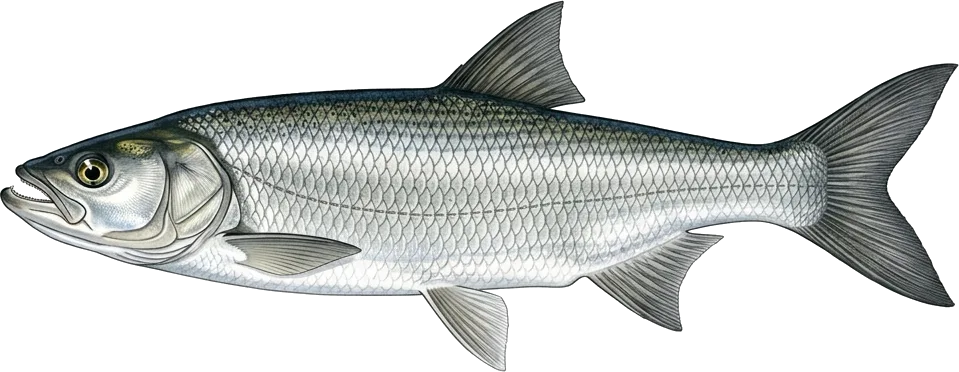
Asp (Aspius aspius) is a pelagic open-water predator of the cyprinid family (Cyprinidae) native to major river systems of Central and Eastern Europe. The species is recognized by an upturned lower jaw with an interlocking tubercle, predatory hooked pharyngeal teeth, and weight up to 10 kg. Anglers target schooling asp with heavy casting spoons, surface poppers, and compact metal jigs.
Asp is an ultra-wary hunter with razor-sharp optics. Success demands 2.7–3.0m long-cast blanks, dense compact pilkers (18–28g), streamer teaser tandems, and lightning-fast surface retrieves.
- ✅ You want to definitively distinguish asp from chub and sabrefish by jaw lock anatomy and fin structure.
- ✅ You want to master extreme 80–100m long-range casting with compact metals (Kastmaster, pilkers, stickbaits).
- ✅ You need proven surface blitz tactics pairing heavy irons with white goat-hair streamer teasers.
- ✅ You want to explore the science of toothless jaw locks, hooked pharyngeal teeth, and acoustic tail-stun shockwaves.
- ✅ You want to master asp blitz mechanics and current runs in 'Volga 2026'.
Ichthyology & Adaptations: Biological Profile of Aspius aspius
European asp (*Aspius aspius*) is the sole obligate pelagic predator among European cyprinids, engineered with distinctive adaptations:
Jaws completely lack oral teeth. The tip of the protruding lower jaw bears a hardened bony tubercle that fits into a matching notch on the upper jaw, clamping seized prey like a vice.
Slicing through bleak schools at 45 km/h, asp banks hard and delivers a thunderous tail slap on the surface. The hydrodynamic shockwave stuns dozens of baitfish, which the corsair vacuums up on the turn.
Asp possesses razor-sharp daytime vision, spotting bank anglers or drifting boats from 60–80 meters away. Approaching closer than 50 meters instantly shuts down the surface feeding frenzy.
Deep in the throat sit curved raptor-like pharyngeal teeth (3.5-5.3) with hooked crowns. They seize swallowed baitfish instantly, forcing them directly into the stomach tract.
Asp vs European Chub vs Sabrefish: River Comparison Guide
Comparative anatomical guide for three fast-water surface species:
- Jaws: TOOTHLESS, with a heavy bony lock tubercle on lower jaw.
- Body: sleek, torpedo-shaped, bright silver with dark navy back.
- Anal fin: broad, CONCAVE (sickle-shaped).
- Hunting: thunderous surface tail slaps ('feeding blitz').
- Size: reaches 5–9+ kg.
- Head: broad, massive, flattened forehead ('broadhead').
- Anal fin: CONVEX, rounded, vivid crimson red.
- Scales: large, dark-bordered with a checkerboard net pattern.
- Diet: beetles, grasshoppers, fry, cherries, cheese.
- Size: 0.5–3.5 kg.
- Body: straight, razor-flat like a sabre blade with a sharp belly keel.
- Pectoral fins: ENORMOUS, wing-like, extending past pelvic fins.
- Lateral line: wavy, zigzagging downward.
- Mouth: strictly superior, pointing upward.
- Size: 0.2–1.2 kg.
Biomechanics of the High-Speed Surface Strike
Asp attacks lures at full speed, intercepting or overtaking from behind. Reel retrieve speeds on Kastmasters reach maximum cadence. Catching the iron, the asp strikes through momentum, snapping its bony jaw lock shut.
The head-on collision strike surpasses all other freshwater species in raw shock. Termed the 'rod-wrencher'—a locked drag guarantees instant line snap or blank fracture. The drag must be set to yield line smoothly during the opening explosive run!
Seasonal Habitats: Rapids, Gravel Spits & Surface Blitzes
Asp holds strictly on open currents, shifting depth layers across the calendar:
🌱 Spring (Post-Spawn Current Breaks): Spawns at +9–12°C over stony rapids. Post-spawn fish hold deep (3.0–6.0m) off headlands and dam tailraces, taking heavy jigs and hopped pilkers.
☀️ Summer (Peak Feeding Blitzes): Shoals form explosive surface blitzes around open channels, sandbars, and bridge pylons. Peak action: dawn (5:00–8:30 AM) and sunset (7:30–9:30 PM) on surface metals and stickbaits.
🍂 Autumn (Deep Staging): Surface blitzes cease; shoals descend to 4.5–9.0m channel breaks to ambush migrating kilka. Heavy 28–35g pilkers and jigged swimbaits rule.
❄️ Winter (Open Water Tailraces): Stages in 6.0–12.0m deep river holes with gentle flow. Targeted in ice-free tailraces using deep jigging and heavy bottom metals.
Asp Baits: Kastmasters, Heavy Pilkers, Stickbaits & Streamers
1. Surface Livebaits
Live surface bleak (lip-hooked on single hooks drifted beneath Sbirulino floats); Volga kilka; gudgeon.
2. Heavy Casting Irons & Spoons
Acme Kastmaster (14–28g, silver/blue or holographic); Halco Twisty (20–30g); classic Trofimov pilkers; Sabunaev three-sided irons.
3. Topwater Walkers & Stickbaits
Lip-less stickbaits (ZipBaits ZBL Fakie Dog, Megabass Dog-X, Smith Towadi, Lucky Craft Sammy 85) on 'walk-the-dog' retrieves across current.
4. White Goat-Hair Streamer Teasers
White goat-hair streamers tied with silver flashabou on #2–4 hooks. Featherweight teasers that flawlessly mimic stunned bleak.
Tackle: Long-Range 2.7–3.0m Blanks & High-Speed Reels
Asp tackle must deliver record-breaking 80–100m casting distance and high-gear retrieval:
Long-Range Shore Blank 2.7–3.0m (10–35g)
Regular-Fast high-modulus carbon blank. Fully loads through the entire mid-section on the cast, catapulting compact metals over the horizon.
High-Gear 4000 Reel (6.0–6.2:1 Ratio)
Recovers 95–105cm of line per crank. Long-cast spool with flawless cross-wrap. Ultra-slick 8-carrier braid PE #0.8–1.0.
Fluorocarbon Leader (0.28–0.35mm / 1.0m)
100% invisible fluorocarbon is mandatory. Asp's sharp eyesight easily spots opaque braid; an invisible trace increases strike frequency 3- to 4-fold.
Debunking Common Asp Myths
Fact: Asp tail-slaps to disorient dozens of schooling prey at once. While jaw teeth are absent, it possesses formidable pharyngeal raptor hooks (3.5-5.3).
Fact: Asp is hyper-wary. Motoring within 60 meters instantly spooks the pack, sending the fish diving into deep water.
Fact: In autumn and spring, specimen asp are caught in 4–8m depths on heavy jigs and hopped pilkers in water as cold as +5–8°C.
Scientific Research on Aspius aspius
'The asp is a surface fish—powerful, swift, and extraordinarily predatory... Plunging into bleak schools with deafening splashes, it strikes water with its broad tail to gather stunned victims.'
'Aspius aspius represents a rare evolutionary transition within Cyprinidae to obligate pelagic piscivory. Body hydrodynamics and pharyngeal anatomy are optimized for high-speed current hunting.'
'Aspius aspius: maximum recorded weight over 12kg, length 120cm. Double-row dental formula 3.5-5.3 with sickle hooks. Serves as an indicator of river current velocity and oxygenation.'
4 Tactical Long-Range Strategies for Asp
Employ a 2.7–3.0m rod with ultra-slick PE #0.8 braid. Cast 10–15m beyond the feeding blitz to avoid spooking fish with splashdown.
Begin reeling the millisecond the iron hits water. Crank at maximum cadence so the lure skips across the surface film leaving a wake.
Mount a goat-hair streamer 30cm ahead of the casting spoon. Asp attacks the fluttering weightless teaser ahead of the chase.
Drift a 65–80mm floating minnow 50–70 meters downstream under overhanging trees, then initiate an aggressive twitching retrieve against current.
Seasonal Matrix: Depths, Optimal Times, Baits & Rigs
| Season | Peak Feeding Time | Depth Zone | Top Baits | Tackle System |
|---|---|---|---|---|
| Spring (April – May) | 08:00 – 11:30 & 15:00 – 18:00 | 2.5 – 5.5 m (Current breaks, dams) | 24–30g Pilkers, deep jigs, cranks | 2.7m rod 10–35g, PE #1.0 braid |
| Summer (June – August) | 05:00 – 08:30 & 19:30 – 21:30 (Blitzes) | 0.1 – 1.5 m (Surface blitz film) | Kastmasters, streamers, stickbaits | 2.7–3.0m Long-cast, High-Gear reel |
| Autumn (Sept – Nov) | 10:00 – 16:30 (Midday hours) | 4.0 – 9.0 m (Channel drop-offs) | 28–35g Pilkers, 4" paddle tails | Jig rod 2.6–2.7m 15–45g |
| Winter (Open Tailraces) | 11:00 – 15:00 (Thaws) | 6.0 – 12.0 m (Deep current holes) | Heavy bottom jigs, narrow metals | Heavy blank with oversized rings |
Angling Diagnostic: Identify What's Impeding Your Asp Success
Select the symptoms you are experiencing for instant technical adjustments:
Asp in 'Volga 2026' Simulator
In 'Volga 2026', European asp is simulated with dynamic surface blitzes, high casting distance thresholds, and violent speed-retrieve strikes. Weight range spans 0.5 to 7.5 kg (trophies reaching 10+ kg). Inhabits open tailraces and rapid currents.
Key in-game locations: 'Deep Fairway', 'Island Reach', 'Old Dam', 'Volga Expanses'.
Asp is featured in tournament quests ('Silver Corsair', 'Surface Blitz Master', 'Long-Cast Champion'), unlocking Japanese pilkers and 3.0m tournament casting rods.
Frequently Asked Questions About Asp
Why is asp called the 'river corsair' and how does its jaw lock work?
Asp is our sole obligate predatory cyprinid. Its jaws lack teeth, but a hardened bony knob on the lower jaw locks into a notch on the upper jaw like a vice, clamping high-speed catches immovable.
Why does the asp slap its tail on the water surface?
Slicing through bleak schools at up to 45 km/h, asp delivers a thunderous tail slap. The resulting acoustic shockwave stuns dozens of baitfish, which the predator circles back to vacuum up.
What is the single best lure for targeting asp feeding blitzes?
A classic silver Acme Kastmaster (14–28g) rigged in tandem with a white goat-hair streamer mounted 30cm ahead of the iron.
How do you cast properly into an active asp feeding frenzy?
Never cast into the epicenter (the splashdown spooks the pack). Overcast by 10–15 meters and burn the lure across the outer perimeter.
How do you tell asp apart from European chub?
Key differences: 1) Anal fin: concave sickle-shaped grey on asp; convex rounded vivid crimson on chub; 2) Mouth: lower jaw protrudes with a lock knob on asp; head is broad and blunt on chub.
Authoritative Ichthyological Sources & Literature: FishBase — Leuciscus aspius (Aspius aspius) Biological Summary · IUCN Red List of Threatened Species — Leuciscus aspius · Л. П. Сабанеев — «Жизнь и ловля пресноводных рыб: Шереспер,_или_жерех» (Викитека) · Институт биологии внутренних вод им. И. Д. Папанина РАН (ИБВВ РАН)
Prepared by the Volga 2026 Editorial Board in strict adherence to aquatic biology and sport angling standards. Volga 2026 Editorial Methodology.