Ichthyology & Classic River Angling · Volga 2026 Encyclopedia
Ide (Orfe)
Leuciscus idus (Linnaeus, 1758)
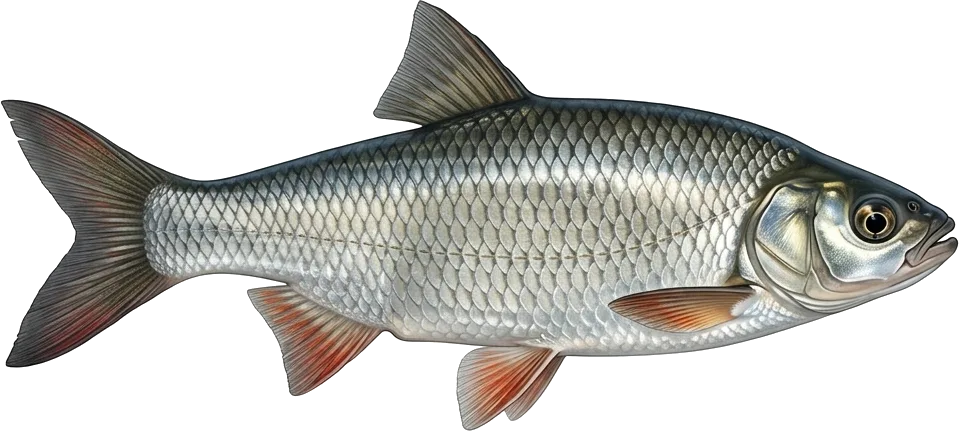
Ide (Orfe) Ide (Leuciscus idus, or orfe) is a large semi-predatory cyprinid fish in the family Leuciscidae dwelling in deep river pools, channels, and lakes of Eurasia. The species features a golden-brass sheen, fine scales (55–61 lateral line count), crimson lower fins, and weight up to 5 kg. Anglers catch ide with small crankbaits, spinners, and steamed peas on feeder tackle.
Ide is a selective powerhouse. Specimen fish demand strict selective tactics: steamed whole green peas or sweetcorn on feeder tackle weed out nuisance fish, high-frequency fat crankbaits trigger predatory reaction strikes, and feeder gum shock absorbers tame the opening surge.
- ✅ You want to master the legendary Volga method of catching specimen ide on steamed green peas via float trotting and feeder.
- ✅ You want to catch trophy ide on spinning tackle: night gravel runs, crankbaits, micro-spoons, and inline spinners.
- ✅ You want to distinguish young ide from chub and asp with 100% certainty via scale count (55–61) and mouth anatomy.
- ✅ You need tactical guidelines for night feeder sessions targeting ide on mussel beds and channel drop-offs.
- ✅ You want to master ide behavioral mechanics and fight dynamics in 'Volga 2026'.
Ichthyology & Adaptations: Biological Profile of Leuciscus idus
The ide (*Leuciscus idus*) is a versatile semi-predatory cyprinid in the family Leuciscidae, combining benthic foraging prowess with open-water hunting:
Biserial pharyngeal teeth (3.5–5.3) possess widened molariform grinding surfaces. This enables adult ide to crush thick zebra mussel shells (Dreissena polymorpha), which form a core nutrient staple.
Ide scales are noticeably finer than those of chub or roach: 55–61 along the lateral line (vs 44–46 in chub). This fine lattice reduces drag in turbulent boils and prevents injuries in snaggy cover.
Upon crossing the 1kg mark, ide undergoes an ontogenetic dietary pivot. It transforms into an active twilight hunter, chasing bleak, roach fry, froglets, and leeches across fast river riffles.
Ide spawns earlier than most cyprinids — immediately following ice-out in April at water temperatures of just +4...+8°C. Shoals surge into tributaries, conquering fierce spring floodwaters.
Ide vs European Chub vs Asp: Comprehensive Identification Keys
Morphological key for distinguishing three large river cyprinids:
- Scales: FINE, 55–61 in lateral line, golden-brass sheen on flanks.
- Mouth: oblique, directed upward (terminal, moderate size).
- Eyes: iris is GREENISH-YELLOW or golden with a dark focal dot.
- Fins: dorsal and caudal greyish; pelvic and anal fins are CRIMSON-RED.
- Body: deep-bodied, arched back, thick and muscular caudal peduncle.
- Scales: LARGE, 44–46 in lateral line, framed with black edges (netted pattern).
- Head: broad, flattened ('chubby forehead'); mouth is ENORMOUS with thick lips.
- Anal fin: distinctly CONVEX (rounded outward), vibrant scarlet red.
- Body: cylindrical, torpedo-like with dark olive-green dorsal line.
- Habitat: shallow gravel riffles, torrential chutes, undercut banks.
- Scales: VERY FINE, 65–75 in lateral line, brilliant silvery-steel coloration.
- Mouth: massive upturned predatory jaw with prominent mandibular chin peg fitting into notch.
- Body: elongated, powerfully built with steel-blue back.
- Fins: deeply forked grey-blue tail with dark margins.
- Hunting: explosive surface tail-slapping strikes crashing through bleak schools.
Biomechanics of Current Takes & Strike Dynamics
Unlike bream’s tentative nibbles, ide takes bait in river currents with explosive velocity. Clamping the pea or crankbait in its jaws, it powers downstream. On feeder tackle, this registers as a violent wrap-around rod bend threatening to drag gear into the water.
The initial 30–60 seconds of combat are make-or-break. Ide charges into the current or nearest snags, head-shaking violently and rolling on the line. Without an elastic buffer (feeder gum or parabolic blank), light traces snap instantly.
In float trotting, an ide take is an immediate, decisive plunge of the float without preamble. The strike must be smooth yet immediate to set the hook firmly.
Seasonal Habitats & Migrations for Specimen Ide
Ide seasonal rhythm begins exceptionally early with pronounced foraging migrations:
Early Spring (April): Immediately after ice-out (+4...+8°C), ide runs up tributaries to spawn. Post-spawn foraging kicks off in late April across tributary mouths, eagerly engulfing nightcrawlers and bloodworms.
Summer (May – August): Ide settles in deep channel runs, eddies beneath clay bluffs, and mussel beds (2.5–5.0m). At dusk and throughout the night, it charges shallow rocky riffles to hunt fry.
Autumn (September – November): Cooling waters clear up. Ide packs tightly onto deep channel shelves (4–7m) blanketed in mussels. Midday feeder sessions with peas or maggots produce the season's heaviest fish.
Winter (December – March): Holds in flowing wintering holes (3.5–8.0m) with gentle currents. Active during thaws, taking heavy lead ice jigs ('uralochka', devil jigs) tipped with bloodworms.
Ide Nutrition: Steamed Peas, Sweetcorn, Leeches & Lures
1. Animal Baits (Spring & Autumn)
Bunch of redworms or large nightcrawler; cockchafer grub; black river leech; cluster of 5–7 maggots. Leeches and lobworms represent lethal nocturnal ide baits.
2. Plant Offerings (Volga Summer Legend)
Steamed whole green field peas — the undisputed king of Volga baits; sweet canned corn; steamed wheat and pearl barley. Peas must be tender inside while keeping skin intact.
3. Flavor Profile & Attractors
Ide favors earthy, natural fragrances: unrefined roasted sunflower oil, aniseed, coriander, garlic (in cold water), and pure molasses.
4. Pea Groundbait Strategy
The foundation of specimen ide baiting is boiled pea mash blended with breadcrumbs, corn meal, and heavy helpings of whole steamed peas (up to 30–40% of total mix).
Tackle Systems: River Feeder, Bolognese Trotting & Ultralight Lures
Ide’s powerful build and fast-water habitat demand robust yet deceptive rigs:
Heavy River Bolognese for Pea Trotting
6.0–7.0m progressive Bolognese rod. Mainline 0.16–0.18mm, hooklength 0.12–0.14mm (40–60cm), forged round-bend hook #8–10 tailored for peas. 4.0–8.0g teardrop river float.
Heavy River Feeder with Feeder Gum
3.6–3.9m feeder rated up to 90–120g. Braid #0.8–1.0 PE with 0.26mm mono shockleader, 60–90g cage feeder, 12cm feeder gum buffer (0.7mm), 60–90cm trace (0.14–0.16mm), hook #10–12.
Ultralight Riffle Spinning (Cranks & Spinners)
2.1–2.4m moderate-fast spinning rod (2–10g rating). Lures: 35–45mm fat crankbaits, #1–2 inline spinners with wide blades, and 2.5–4.5g gold/copper micro-spoons.
Debunking Common Ide Myths
Fact: Specimen ide exceeding 1kg is a dedicated predator! It regularly ambushes fry, froglets, and attacks crankbaits and spinners with ferocity matching chub or zander.
Fact: Ide features much finer scales (55–61 vs 44–46), a deeper body, smaller oblique mouth, and concave crimson anal fin (vs chub's convex bright scarlet fin).
Fact: Shoreline Bolognese float trotting and modern river feeder tactics with pea groundbait produce spectacular catches of trophy ide right from the riverbanks.
Scientific Research on Leuciscus idus
'The ide is one of the most famous and abundant fishes... It is remarkably beautiful, especially in spring: golden scale reflections, fiery-red lower fins lend it vibrant splendor... Ide is exceptionally wary, cautious, and intelligent; since time immemorial, steamed field peas have served as the supreme bait for specimen ide.'
'Trophic ecology of Leuciscus idus across Volga reservoirs displays a distinct ontogenetic shift: juveniles (<400g) forage on zoobenthos and filamentous algae, whereas mature individuals (>1.0–1.5kg) transition into active predation, consuming forage fishes (bleak, roach) and large bivalve molluscs (Dreissena polymorpha).'
'Leuciscus idus: maximum recorded length 102 cm, weight up to 8.0 kg. Biserial pharyngeal teeth 3.5–5.3 with broadened chewing crowns. Early spring spawning occurs at +4...+8°C immediately following ice break-up. Highly adaptable eurybiont exploiting both riffles and abyssal channel breaks.'
4 Specimen Tactical Strategies for Ide
Bait the bluff run with clay balls packed with steamed peas. Trot your float down current with a single soft, uncracked pea on hook #8.
Locate a 3.5–5m shell-bed trough. Feed with crushed leeches and sweetcorn. Specimen ide runs peak between midnight and 03:30.
At sunset, position above a rocky riffle. Float a 38–42mm crank downstream, retrieving on a slow, sweeping cross-current swing.
On 4–6m flowing winter glides, deploy a large tungsten devil-jig with a white bead, fishing a wide, rhythmic cadence to tempt specimen ide.
Seasonal Matrix: Depths, Optimal Times, Baits & Rigs
| Season | Peak Feeding Time | Depth Zone | Top Baits | Tackle System |
|---|---|---|---|---|
| Spring (April – May) | 08:00 – 18:00 (All day) | 1.5 – 3.0 m (Tributary mouths) | Nightcrawler, worm, bloodworm | Feeder, heavy Bolognese |
| Summer (June – August) | 21:00 – 05:00 (Night & dusk) | 0.8 – 2.5 m (Riffles night), 3.5 – 5.0 m (Day) | Steamed peas, corn, crankbaits | Pea trotting, spinning, feeder |
| Autumn (Sept – Oct) | 11:00 – 16:30 (Midday warmth) | 3.5 – 7.0 m (Channel shelves) | Peas, maggot cluster, leech | Heavy feeder with feeder gum |
| Winter (Ice Fishing) | 09:30 – 15:00 (Thaws) | 4.0 – 8.0 m (Flowing winter pools) | Heavy jig, devil jig (chertezhnik) | Winter ice rod with stiff nod |
Angling Diagnostic: Identify What's Impeding Your Ide Catch
Select the symptoms you are experiencing for instant technical adjustments:
Ide (Orfe) in 'Volga 2026' Simulator
In 'Volga 2026', ide is modeled as a powerful, wary semi-predator exhibiting distinct nocturnal riffle migrations. Weight spectrum spans 0.3 to 4.5 kg. It demands calibrated reel drags and selective bait choices.
Key in-game locations: 'Clay Bluff Eddy', 'Rocky Riffle', 'Mussel Bar', 'Island Reach'.
Ide is featured in specimen questlines ('Volga Gold', 'Night Riffle', 'The Steamed Pea Secret'), unlocking premium crankbaits and river feeder rods.
Frequently Asked Questions About Ide
How does ide differ from European chub?
Primary distinctions: ide has fine scales (55–61) with golden sheen, concave crimson anal fin, and moderate mouth. Chub has large scales (44–46) with black edges, convex scarlet anal fin, and broad head with huge mouth.
Why are steamed field peas considered the best ide bait?
Peas possess the ideal texture and sweet nutty protein, mimicking zebra mussels to ide while completely eliminating annoying takes from juvenile roach, silver bream, and bleak.
What time of day is best for specimen ide?
In summer, peak action occurs at twilight and throughout the night (22:00 to 03:30) when specimen ide ascends from deep holes onto riffles. In spring and autumn, daytime feeding dominates.
Which spinning lures are most effective for ide?
Fat crankbaits (35–45mm), #1–2 inline spinners with round blades, and 2.5–4.5g micro-spoons in gold, copper, and matte black finishes.
Why is feeder gum used when feeder fishing for ide?
Ide is renowned for savage initial wrap-around bites and violent head-shakes. Elastic feeder gum cushions shock loads, preventing snapped hooklengths.
Authoritative Ichthyological Sources & Literature: FishBase — Leuciscus idus (Linnaeus, 1758) Species Summary · IUCN Red List of Threatened Species — Leuciscus idus · Л. П. Сабанеев — «Жизнь и ловля пресноводных рыб: Язь» (Викитека) · Институт биологии внутренних вод им. И. Д. Папанина РАН (ИБВВ РАН)
Prepared by the Volga 2026 Editorial Board in strict adherence to aquatic biology and sport angling standards. Volga 2026 Editorial Methodology.