Ichthyology & Match Speed Angling · Volga 2026 Encyclopedia
Common Bleak
Alburnus alburnus (Linnaeus, 1758)
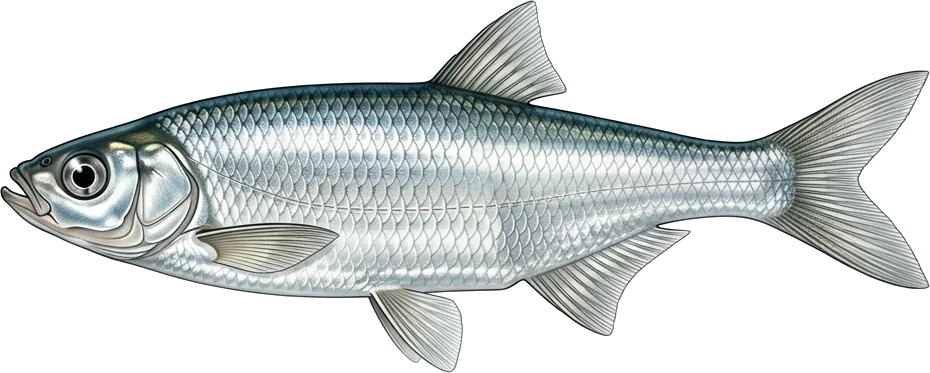
Common Bleak Common bleak (Alburnus alburnus) is an epipelagic freshwater cyprinid fish in the family Leuciscidae abundant in sunlit surface waters across Europe and western Asia. The species is characterized by an upturned superior mouth, a scaleless ventral keel, guanine-rich deciduous silver scales, and weight up to 100 g. Caught with ultra-fast speed whips and dry flies using single maggots.
Common bleak is the ultimate masterclass in reflex speed and rig delicacy. Triumph relies on three pillars: ultra-light 2.5–3.5m whips with flick tips, size #20–24 long-shank hooks, and constant surface clouds generated by regular dollops of watery slurry.
- ✅ You want to master high-speed tournament bleak fishing at a rate of 2–3 fish per minute.
- ✅ You want to master surface suspension groundbaits that create long-lasting milky clouds.
- ✅ You need calibrated ultra-light rigs: 0.2–0.4g needle floats and 0.07–0.08mm snells.
- ✅ You want to explore the science of pearlescent guanine crystal optics in bleak scales.
- ✅ You want to master speed cadence and bleak surface schooling in 'Volga 2026'.
Ichthyology & Adaptations: Biological Profile of Alburnus alburnus
Common bleak (*Alburnus alburnus*) is a pelagic planktivore in the family Leuciscidae specialized for feeding in the uppermost surface film:
Bleak scales contain dense arrays of guanine crystals producing a mirror-like shine. In 1656, Parisian artisan Jaquin discovered how to extract 'essence d'Orient' from bleak scales to manufacture world-renowned imitation pearls.
The lower jaw exceeds the upper in length and curves sharply upward, forming a scoop-like aperture. This allows bleak to skim pollen, aphids, midges, and cladocerans directly off the surface film.
A sharp, scaleless fleshy keel extends from the pelvic fins to the vent. It acts as a hydrodynamic rudder, providing rapid directional stability during high-speed surface turns.
Bleak possess one of the fastest neuromuscular reaction speeds among freshwater fishes, capable of sighting a falling speck, launching a strike, and closing its jaws in under 0.08 seconds.
Common Bleak vs Riffle Bleak vs Sabrefish: Pelagic Identification
Identification guide for three surface-cruising river species:
- Body: slender, laterally compressed; deciduous scales leave a silvery sheen on hands.
- Lateral line: uniform silver without double-row black dashes.
- Mouth: strictly superior / upturned.
- Anal fin: long (18–23 rays), originating below the posterior base of dorsal.
- Size: 10–15 cm length (rarely 20–25 cm), weight 20–60 g (rarely 100 g).
- Lateral line: bordered by a DISTINCT DOUBLE ROW OF BLACK DOTS ('stitched seam').
- Body: deeper and broader than common bleak.
- Fins: yellowish-orange bases on pectoral and pelvic fins.
- Habitat: clean rocky streams and torrents (listed in Regional and Federal Red Books).
- Conservation: strictly protected, must be released immediately upon capture!
- Body: sabre-curved with an entirely straight back and deep convex belly.
- Pectoral fins: wing-like, exceptionally long, extending beyond pelvic bases.
- Lateral line: dramatically wavy and zigzagging down the lower belly.
- Size: reaches 40–55 cm and 0.5–1.5 kg.
- Behavior: fast pelagic open-water surface predator.
Biomechanics of the Split-Second Strike
As bait hits the surface, bleak intercept it on the drop ('splash take'). The fish engulfs the larva in a fraction of a second and bolts laterally, plunging or skating the float across the film.
If the strike lags by even 0.5 seconds, the bleak senses hook wire resistance and rejects the bait. Tournament hooksets are executed instantly from the wrist the moment the float settles.
Speed match fishing utilizes size 20–24 long-shank barbless or micro-barb hooks, enabling instant one-motion dehooking directly over the keepnet.
Seasonal Surface Habitats & Shoals for Bleak
Bleak behavior is intimately governed by surface water temperature, plankton drift, and airborne insect hatches:
Spring (April – May): Post ice-out at +12...+15°C, bleak mass in enormous shoals in sun-warmed shallow bays, creek mouths, and sandbars, preparing for batch spawning over submerged weeds.
Summer (June – August): Peak activity. Bleak cruise in the top 5–30cm along riffle edges, bridge pilings, and piers. Foraging is continuous throughout daylight, culminating in evening surface frenzies on midge falls.
Autumn (September – November): First frosts cool the surface, pushing shoals into midwater columns (1.5–3.5m) near drop-offs. Feeding turns localized, responding best to single bloodworms.
Winter (December – March): Bleak do not hibernate, wintering suspended in midwater above deep pools (4–8m) with slow circular eddies. Caught through the ice on tiny tungsten teardrop jigs.
Bleak Nutrition: Pinkies, Micro-Flies & Milky Suspensions
1. Animal Baits (Tournament Standard)
Small pinkie maggots (white or red); joker bloodworms; houseflies; mayfly nymphs. Pinkie is king for tournament speed: its tough cuticle endures rapid takes without re-baiting.
2. Plant Offerings
Thin semolina paste extruded from a syringe needle; fresh white bread punch. In quiet summer heat, tiny dough droplets trigger instantaneous strikes.
3. Attractors & Visual Triggers
Vanilla, milk powder, fine coriander, and roasted peanut flour. The primary trigger for bleak is VISUAL: an opaque white or yellow cloud suspended in the top 20cm attracts shoals immediately.
4. The Perfect Surface Slurry Recipe
Combine ultra-fine breadcrumb flour, powdered milk (up to 20%), corn flour, and clouding clay. Overwet to a runny batter consistency and flick a spoonful every 30 seconds.
Tackle: Specialized Speed Whip Systems
High-cadence match fishing demands perfectly balanced ultra-light gear:
Dedicated Speed Whip (2.5–3.5m)
Featherlight high-modulus carbon rod weighing 60–90g with a sensitive solid carbon flick tip. Rig length cut 20–30cm shorter than the rod to swing fish straight to hand. Mainline 0.10mm, hooklength 0.07–0.08mm (12–15cm). 0.2–0.4g needle float with single micro-shot near body.
Pellet Waggler & Surface Feeder
Light 2.7m picker or match rod with a clear splash-waggler float, designed to target distant surface bleak feeding frenzies 20–35m out across wide reservoirs.
Fly Fishing & Tenkara with Micro-Flies
Ultra-light #1–2wt fly rod or 3.0m tenkara. Tiny dry patterns (Black Gnat, Griffiths Gnat, micro-ants) on size 20–22 hooks. Casting to rises produces takes instantly.
Debunking Common Bleak Myths
Fact: Autumn bleak contains 10–12% healthy fat! Dried Volga bleak rivals smelt and vendace in culinary delicacy, while crispy deep-fried bleak is a celebrated European delicacy.
Fact: On 0.14mm line with a 1.5g float, bleak rejects bait within 0.1 seconds. Only a surgical 0.08mm snell and a 0.2–0.3g needle float guarantee reliable tournament hook-ups.
Fact: Bleak remains active throughout the winter. Suspending in midwater above deep pools, it feeds aggressively on micro-jigs during thaw days.
Scientific Research on Alburnus alburnus
'The bleak belongs among the most prolific and abundant fishes... Cruising surface layers incessantly, it snatches everything falling onto the water with extraordinary velocity... Its scales contain abundant silvery pigment, historically refined into the celebrated essence d'Orient for faux pearls.'
'In 1861, French chemist Charles-Louis Barreswil demonstrated that the pearlescent pigment of bleak scales (essence d'Orient, pioneered by Jaquin in 1656) consists of crystalline organic guanine, acting as dynamic mirror camouflage in open pelagic zones.'
'Alburnus alburnus: fecundity reaches 5,000–7,000 eggs across batch spawnings at +14...+16°C. An obligate planktivore equipped with an elongated anal fin (18–23 rays) and biserial pharyngeal dentition (2.5–5.2) specialized for capturing micro-invertebrates.'
4 Tactical High-Speed Strategies for Bleak
Short 3m whip, pendulum flick into the cloud. Strike on second one, swing fish straight to chest, unhook and repeat.
Flick a marble-sized pinch of milky slurry every 30 seconds. A suspended white cloud in the top 20cm holds thousands of fish at rod tip.
Deliver a micro-fly on a #1wt line with a subtle slap. The surface sound triggers an immediate competitive engulfment.
Step-scout layers from 1.5 to 4.0m above a deep hole. Once the school is intercepted, lock depth setting.
Seasonal Matrix: Depths, Optimal Times, Baits & Rigs
| Season | Peak Feeding Time | Depth Zone | Top Baits | Tackle System |
|---|---|---|---|---|
| Spring (May) | 08:00 – 18:00 (All day) | 0.2 – 0.8 m (Shallows & bays) | Pinkie, bloodworm, housefly | 3m Whip, 0.3g float |
| Summer (June – August) | 06:00 – 21:00 (All daylight) | 0.05 – 0.3 m (Top film) | Pinkie, dough, micro-flies | Speed whip 2.5–3.5m, fly #1/2 |
| Autumn (Sept – Oct) | 11:00 – 16:00 (Warm hours) | 1.5 – 3.5 m (Mid-water drop-offs) | Single bloodworm, pinkie | 4–5m Whip (0.8g float) |
| Winter (Ice Fishing) | 10:00 – 15:00 (Thaw periods) | 2.0 – 5.0 m (Suspended over deeps) | Joker bloodworm on micro-jig | Balalaika with sensitive quill |
Angling Diagnostic: Identify What's Impeding Your Bleak Speed Rate
Select the symptoms you are experiencing for instant technical adjustments:
Common Bleak in 'Volga 2026' Simulator
In 'Volga 2026', common bleak is simulated with high surface reaction velocity. Weight spectrum spans 0.01 to 0.12 kg. It trains split-second reflexes and provides prime livebait for trophy predators.
Key in-game locations: 'Old Quay', 'Sand Spit', 'Tram Bend', 'City Embankment'.
Bleak is featured in tournament speed events ('Volga Sprint', 'Silver Flash', 'Champion's Cadence'), rewarding tournament whip rods.
Frequently Asked Questions About Common Bleak
What is 'essence d'Orient' and how was it produced from bleak?
'Essence d'Orient' was a suspension of reflective guanine crystals washed from millions of bleak scales, used to coat hollow glass beads internally to produce world-famous artificial pearls.
How do you distinguish common bleak from protected riffle bleak?
Key marker: riffle bleak features a conspicuous double row of black dashes flanking the lateral line ('stitched seam') and a deeper body. Common bleak has an unmarked silvery flank.
What groundbait works best for surface bleak?
The best mix is a runny slurry of fine breadcrumb, milk powder, and oat flour. Hitting the surface, it creates a persistent white cloud suspended in the top 20cm.
What rod length is optimal for speed fishing?
In competitive match angling, 2.5–3.5m is optimal. A short whip enables casting, striking, and swinging fish to hand in 4–5 seconds flat.
Where do you locate bleak under winter ice?
Under winter ice, bleak suspend in mid-water (2–4m depth over 5–9m deeps) in gentle eddies, readily taking tiny shiny jigs with joker bloodworms.
Authoritative Ichthyological Sources & Literature: FishBase — Alburnus alburnus (Linnaeus, 1758) Species Summary · IUCN Red List of Threatened Species — Alburnus alburnus · Л. П. Сабанеев — «Жизнь и ловля пресноводных рыб: Уклейка» (Викитека) · Gallica BNF — Barreswil, Sur le blanc d'ablette pour les perles fausses (1861)
Prepared by the Volga 2026 Editorial Board in strict adherence to aquatic biology and sport angling standards. Volga 2026 Editorial Methodology.