Rheophilic Cyprinid Biology & Specimen River Feeder Masterclass · Volga 2026 Encyclopedia
Barbel
Barbus barbus (Linnaeus, 1758)
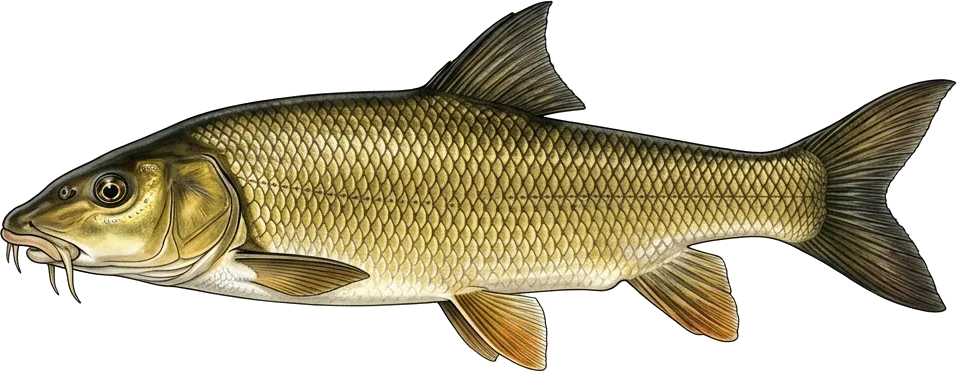
Barbel (Barbus barbus) is a muscular rheophilic bottom-dwelling cyprinid fish native to fast-flowing gravel rivers across Europe. The species features four sensory mouth barbels, a powerful streamlined body, serrated dorsal fin ray, and weight up to 12 kg. Anglers catch barbel on heavy river feeder gear using cheese paste, pellets, luncheon meat, and large lobworms.
Barbel demands uncompromising specimen gear: 3.9–4.2m Extra-Heavy feeder (150–180g test), 0.30mm mono shockleader, stiff 0.20–0.24mm fluorocarbon snells, and bait offerings of aged cheese cubes, juicy lobworms, or crayfish tails.
- ✅ You want to definitively distinguish barbel from gudgeon and carp by 4-barbel configuration and serrated dorsal spine.
- ✅ You want to master specimen river-feeder tactics on boiling boulder chutes with 120–160g heavy claw cages.
- ✅ You need proven specimen baits: aged Gouda/Parmesan cubes, Halibut & Cheese boilies, juicy lobworms, and crayfish tail meat.
- ✅ You want to understand the lethal toxicity of barbel spawning roe (ichthyotoxin barbine) and food-safety facts.
- ✅ You want to master barbel mechanics and roaring-current quests in 'Volga 2026'.
Ichthyology & Morphological Adaptations: Biological Profile of Barbus barbus
Barbel (*Barbus barbus*) is a specialized rheophilic powerhouse exhibiting formidable physical adaptations:
Equipped with 4 fleshy barbels: 2 short on the upper lip and 2 long at jaw corners. Lined with dense sensory buds, they detect benthic mollusks and insect larvae by touch and taste in turbulent rapids.
The primary dorsal ray is thickened into a stout bony spine edged with sharp, backward-pointing saw teeth. During the fight, barbel flares this spine, frequently severing tight monofilament.
During spring spawning, the eggs and black peritoneal membrane accumulate thermostable ichthyotoxin (barbine). Consuming barbel roe induces severe cholera-like gastroenteritis and neuromuscular distress!
The cylindrical, rounded cross-section body, flattened belly, and broad caudal peduncle generate flawless hydrodynamics for anchoring and cruising in currents exceeding 2.0 m/s.
Barbel vs Common Gudgeon vs Wild Carp: Identification Guide
Comparative anatomical guide for three barbel-bearing cyprinid species:
- Barbels: 4 FLESHY BARBELS (2 on upper snout, 2 at jaw corners).
- Dorsal fin: stout SERRATED SAW-SPINE ray.
- Body: cylindrical, muscular, torpedo-shaped.
- Anal fin: short (5 branched rays).
- Size: 40–85 cm (1.5–6.0 kg, records to 10.0+ kg).
- Barbels: ONLY 2 BARBELS (one at each jaw corner, snout bare).
- Dorsal fin: soft rays, serrated saw-spine ENTIRELY ABSENT.
- Coloration: dark blotches along lateral line.
- Size: tiny (8–15 cm, 15–40g).
- Roe: harmless and non-toxic.
- Barbels: 4 barbels (body much deeper and heavier-set).
- Dorsal fin: VERY LONG (17–22 branched rays).
- Scales: giant golden-bronze armor with dark margins.
- Habitats: deep slow pools, woody snags (avoids heavy rapids).
- Size: 3.0–20.0+ kg.
Mechanics of the Locomotive Take & Drag Battle
Cruising boulder rapids pinned hard to the substrate, barbel spots a cheese cube or lobworm bunch. Inhaling the payload on the move without pausing, it accelerates downstream or charges headlong into the torrent. The strike slams the rod into a frantic full-blank curve, threatening to catapult it into the foam.
Fighting barbel in heavy flow is the ultimate adrenaline rush. The fish leverages the full hydraulic force of the river, locking behind bottom boulders and flexing its serrated spine against the line. Never clamp your drag lock-tight—tune friction drag to 70% of hooklink breaking strain!
Seasonal Habitats: Boulder Rapids, Dam Tailraces & Deep Chutes
Barbel is an obligate thermophilic rheophile active from late spring through autumn:
🌱 Spring (Spawning Rapid Ascent): Pre-spawn pods surge into the fastest gravel chutes (1.5–3.0m) at +15...+18°C. Targeted with lobworm bunches and caddis larvae.
☀️ Summer (Peak Specimen Season): Patrols roaring weir tailraces, boulder headlands, and island narrows (2.0–6.0m). Prime feeding occurs at night (10:00 PM – 4:00 AM) and late dusk.
🍂 Autumn (Deep Gravel Shelf Staging): Drops onto 5.0–10.0m deep channel shelves over hard gravel substrate. Feeds during midday and evening on halibut pellets and lobworms.
❄️ Winter (Wintering Torpor): Gathers in tight dormant pods inside deep 8.0–16.0m river trenches. Feeding halts; sport angling is unproductive.
Barbel Baits: Aged Cheese, Lobworms, Halibut Pellets & Crayfish Tails
1. Top Animal Baits
Cluster of 2–3 giant juicy lobworms; fresh river crayfish tail meat; brook lamprey ammocoetes larva (peskoroyka); fat cockchafer grub.
2. Aged Cheese & Hair-Rigged Cheese Boilies
12–15mm cubes of hard mature cheese (Gouda, Cheddar, Parmesan); dedicated Halibut & Cheese river boilies; spiced luncheon meat cubes.
3. Attractors & Specimen Dips
Concentrated cheese oil, pure halibut marine oil, crushed garlic, and fermented krill. Dense oily scents resist rapid wash-out in boiling current.
4. Heavy Pellet & River Clay Groundbait
Dense mix of 4–8mm marine halibut pellets, boiled hemp, chopped lobworms, and 40% river gravel bound firmly with heavy bentonite clay.
Tackle: Extra-Heavy 4.2m Feeders, 0.30mm Shockleaders & 0.22mm Fluorocarbon
Taming river steam engines in heavy rapids demands heavy-duty specimen tackle:
Extra-Heavy Feeder 3.9–4.2m (140–180g Rating)
Stout thick-walled carbon blank with 3.5–5.0 oz carbon quivertips. Power size 5000–6000 reel with Baitrunner or Quick Drag system to handle violent takes.
0.30mm Mono Shockleader + 120–150g Claw Vampire Feeders
PE #1.2 braid coupled to an 8–10m 0.30mm mono shockleader (for abrasion cushioning), locked to 120–150g wire claw feeders.
70–100cm Stiff Fluorocarbon Snells (0.20–0.24mm)
Stiff abrasion-grade fluorocarbon resisting barbel saw-spine slicing, armed with heavy forged Owner/Korda Wide Gape hooks #6–8.
Debunking Common Barbel Myths
Fact: Barbel roe is LETHALLY TOXIC during spawning! It contains barbine ichthyotoxin, triggering violent gastroenteritis, cramps, and collapse.
Fact: Barbel (*Barbus barbus*) is a distinct large species possessing 4 barbels (gudgeon has only 2) and a serrated dorsal saw-spine.
Fact: Barbel is an obligate rheophile of fast boulder rapids. Top offerings are aged cheese, giant lobworms, crayfish, and marine halibut pellets.
Scientific Research on Barbus barbus
'The barbel, or miron, is one of the strongest and most tireless fishes of our rivers... Inhabiting rocky rapids, it overturns stones and fights with locomotive power.'
'Barbus barbus is an obligate benthic rheophile. Spawning ovaries and peritoneum produce cyprinid ichthyotoxin, serving as a biochemical defense shielding egg clutches from aquatic predators.'
'Barbus barbus: maximum recorded weight exceeds 12.0kg, length 100cm, lifespan 25 years. 3-row pharyngeal teeth (2.3.5-5.3.2) exert immense crushing force against thick Dreissena mussel shells.'
4 Tactical Specimen River Feeder Strategies for Barbel
Mount a 14mm cube of aged Gouda or Cheddar on a hair rig with an extra-wide bait stop. Cheese holds firm on current and steadily leaks amino acids.
Deploy 130–150g claw wire cages. The feeder must sit motionless behind a boulder lie without shifting under relentless current flow.
At night, barbel roam 1.5m shallow gravel bars. Fish 20–30m from shore, utilizing isotope indicators and engaged reel baitrunners.
Guide the spent barbel into a wide rubber-mesh landing net. Never allow the taut hooklink to contact the fish's flared dorsal saw-spine!
Seasonal Matrix: Depths, Optimal Times, Baits & Rigs
| Season | Peak Feeding Time | Depth Zone | Top Baits | Tackle System |
|---|---|---|---|---|
| Spring (May – June) | 06:00 – 11:30 & 16:00 – 20:30 | 1.5 – 3.5 m (Boiling boulder rapids) | Lobworm bunch, caddis, lamprey larva | Extra-Heavy 4.2m feeder, 0.22mm |
| Summer (July – August) | 22:00 – 04:30 (Night peak) & 05:00 – 08:30 | 2.0 – 5.5 m (Weir chutes & boulders) | Aged cheese cube, cheese boilie, crab | Extra-Heavy feeder with baitrunner |
| Autumn (Sept – Oct) | 11:00 – 17:00 (Warm midday) | 5.0 – 10.0 m (Deep rocky channel shelves) | 14mm Halibut pellets, lobworm bunch | Heavy 160g feeder, braided hooklink |
| Winter (Torpor) | Dormant in pits (Angling inactive) | 8.0 – 16.0 m (Deep winter trenches) | Non-feeding winter dormancy | Angling closed (wintering reserve) |
Angling Diagnostic: Identify What's Impeding Your Barbel Catch
Select the symptoms you are experiencing for instant technical adjustments:
Barbel in 'Volga 2026' Simulator
In 'Volga 2026', barbel is simulated with freight-train upstream surge kinematics, dorsal saw-spine line breakoff risks, and midnight cheese-boilie specimen sessions. Weight spectrum spans 1.0 to 8.5 kg. Inhabits boiling boulder chutes, weir tailraces, and rapid currents.
Key in-game locations: 'Boiling Rapid', 'Stony Headland', 'Old Riverbed', 'Volga Expanses'.
Barbel crowns the heavy-current trophy questline ('Volga Steam Engine', 'Secret of the Cheese Hair Rig', 'Boulder Duel 180g'), unlocking 4.2m Extra-Heavy feeder blanks and baitrunner reels.
Frequently Asked Questions About Barbel
Is barbel roe truly toxic and dangerous to humans?
Yes, this is scientifically verified. During spawning, barbel ovaries and black peritoneal lining contain barbine ichthyotoxin. Ingestion induces severe gastroenteritis, cramps, and diarrhea. The meat itself is safe and edible.
How do you distinguish barbel from gudgeon?
Key differences: 1) Barbels: barbel has 4 barbels (2 on snout, 2 at jaw corners), gudgeon has only 2; 2) Dorsal fin: barbel bears a stout serrated saw-spine (gudgeon has soft rays); 3) Size: barbel reaches 3–6+ kg vs gudgeon's max 40g.
What is the single best bait for river barbel?
A cube of hard aged cheese (Parmesan, Cheddar, Gouda) on a hair rig, juicy lobworm clusters, fresh crayfish tail meat, and marine halibut pellets.
What is the biological purpose of the serrated dorsal spine?
The spine serves as defense against apex predators (catfish, pike, zander) and assists the fish in wedging firmly between riverbed boulders against torrential flow.
What time of day does barbel feed most aggressively?
During warm months, trophy barbel feed most aggressively under the cover of darkness (10:00 PM to 4:00 AM) and at early dawn over shallow gravel chutes.
Authoritative Ichthyological Sources & Literature: FishBase — Barbus barbus Biological Summary · IUCN Red List of Threatened Species — Barbus barbus · Л. П. Сабанеев — «Жизнь и ловля пресноводных рыб» (Викитека) · Институт биологии внутренних вод им. И. Д. Папанина РАН (ИБВВ РАН)
Prepared by the Volga 2026 Editorial Board in strict adherence to aquatic biology and sport angling standards. Volga 2026 Editorial Methodology.