Ichthyology & Benthic Ice Angling · Volga 2026 Encyclopedia
Eurasian Ruffe
Gymnocephalus cernua (Linnaeus, 1758)
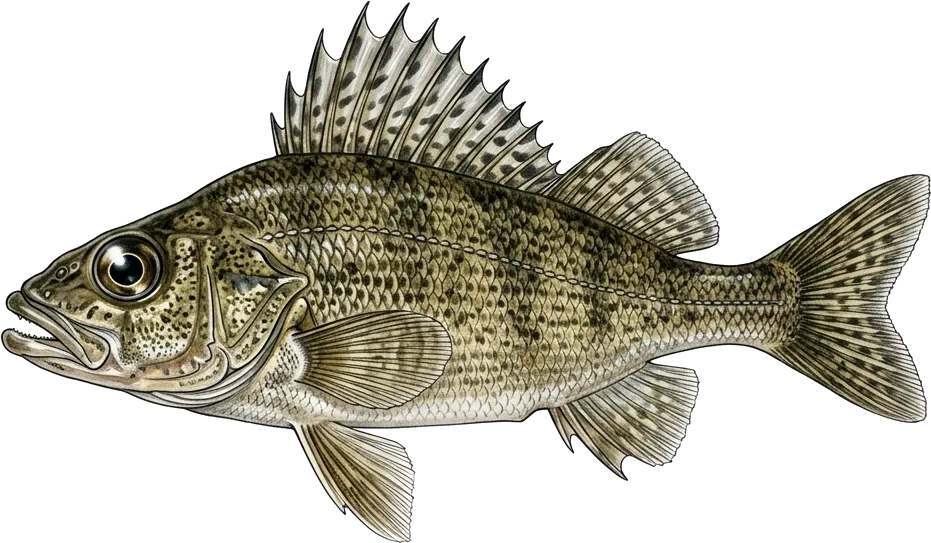
Eurasian Ruffe Eurasian ruffe (Gymnocephalus cernua) is a spiny benthic freshwater percid fish native to the riverbeds, shadowed channels, and lakes of Eurasia. The species is characterized by a single continuous dorsal fin with 11–16 stiff spines, prominent cephalic lateral line muciferous cavities, and weight up to 250 g. Anglers catch ruffe on bottom rigs and ice jigs tipped with bloodworm.
Ruffe is the master of cold, shaded abysses. Immune to silt opacity, it navigates via huge cephalic lateral line pores. Success requires resting a tungsten jig tipped with bloodworms on the bed with rhythmic bottom taps, keeping an unhooking disgorger always ready.
- ✅ You want to quickly locate and catch dozens of winter ruffe for gourmet soup or tournament points.
- ✅ You seek the authentic recipe for Russian Royal Ukha utilizing ruffe without scaling.
- ✅ You use ruffe as prime livebait for night ledgering targeting burbot, zander, and big perch.
- ✅ You want to grasp morphological distinctions between common ruffe, Don ruffe, and juvenile perch.
- ✅ You want to master ruffe foraging mechanics and ice fishing in 'Volga 2026'.
Ichthyology & Adaptations: Biological Profile of Gymnocephalus cernua
The Eurasian ruffe (*Gymnocephalus cernua*) is a specialized percid adapted to thrive and hunt across silty substrates under complete optical deprivation:
Deep muciferous lateral line cavities equipped with enlarged neuromasts cover the skull and gill covers. This acoustic radar detects micro-vibrations from burrowing chironomid larvae in zero visibility.
Unlike perch, ruffe possesses a continuous dorsal fin uniting 11–16 sharp spines with soft rays. Preopercular spines and stiff rays deter predators, forcing pike and zander to ingest it strictly tail-first.
Ruffe skin secretes dense bactericidal slime loaded with mucins and antimicrobial peptides. It prevents abrasions in rocky silt and produces the famous rich gelatinous body in fish broth.
The retina is backed by a reflective guanine layer (tapetum lucidum), creating a bluish luminescence. This amplifies faint photons, granting superior nocturnal vision in deep muddy waters.
Common Ruffe vs Don Ruffe vs Eurasian Perch
Comparing three related Percidae species native to the Volga basin:
- Snout: short, obtuse, slightly rounded with upper jaw projecting.
- Dorsal fin: SINGLE CONTINUOUS (spiny and soft portions seamlessly fused).
- Color: olive-grey back peppered with irregular dark brown specks.
- Head: conspicuous sensory pits along lateral canals; sharp preopercular spine.
- Habitat: deep holes, muddy river reaches, cold shaded pools.
- Snout: elongated, wedge-shaped and pointed forward ('long-nosed').
- Color: much paler yellowish-sand with sharper, sparser black dots.
- Body: sleeker and more streamlined, adapted for rapid river currents.
- Scales: smaller and firmer; substantially less mucus than common ruffe.
- Habitat: strictly fast-flowing rivers with pristine sand/gravel beds.
- Dorsal fins: TWO COMPLETELY SEPARATE fins with distinct gap between them.
- Color: bold vertical dark bars across flanks ('tiger stripes').
- Fins: pelvic, anal, and caudal fins are vibrant orange or blood red.
- Head: smooth without sensory cavities; rough ctenoid scales.
- Hunting: daytime visual hunter chasing fry in mid-water columns.
Biomechanics of the Deep-Gulp Ruffe Take
Ruffe hovers directly above the bait on its pectoral fins and expands its gills, vacuuming the bloodworm or worm deep into its pharynx. On a winter ice nod, this translates into a deliberate, smooth downward bend followed by persistent trembling.
Due to this vacuum engulfment, ruffe swallows hooks directly into its stomach within seconds. Any delayed strike means deep hook removal, requiring an unhooking disgorger immediately.
A proven trigger is 'bottom thumping': 3–5 sharp taps against the substrate stir a micro-cloud, followed by a 3–5 second motionless pause when the aggressive engulfment occurs.
Seasonal Habitats & Depths for Eurasian Ruffe
Ruffe is a cold-adapted eurythermic fish favoring shaded benthic sanctuaries with low light levels:
Spring (April – May): Spawning at +6...+12°C prompts migrations from abyssal holes onto rocky-sand reefs and clay shelves (1.0–2.5m). Females deposit up to 200,000 adhesive eggs over stones and timber.
Summer (June – August): Shunning warm surface layers, ruffe retreats to deep channels (4–10m), sheltering beneath bridge footings, sunken barges, and shaded bluffs. Foraging peaks after sunset.
Autumn (September – November): Cooling waters trigger dense schooling on channel slopes (3–6m). Foraging reaches a peak as ruffe prepares for winter, gorging on worm bunches presented on ledger rigs.
Winter (December – March): Peak ice angling season. Ruffe feeds aggressively all winter even during midwinter freezes. Massing in dense carpets across deep bays and silt holes (3–8m), it takes bloodworm jigs reliably.
Baits, Attractors & Substrate-Tapping Tactics
1. Natural Animal Baits (Absolute Dominance)
Fresh large bloodworms (fished in clusters of 2–3 or single); piece of red dung worm; goldenrod gall grubs. Bloodworm is ruffe’s native staple, triggering an instant visual and olfactory take.
2. Plant Offerings (Zero Interest)
Ruffe is a dedicated benthivore and carnivore. It completely ignores dough, corn, bread, and cereals. Plant baits are entirely ineffective.
3. Natural Scents & Attractors
Ruffe repels from artificial sweet fragrances. The ultimate triggers are crushed bloodworm juices, chopped worm oils, and stirred bottom sediment minerals.
4. Micro-Feeding with Joker Bloodworms
No breadcrumbs! Feed the ice hole with small pinches (10–15 larvae) of joker bloodworms delivered via a bottom-release cone feeder directly onto the bed every 20 minutes.
Tackle Systems: Winter Ice Balalaika & Bottom Ledgering
Targeting ruffe requires crisp indication of substrate contact and subtle takes:
Winter Ice Rod ('Balalaika') with Lavsan Nod
Compact foam balalaika rod, 0.08–0.10mm mono, tapered lavsan nod (5–7cm). Dark 2.0–2.8mm tungsten ball or teardrop jig (black, copper, gunmetal) armed with hook #18–20.
Bottom Ledger & Light Picker Rig
Light 2.4–2.7m picker with 0.5 oz tip, running 10–15g lead sinker, 20cm hooklength (0.10mm), and long-shank hook #16–18. Perfect for autumn ledgering on deep channel drop-offs.
Winter Burbot Set-Line with Ruffe Livebait
Ice tip-up or ledger set with 0.35–0.40mm mono, 20–40g sliding sinker, and durable leader. Living ruffe is lip-hooked or tail-pinned directly onto the bottom of the channel.
Debunking Common Ruffe Myths
Fact: Ruffe possess no venom glands. However, puncture wounds introduce mucus proteins and benthic bacteria, causing mild local swelling. Simple antiseptic treatment resolves it quickly.
Fact: A disastrous culinary mistake! The epidermal mucus contains gelatinous collagen that gives Royal Ukha its legendary velvety body. Ruffe is only gutted and simmered whole in cheesecloth.
Fact: Ruffe maintains peak metabolic feeding efficiency at near-freezing temperatures (+0.5...+2°C), actively taking baits during the harshest midwinter freezes in January and February.
Scientific Research on Gymnocephalus cernua
'The ruffe abounds in immense numbers across almost all rivers and lakes... Holding strictly to the bottom in deep and shaded reaches, it feeds on insect larvae, fish roe, and worms... Gastronomically, ruffe is irreplaceable for ukha soup, imparting unmatched gelatinous body and sweet flavor through its rich mucus.'
'The mechanosensory lateral line system of Gymnocephalus cernua exhibits hypertrophied cranial canals packed with large neuromasts. Unlike Eurasian perch, whose neuromast sensitivity diminishes with maturity, ruffe maintains superior benthic prey detection under total turbidity and zero optical illumination throughout its entire lifespan.'
'Gymnocephalus cernua: continuous dorsal fin (XI–XVI spines, 11–15 soft rays). Fecundity reaches 130,000–200,000 eggs. Forages actively down to +0.5°C, serving as a primary consumer of Chironomidae larvae and an aggressive benthic food competitor to juvenile coregonids and cyprinids.'
4 Tactical Strategies for Ruffe
Lower the jig onto bottom and execute 3–5 sharp taps to stir a silt cloud, followed by a 3–5 second motionless pause when the engulfment occurs.
Hook 2–3 plump bloodworms through the head tag. The wriggling tails broadcast a concentrated amino acid trail that draws ruffe across the mud.
At dusk and night, ruffe ascends to 2.5–4.0m channel shelves. Deploy stationary bottom rigs tipped with redworm or bloodworm.
Gut captured ruffe, remove gills, and wrap unscaled in cheesecloth. Simmer for 30 minutes to yield a thick, gelatinous stock foundation.
Seasonal Matrix: Depths, Optimal Times, Baits & Rigs
| Season | Peak Feeding Time | Depth Zone | Top Baits | Tackle System |
|---|---|---|---|---|
| Spring (April – May) | 07:00 – 19:00 (All day) | 1.0 – 2.5 m (Rocky shallows) | Bloodworm, worm piece | Bottom float rig |
| Summer (June – August) | 21:00 – 04:00 (Night & dusk) | 4.0 – 9.0 m (Deep channel holes) | Redworm, bloodworm | Ledger rig, light picker |
| Autumn (Sept – Nov) | 08:00 – 17:00 (Overcast days) | 3.5 – 7.0 m (Clay drop-offs) | Bloodworm bunch, worm | Picker, boat drop-line |
| Winter (Ice Fishing) | 08:30 – 16:30 (All daylight hours) | 3.0 – 8.0 m (Wintering pools) | Bloodworm on tungsten jig | Balalaika with lavsan nod |
Angling Diagnostic: Identify What's Impeding Your Ruffe Catch
Select the symptoms you are experiencing for instant technical adjustments:
Eurasian Ruffe in 'Volga 2026' Simulator
In 'Volga 2026', ruffe is modeled with strict benthic substrate physics. Weight spectrum spans 0.02 to 0.25 kg. It is vital for crafting gourmet ukha and serves as the prime livebait for trophy burbot.
Key in-game locations: 'Deep Backwater', 'Mill Pool', 'Dawn Pier', 'Winter Reach'.
Ruffe is featured in quests 'Royal Ukha', 'Burbot Night Patrol', and 'Winter Exam', unlocking specialized tungsten ice jigs and disgorgers.
Frequently Asked Questions About Eurasian Ruffe
Is it true that ruffe should never be scaled for authentic Royal Ukha?
Absolutely true! Ruffe is only gutted with gills excised, leaving scales and slime intact. Simmering dissolves the mucus into an unparalleled clear, gelatinous, and sweet broth.
How does common ruffe differ from Don ruffe?
Common ruffe (Gymnocephalus cernua) has a short obtuse snout and dark olive mottling. Don ruffe (Gymnocephalus acerinus) features an elongated wedge snout, pale sandy hue, and lives strictly in fast currents.
Is a prick from a ruffe dorsal spine dangerous to anglers?
Ruffe carries no venom, but the prick hurts due to mucus and benthic bacteria entering the wound. Rinse with clean water and apply an antiseptic.
Why is ruffe considered the best livebait for burbot?
Ruffe and burbot share cold, deep habitats. Pinned to a ledger rig, ruffe hugs the bed and wriggles tirelessly for hours in freezing water, attracting burbot via scent and vibration.
How can you prevent ruffe from swallowing hooks deep into the stomach?
Strike immediately on the first deflection of the nod or float. Employ long-shank hooks and always keep an unhooking disgorger within immediate reach.
Authoritative Ichthyological Sources & Literature: FishBase — Gymnocephalus cernua (Linnaeus, 1758) Species Summary · IUCN Red List of Threatened Species — Gymnocephalus cernua · Л. П. Сабанеев — «Жизнь и ловля пресноводных рыб: Ёрш» (Викитека) · Институт биологии внутренних вод им. И. Д. Папанина РАН (ИБВВ РАН)
Prepared by the Volga 2026 Editorial Board in strict adherence to aquatic biology and sport angling standards. Volga 2026 Editorial Methodology.