Rheophilic Salmonid Biology & Finesse Fly Angling · Volga 2026 Encyclopedia
European Grayling
Thymallus thymallus (Linnaeus, 1758)
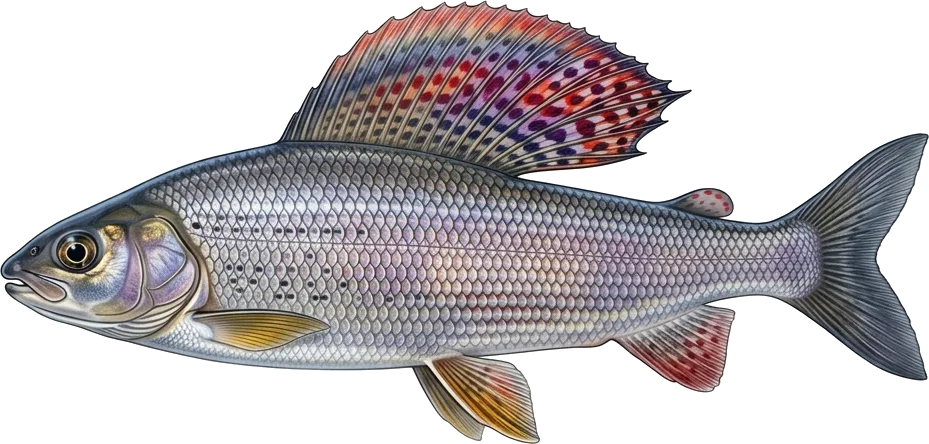
European Grayling European grayling (Thymallus thymallus) is an elegant salmoniform freshwater fish of the family Thymallidae thriving in cold, gravel-bedded European rivers. The species is instantly recognized by a huge sail-like dorsal fin patterned with iridescent violet spots, pear-shaped pupil, and weight up to 3 kg. Anglers catch grayling on dry flies, nymphs, and micro-spinners.
Grayling demands finesse fly craft: lightweight #3–4 tackle, hairline 0.10–0.12mm tippets, matching the hatch with dry flies and weighted nymphs, and drag-free dead-drift presentations.
- ✅ You want to definitively distinguish European grayling from Siberian grayling by dorsal ray counts (17–24) and spot patterns.
- ✅ You want to master drag-free dry-fly dead-drifting and modern Euro/French tungsten nymphing techniques.
- ✅ You need proven fly patterns: legendary Red Tag, Klinkhamer, Superpupa, tungsten Pheasant Tail, and micro-spinners.
- ✅ You want to explore salmonid science: hydrofoil dorsal sail, wild thyme aroma (*Thymallus*), and adipose fin biology.
- ✅ You want to master grayling fly mechanics and river rapid quests in 'Volga 2026'.
Ichthyology & Flow Adaptations: Biological Profile of Thymallus thymallus
European grayling (*Thymallus thymallus*) is a refined coldwater salmonid displaying specialized hydraulic and sensory adaptations:
The dorsal fin contains 17–24 extended rays reaching the adipose fin when folded, adorned with rows of iridescent emerald, violet, and purple ocelli. It acts as an adjustable hydrofoil rudder and hydraulic parachute in fast current.
Freshly landed grayling emits a delicate fragrance of wild thyme or fresh cucumber, giving rise to its generic name *Thymallus*. The aroma stems from volatile terpene compounds in its epidermal mucus.
The pupil is pear-shaped and drawn forward to a point. This provides acute binocular magnification looking upward and forward to spot minuscule drifting insects down to 2–3mm in diameter.
Grayling inhabits rapid gravel-bottom reaches with flow velocities of 0.5–1.2 m/s and dissolved oxygen levels above 8–10 mg/l. It cannot survive in warm stagnant water.
European Grayling vs Siberian Grayling vs Brown Trout: Guide
Comparative anatomical guide for rapid-water salmonid companions:
- Dorsal sail: 17–24 RAYS with parallel horizontal rows of square emerald/violet spots.
- Body spots: fine V-shaped black flecks confined strictly to the front third.
- Basin: European rivers, Upper Volga, Kama, Baltic basin.
- Size: 0.3–1.2 kg (rarely to 2.0+ kg).
- Dorsal sail: MASSIVE HEIGHT (up to 20cm) with swirling ocelli and fiery red margin.
- Mouth: larger jaws adapted for bigger prey.
- Basin: Siberian river basins (Ob, Yenisey, Lena, Amur).
- Coloration: dark coppery-bronze with vivid purple sheen.
- Size: reaches 1.5–3.0 kg.
- Dorsal fin: STANDARD, short (no expansive sail).
- Spots: SCARLET & BLACK SPOTS IN WHITE HALOS over entire flank.
- Mouth: deep predatory jaws armed with sharp teeth.
- Behavior: ambush predator behind boulders (grayling patrols the open current).
- Size: 0.2–2.0 kg.
Mechanics of the Surface Sip & Dorsal Sail Drag
Resting near the gravel bed in 0.8–1.5m moderate current, grayling spots a drifting dry fly. Gliding diagonally upward against flow, it delicately sips the fly off the surface film (leaving a subtle ring) before returning straight to the bottom.
On the strike, grayling instantly erects its huge dorsal sail, turning its broadside perpendicular to the current. Torrential water pressure against the sail creates hydraulic resistance akin to a fish triple its size! Cushion every pulse with rod flex on delicate 0.12mm tippets.
Seasonal Habitats: Rapids, Tail-Outs & Mountain Streams
Grayling movements track water temperature and aquatic insect emergences:
🌱 Spring (Post-Spawn Gorging): Spawns at +6–10°C on shallow gravel bars. Post-spawn pods feed heavily on stonefly and caddis larvae in 1.0–2.0m medium runs.
☀️ Summer (Peak Dry-Fly Season): Patrols the seam between fast current and back-eddies, rapid tail-outs, and riffles (0.5–1.2m). Peak surface feeding coincides with evening mayfly spinner falls (7:00–10:30 PM).
🍂 Autumn (Pre-Winter Feeding Frenzy): Large schools concentrate in 1.5–3.0m deep rocky glides. Feeds aggressively all day long on heavy tungsten Euro-nymphs.
❄️ Winter (Wintering Pools): Drops into 2.5–5.0m ice-free deeps and slow wintering holes. Caught through ice on small tungsten jigs baited with bloodworms or beadheads.
Grayling Offerings: Dry Flies, Tungsten Nymphs & Micro-Spinners
1. Proven Dry Fly Patterns (#14–18)
Red Tag (unbeaten legend with scarlet wool tail), Klinkhamer Special (orange post), Superpupa (floating caddis pupa), Parachute Adams, and Carpenter Ant.
2. Tungsten Euro-Nymphs (#12–16)
Pheasant Tail Jig Nymph with 2.5–3.5mm slotted tungsten bead, Hare's Ear, Czech Hydropsyche scuds, and UV-collar Jig nymphs with fluorescent hot spots.
3. Inline Micro-Spinners (1.5–3.5g)
Mepps Aglia #00–1 in copper and black, Smith Niakis 3.0g, Blue Fox Vibrax #0, Daiwa Silver Creek. Instant blade rotation in light stream flow.
4. Tyrolean Stick & Drift Rigs
15–30g Tyrolean wand bounces softly over bottom rocks, trailing 2–3 wet flies or vinyl nymphs in mid-water.
Tackle: #3–4 Fly Rods, Euro-Nymphing Blanks & Finesse Tippets
Finesse grayling angling demands ultra-light blanks and hair-thin shock absorption:
Standard Fly Rod 8.6–9.0 ft (#3–4, Medium-Fast)
Delicate graphite blank with supple tip. WF-3-F or DT-3-F floating line with 9–12ft tapered leader terminating in 0.10–0.12mm (6X–7X) fluorocarbon tippet.
Euro-Nymphing Rod 10.0–10.6 ft (#2–3 Weight)
Extra-long lightweight rod with soft tip for direct contact drift of two tungsten nymphs on a 0.55mm level Euro line with two-tone sighter.
Ultralight Area/Stream Spinning Blank (0.5–3.5g)
Soft parabolic spinning blank for launching 1.5–2.5g micro-spinners, rigged with 0.12–0.14mm nylon or PE #0.2 braid to protect soft grayling mouths.
Debunking Common European Grayling Myths
Fact: Grayling feeding peaks during cold, drizzly autumn days in September–October on deep tungsten Euro-nymphs.
Fact: The dorsal sail is a critical hydrodynamic stabilizer in torrential flow, enabling high-speed maneuvers across rapids.
Fact: European grayling attains weights of 1.5–2.5 kg and lengths of 50–60cm, representing one of the finest sport fighters in European rivers.
Scientific Research on Thymallus thymallus
'The grayling is one of the most beautiful and nimble fishes... Its magnificent dorsal fin reflects rainbow hues, and its fresh flesh smells of thyme. It dwells in cold rocky rapids.'
'Thymallus thymallus exhibits marked oxyphily and a narrow stenothermal optimum. Dorsal sail coloration patterns serve as reliable markers for isolated river sub-populations.'
'Thymallus thymallus: maximum recorded weight 6.7kg (Nordic lakes), in Russian rivers up to 2.5–3.0kg, length 60cm. Protected in central Russian regions.'
4 Tactical Stream Fly Strategies for Grayling
Cast 45 degrees upstream. Perform upstream line mends so the dry fly floats at exact bubble speed without micro-drag.
Drop a #14–16 Red Tag along the current seam. The scarlet wool tag provokes grayling into deliberate, confident surface sips.
Drift twin tungsten jig nymphs on a tight 0.12mm leader along rocky runs, detecting lightning takes via high-vis two-tone sighter.
When grayling braces its sail across current, drop the rod low and sweep sideways, steering the fish into slack bank eddies.
Seasonal Matrix: Depths, Optimal Times, Baits & Rigs
| Season | Peak Feeding Time | Depth Zone | Top Baits | Tackle System |
|---|---|---|---|---|
| Spring (May – June) | 10:00 – 17:00 (Midday warming) | 1.0 – 2.0 m (Pools below rapids) | Tungsten nymphs, wet flies | 10.6 ft Euro rod #3, 0.12mm tippet |
| Summer (July – August) | 19:00 – 22:30 (Dusk hatch) & 05:30 – 08:30 | 0.4 – 1.2 m (Riffles, rapid tail-outs) | Dry flies: Red Tag, Klinkhamer, #0 spin | 9.0 ft Fly rod #3–4, WF-3-F line |
| Autumn (Sept – Oct) | 09:00 – 16:30 (All daylight) | 1.5 – 3.0 m (Deep rocky glides) | Heavy Czech nymphs, 2.5g spoons | Nymphing outfit or UL spin 0.5–3g |
| Winter (Ice Season) | 10:30 – 14:30 (Sunny midday) | 2.5 – 5.0 m (Riverbed deeps) | Tungsten jigs with bloodworms | Ice jig rod, 0.10mm nylon |
Angling Diagnostic: Identify What's Impeding Your Grayling Catch
Select the symptoms you are experiencing for instant technical adjustments:
European Grayling in 'Volga 2026' Simulator
In 'Volga 2026', European grayling is simulated with authentic dry-fly drag-free drift physics, surface rise rings, and dorsal sail hydrofoil resistance. Weight spectrum spans 0.2 to 1.8 kg. Inhabits rapid-water riffles and gravel glides.
Key in-game locations: 'Forest Creek', 'Stony Headland', 'Winter Rapid', 'Cold Reach'.
Grayling crowns the fly-fishing quest series ('Knight of the Rainbow Sail', 'Secret of Thyme Creek', 'Rapid Cup'), unlocking #3-weight fly outfits and legendary Red Tag patterns.
Frequently Asked Questions About European Grayling
Why does fresh grayling smell of wild thyme?
Epidermal mucus of fresh grayling contains volatile terpene compounds emitting a distinctive fragrance of wild thyme or fresh cucumber. This inspired Linnaeus to name the genus *Thymallus*.
What is the single most effective dry fly pattern for grayling?
The legendary Red Tag (#14–16) featuring a peacock herl body and vibrant scarlet wool tag, as well as Klinkhamer Special and Superpupa.
What is the biological function of grayling's enormous dorsal sail?
The dorsal sail acts as a hydrodynamic rudder and stabilizer during rapid maneuvers, deploying as a water parachute during fights to create heavy resistance against current.
How do you distinguish European grayling from Siberian grayling and what is its conservation status?
By the sail: European has 17–24 rays and parallel emerald rows; Siberian has a taller sail with swirling ocelli. In the Volga basin, European grayling is listed in the Red Data Book of Russia and regional Red Books; harvesting is strictly illegal.
Why must anglers avoid horsing grayling during the fight?
Grayling has fragile, delicate lip membranes ('paper mouth'). Heavy-handed hauling tears the hook straight through the jaw. Play fish gently, relying on rod flex.
Authoritative Ichthyological Sources & Literature: FishBase — Thymallus thymallus Biological Summary · IUCN Red List of Threatened Species — Thymallus thymallus · Л. П. Сабанеев — «Жизнь и ловля пресноводных рыб» (Викитека) · Институт биологии внутренних вод им. И. Д. Папанина РАН (ИБВВ РАН)
Prepared by the Volga 2026 Editorial Board in strict adherence to aquatic biology and sport angling standards. Volga 2026 Editorial Methodology.