Stenothermic Rheophile Ecology & Spring-Creek Micro Angling · Volga 2026 Encyclopedia
Common Minnow
Phoxinus phoxinus (Linnaeus, 1758)
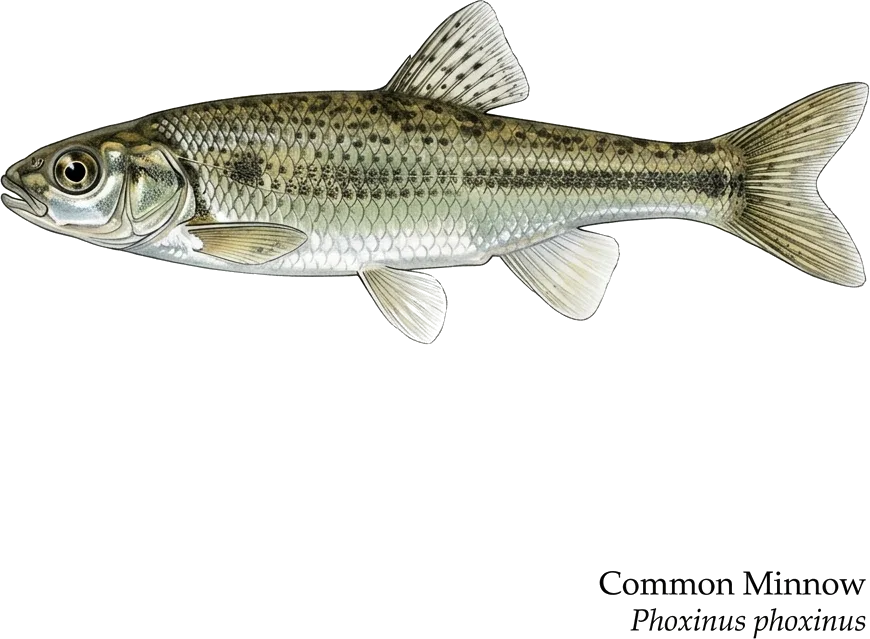
Common Minnow Common minnow (Phoxinus phoxinus) is a small, shoaling cyprinid fish ubiquitous in cold, well-oxygenated gravel streams and clear lakes across Eurasia. The species features intricate mottled flank bars, vivid crimson breeding coloration in males, and weight up to 30 g. Anglers catch minnows on delicate whip rigs with micro-hooks for sport or use them as prime predatory livebait.
Common minnow demands featherweight tackle: 3.0–3.6m telescopic whip or 3.2m tenkara rod, 0.08–0.10mm mono, 0.3–0.5g micro-float, barbless #18–22 hook, and tiny baits: single bloodworm, pinky maggot, or #20 Pheasant Tail micro-nymph.
- ✅ You want to definitively understand Phoxinus phoxinus biology: pure-water bioindication, male nuptial colors, and Schreckstoff alarm pheromone dynamics.
- ✅ You want to master high-speed trotting and drift-fishing on shallow gravel riffles, spring creeks, and rocky runs.
- ✅ You need top micro-baits: fresh bloodworms, single pinkies, micro-bread pinches, and dry midge flies.
- ✅ You want to explore Japanese tenkara methods for taking stream minnows on micro-nymphs in clear mountain torrents.
- ✅ You want to master common minnow mechanics and spring-creek quests in 'Volga 2026'.
Ichthyology & Cold-Spring Rheophilic Adaptations: Profile of Phoxinus phoxinus
Common minnow (*Phoxinus phoxinus*) is a benchmark stenothermic rheophile inhabiting oxygen-saturated cold streams:
Hyper-sensitive to aquatic pollution and thermal stress. Thrives exclusively in waters with dissolved oxygen above 8–10 mg/L and temperatures under +18°C. Its disappearance signals stream degradation.
During spring spawning (May–June), males undergo a stunning metamorphosis: bellies glow fiery carmine-red, opercles flash emerald-green, and heads are adorned with hard white pearl breeding tubercles.
Epidermal club cells contain an alarm substance (Schreckstoff). When skin is punctured by a predator, the pheromone dissolves into the current, triggering immediate panic and dispersal across the entire school.
Continuously swimming against rapid current, the minnow school maintains a ferocious metabolism, relentlessly intercepting drifting mayfly nymphs, blackfly larvae, and caddis.
Common Stream Minnow vs Mud Minnow vs Common Dace: Identification Guide
Comparative anatomical guide for three small cyprinids:
- Body: SLENDER, STREAMLINED spindle shape.
- Flanks: bold dark cross-bars over golden-olive background.
- Belly: FLAMING CRIMSON in breeding males.
- Biotope: FAST COLD SPRING CREEKS with clean gravel.
- Size: 5–10 cm (8–35g).
- Body: PLUMP, DEEP, robust (slightly humped).
- Color: olive-yellow with fine dark freckles (lacks bold bars).
- Belly: whitish-yellow (never crimson).
- Biotope: STAGNANT PEAT BOGS and shallow quarries.
- Size: 6–12 cm (15–90g).
- Body: streamlined, clad in LARGE BRIGHT SILVER SCALES.
- Color: pure silver flanks unspotted without bars.
- Mouth: subterminal, slightly pointed.
- Size: noticeably larger (15–25 cm, 100–350g).
- Habitats: medium to large rivers with swift current.
Mechanics of the Lightning Riffle Take & High-Speed Trotting
Trotting a micro-float over a shallow gravel riffle, the minnow school races to intercept the drifting bloodworm. The quickest fish snatches the offering on the fly: the 0.4g float plunges with a crisp pop, vanishing into the current in a fraction of a second.
Strike instantly with a delicate flick of the wrist. On a 3.0m ultralight whip, the minnow quivers like a lively coil spring, swinging cleanly into the angler's hand. Release from a barbless hook takes exactly 1 second, enabling 5–6 successful hookups per minute!
Seasonal Habitats: Spring Seeps, Gravel Riffles & Headwater Torrents
Common minnow thrives exclusively in cold, swift-flowing streams over clean gravel:
🌱 Spring (Spawning Riffles): Mass ascent to the shallowest gravel riffles (0.15–0.4m). Courting males swarm in current, enthusiastically taking bloodworms and midge larvae.
☀️ Summer (Peak Spring-Creek Season): Shoals hold on riffle-to-pool seams beneath forest canopy (0.3–0.8m). Peak feeding: unbroken all day from dawn till dusk.
🍂 Autumn (Deep Pool Retreat): Drops into 0.8–1.5m deeper spring-pool basins. Bites reliably on micro-bloodworms along slow bubble seams.
❄️ Winter (Spring-Fed Refugia): Concentrates inside open unfrozen spring seeps (+4...+6°C). Forages slowly on tiny benthic gammarus amphipods.
Common Minnow Baits: Bloodworms, Pinkies, Bread Flake & Tenkara Micro-Flies
1. Natural Micro-Baits (Top Choice)
Single fresh ruby bloodworm; one pinky micro-maggot; tiny caddis larva plucked from stream stones; 2mm tip of redworm.
2. Fluffy Bread Flake & Semolina
Match-head sized pinch of fresh white bread crumb; micro-droplet of semolina paste wrapped on the hook point.
3. Tenkara & Fly Micro-Patterns
Pheasant Tail nymphs, Killer Bug, and wet Kebari flies on #18–22 hooks; tiny Griffith's Gnat #20 dry flies on fine tippet.
4. Fine Sand & Breadcrumb Attractant
Handful of clean stream sand mixed with a spoonful of fine breadcrumbs. Tossed into current, it sparks a feeding rush with its splash and cloud.
Tackle: 3.0–3.6m Carbon Whip, 0.08mm Mono, 0.4g Micro-Float & Barbless #20
Targeting swift stream minnows demands featherweight, surgical spring-creek tackle:
3.0–3.6m Telescopic Carbon Whip (Weight under 80g) or 3.2m Tenkara Rod
Delicate carbon blank with supple tip action engineered for high-speed wrist fishing beneath dense woodland canopy.
Ultra-Thin 0.08–0.10mm Clear Mono Direct Rig
Supple knotless mono rigged straight through, ensuring an unhindered, 100% natural bait drift through swirling currents.
0.3–0.5g Teardrop Balsa Float + Owner Sode Barbless #20–22 Hook
Miniature teardrop balsa float shotted with a single #11 micro-split, paired with a barbless micro-hook for zero-delay unhooking.
Debunking Common Stream Minnow Myths
Fact: Common minnow (*Phoxinus phoxinus*) perishes under pollution or hypoxia; stillwater ponds harbor mud/lake minnows.
Fact: These are mature male common minnows in their spring nuptial dress ('stream beauties') courting females.
Fact: Sight-fishing for minnows on tenkara and micro-tackle is a pinnacle of precision sport (yielding up to 100 fish per hour).
Scientific Research on Phoxinus phoxinus
'The minnow, or riffle beauty—is the most handsome fish of pristine springs and mountain torrents... Males in May blaze with vivid carmine and gold.'
'Phoxinus phoxinus is a seminal model in fish chemical ecology. Karl von Frisch's discovery of the Schreckstoff alarm pheromone in minnow skin proved alarm communication in Teleostei.'
'Phoxinus phoxinus: maximum recorded weight 35–45g, length 10–14cm, lifespan 5–6 years. Dissolved O2 optimum sits at 9.0–11.5 mg/L at +10...+15°C.'
4 Tactical Spring-Stream Strategies for Common Minnow
Troat a featherweight float down a gravel run. Minnows dart out from stone eddies to intercept the drifting bloodworm in mid-stream.
Cast a #20 Kebari nymph 3 meters upstream. Guide the drift with gentle micro-pulsing twitches of the supple tenkara rod tip.
Deploy barbless hooks. The fish drops into the keeper bucket or is released with a single touch without injuring delicate lips.
In gin-clear brook waters, minnows are skittish. Approach behind tree trunks and avoid aggressive overhead rod waves.
Seasonal Matrix: Depths, Optimal Times, Baits & Rigs
| Season | Peak Feeding Time | Depth Zone | Top Baits | Tackle System |
|---|---|---|---|---|
| Spring (Nuptial Riffles) | 10:00 – 17:30 (Full daylight) | 0.15 – 0.4 m (Shallow gravel riffles) | Single bloodworm, pinky, bread | 3.0m Whip, 0.3g float, 0.08mm mono |
| Summer (Spring Stream Canopy) | 07:00 – 19:30 (Continuous feeding) | 0.3 – 0.8 m (Canopy runs & pool heads) | Bloodworm, pinky, #20 nymphs | 3.2m Tenkara or ultralight whip |
| Autumn (Deep Spring Basins) | 11:00 – 15:30 (Warm calm window) | 0.8 – 1.5 m (Deep spring seeps) | Juicy bloodworm on micro-hook | 3.6m Whip with 0.5g float |
| Winter (Spring Creek Pools) | 11:30 – 14:30 (Open spring pools) | 0.8 – 1.6 m (Open +5°C spring runs) | Micro bloodworm on tungsten bead | Winter micro-float rod |
Angling Diagnostic: Identify What's Impeding Your Common Minnow Catch
Select the symptoms you are experiencing for instant technical adjustments:
Common Minnow in 'Volga 2026' Simulator
In 'Volga 2026', common minnow is simulated as a nimble resident of pristine cold spring creeks ('a tiny clean fish of springs') featuring instant current-drift takes, affinity for clear gravel riffles, bloodworm, bread, maggot, and fly tactics. Weight spectrum spans 10 to 80 g. Inhabits spring brooks, river headwaters, and swift gravel shallows.
Key in-game locations: 'Spring Brook', 'Rocky Riffle', 'Forest Headwater', 'Volga Expanses'.
Common minnow unlocks the spring-stream and tenkara questline ('Crystal Riffle Beauty', 'Secret of the Nuptial Dress', 'Master of Spring Trotting'), unlocking Stream Finesse whip blanks and artisan tenkara micro-fly packs.
Frequently Asked Questions About Common Minnow
Why does the common minnow inhabit strictly pristine water?
Common minnow (*Phoxinus phoxinus*) is a stenobiontic rheophile requiring high dissolved oxygen (8–10+ mg/L) and cool temperatures, perishing rapidly under pollution or thermal warming.
What is the Schreckstoff alarm substance in minnows?
It is an alarm pheromone secreted by epidermal club cells when damaged by a predator, instantly warning the entire school to scatter into rock crevasses.
What is the best tackle setup for catching stream minnows?
A lightweight 3.0–3.5m whip (or 3.2m tenkara rod) with 0.08mm mono, a 0.3–0.4g micro-float, and a barbless Owner Sode #20 hook baited with a single bloodworm.
Why do male minnows turn bright crimson in spring?
This is a hormone-driven nuptial dress developed during spring spawning to court females and signal genetic vigor on the breeding riffle.
What maximum weight can a common minnow reach?
Common minnow reaches 25–35g (rarely 45–50g) at lengths of 8–10 cm, remaining a miniature gem of pristine waterways.
Authoritative Ichthyological Sources & Literature: FishBase — Phoxinus phoxinus Biological Summary · IUCN Red List of Threatened Species — Phoxinus phoxinus · Л. П. Сабанеев — «Жизнь и ловля пресноводных рыб» (Викитека) · Институт биологии внутренних вод им. И. Д. Папанина РАН (ИБВВ РАН)
Prepared by the Volga 2026 Editorial Board in strict adherence to aquatic biology and sport angling standards. Volga 2026 Editorial Methodology.