Stream Salmonid Ichthyology & Finesse Creek Angling · Volga 2026 Encyclopedia
Brown Trout
Salmo trutta morpha fario (Linnaeus, 1758)
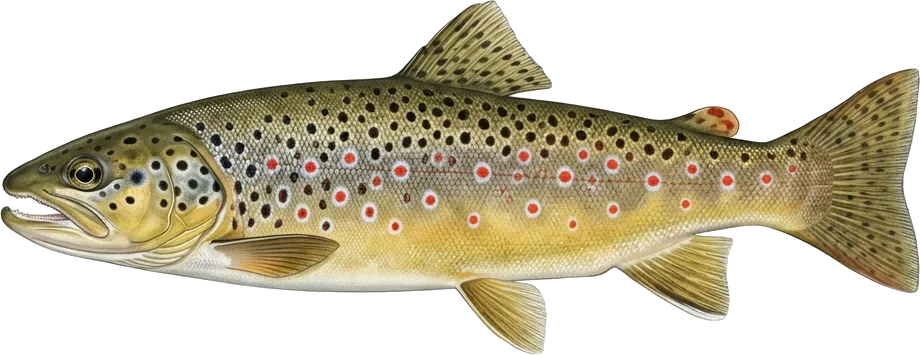
Brown Trout Brown trout (Salmo trutta morpha fario, or brook trout) is a cold-water predatory salmonid fish native to pristine, oxygen-rich gravel streams across Eurasia. The species is characterized by an adipose fin, dark and haloed crimson spots, and weight reaching 5 kg. Anglers target wild trout using finesse fly gear with dry flies, micro-nymphs, and ultralight spinning spoons.
Brown trout demands stealth stalking, upstream presentation precision on 0.5–5g ultralight or #3–4 fly tackle, and single barbless hooks for immaculate catch-and-release survival.
- ✅ You want to definitively distinguish brown trout from rainbow trout and char by scarlet ocellated spots.
- ✅ You want to master upstream casting and sinking minnow twitching in torrential spring-fed streams.
- ✅ You need proven lures: sinking minnows (D-Contact, Rigge), inline spinners (Black Fury), and dry flies (Klinkhamer).
- ✅ You want to explore salmonid science: adipose fin, coldwater oxyphily (>9 mg/l O2), and Snell's window optics.
- ✅ You want to master stream trout mechanics and rapids quests in 'Volga 2026'.
Ichthyology & Stream Adaptations: Biological Profile of Salmo trutta morpha fario
Brown trout (*Salmo trutta fario*) is a coldwater salmonid displaying specialized sensory and aerodynamic adaptations:
Flanks and back bear dark and vibrant scarlet spots encircled by pale whitish or bluish halos. This is the definitive species marker: rainbow trout entirely lack red haloed spots.
The rayless adipose fin behind the dorsal fin is densely innervated. It acts as a hydrodynamic flow sensor, detecting micro-vortices during high-speed bursts in turbulent rapids.
Trout possess acute binocular vision. Concealed behind stream boulders, it scans the surface through a 97-degree refractive optical cone ('Snell's window'), intercepting drifting insects in split-second vertical charges.
Optimal water temperature ranges from +9°C to +15°C. When water warms past +20°C or dissolved oxygen drops below 6 mg/l, trout suffer lethal asphyxiation and cease feeding.
Brown Trout vs Rainbow Trout vs Char: Salmonid Guide
Comparative anatomical guide for three premier coldwater salmonids:
- Spots: SCARLET & BLACK SPOTS ENCIRCLED BY PALE HALOS.
- Lateral band: iridescent pink stripe is ENTIRELY ABSENT.
- Tail: caudal fin almost devoid of dark spots.
- Habitat: cold, spring-fed rushing creeks and river headwaters.
- Size: 0.2–1.5 kg (river specimens to 3+ kg).
- Band: VIVID IRIDESCENT PINK/PURPLE lateral band.
- Spots: dense fine black spots WITHOUT HALOS.
- Tail: caudal fin densely peppered with black spots.
- Red spots: COMPLETELY ABSENT.
- Size: 0.8–5.0+ kg (commercial fisheries and lakes).
- Fins: CRISP SNOW-WHITE LEADING EDGES on pectoral and pelvic fins.
- Scales: microscopic, deeply embedded (velvety smooth skin).
- Coloration: vibrant orange belly with pale cream spots on dark body.
- Habitat: deep, freezing oligotrophic northern lakes.
- Size: 1.0–4.0 kg.
Mechanics of the Stream Strike & Aerobatic Head-Shakes
Stationed in the low-pressure eddy behind a riverbed boulder, trout detects the drifting minnow or dry fly. Exploding forward at up to 5 m/s, it grips the lure between toothed jaws and whips instantly back toward its pocket sanctuary.
Hooked, trout unleashes acrobatic fury: three to four instant aerial cartwheels (50–70cm high), violent head-shaking, and lunges toward undercut root tangles. A moderate-action (Regular) stream blank cushions every leap without introducing line slack!
Seasonal Habitats: Springhead Pools, Whitewater Rapids & Deep Holes
Trout stationing shifts with water temperature cycles and aquatic insect hatches:
🌱 Spring (High Cold Flow): In +6–10°C meltwater, trout hold in deep resting pools below main rapids (1.0–2.0m). Sinking 50mm minnows and heavy tungsten nymphs fished deep dominate.
☀️ Summer (Peak Stream Season): Stations throughout boiling pocket-water, behind rocks, and beneath overhanging alder branches (0.3–1.0m). Peaks at dawn (5:00–8:30 AM) and evening hatch (7:30–10:30 PM).
🍂 Autumn (Pre-Spawn Aggression): Dressed in vivid spawning colors, trout migrate to headwater gravel shallows (0.2–0.6m), aggressively hammering bright spinners and sculpin streamers.
❄️ Winter (Gravel Spawning & Spring Deeps): Spawns on gravel beds in November. Winters in ice-free, spring-fed resting pools, lazily foraging on benthic scuds (Gammarus).
Trout Lures: Sinking Minnows, Spinners, Micro-Spoons & Dry Flies
1. Heavy Sinking Stream Minnows (40–55mm)
Smith D-Contact 50, ZipBaits Rigge 45S, Duo Spearhead Ryuki 45S/50S, Jackson Trout Tune. Sinking fast on heavy current, they dart aggressively on sharp twitching pulses.
2. Inline Spinners & Micro-Spoons (1.5–4.5g)
Mepps Black Fury #0–1 with red/yellow dots, Smith Pure 2.7–3.5g, Forest Pal, Daiwa Silver Creek Spinner. Spin flawlessly across boiling whitewater chutes.
3. Fly Patterns (Dries, Nymphs & Streamers)
Dry flies: Klinkhamer Special #12–14, Parachute Adams, Elk Hair Caddis; tungsten nymphs: Pheasant Tail; streamers: Woolly Bugger and Sculpin patterns.
4. Natural Stream Offerings
Live caddis larvae in pebble cases, scuds (Gammarus), or small redworms drifted under a light float rig (where locally permitted).
Tackle: Stream Ultralight Blanks (1.5–1.8m) & #3–4 Fly Outfits
Maneuvering tight, overgrown forest creeks demands short, springy casting blanks:
Stream Spinning Blank 1.45–1.75m (0.8–5.0g, Regular-Fast)
Short blank blending glass and carbon with stubby handle for underhand flip casts beneath alders. Size 1000–2000S reel with ultra-smooth micro-pitch drag.
Finesse PE #0.2–0.4 Braid + Fluorocarbon Leader
High-grade PE #0.2–0.35 braid paired with 1.0–1.5m of 0.14–0.16mm fluorocarbon leader for optical invisibility and rock abrasion resistance.
Fly Fishing Outfit #3–4 (7.6–8.6 ft / Medium-Fast)
3-weight fly rod with weight-forward floating line (WF-3-F) and a 9ft tapered leader (5X–6X tippet 0.12–0.14mm) for whisper-quiet dry fly delivery.
Debunking Common Brown Trout Myths
Fact: They belong to separate biological genera: brown trout is Atlantic salmon (*Salmo trutta*), while rainbow trout is Pacific salmon (*Oncorhynchus mykiss*).
Fact: Human body heat (+36.6°C) causes lethal thermal burns and strips the protective mucus layer. Handle trout ONLY with soaked hands in water or a rubber net!
Fact: Trout boast exceptional color and UV vision. Switching from gold/flash to matte black with red dots frequently turns a dead pool into explosive action.
Scientific Research on Salmo trutta fario
'The brook trout ranks among the most beautiful, agile, and spirited fishes... Inhabiting strictly pristine cold spring creeks with stony beds, it demands high oxygen and rushing current.'
'Salmo trutta fario is the resident freshwater morph of brown trout. The species displays remarkable phenotypic plasticity, founding isolated self-sustaining micro-populations in spring creeks.'
'Salmo trutta: maximum recorded weight of lacustrine/fluvial forms exceeds 20kg; stream forms reach 2–5kg. The adipose fin functions as a mechanosensory flow organ.'
4 Tactical Stream Trout Strategies
Wade strictly upstream against flow, hugging bank cover and minimizing wading crunch. Trout gaze forward and cannot see your downstream approach.
Drop your sinking minnow right into the calm low-pressure eddy behind a boulder. Trout lurk in this dead zone and strike within one second.
Work sinking minnows with rapid wrist snaps while cranking fast to eliminate current slack. The lure must dart erratically across rushing current.
Cradle fish in a knotless rubber net, unhook barbless singles underwater with forceps, and release without warm skin contact.
Seasonal Matrix: Depths, Optimal Times, Baits & Rigs
| Season | Peak Feeding Time | Depth Zone | Top Baits | Tackle System |
|---|---|---|---|---|
| Spring (April – May) | 10:00 – 16:30 (Midday warming) | 0.8 – 1.8 m (Pools below falls) | Sinking 50mm minnows, heavy nymphs | 1.6m Ultralight, PE #0.3, 0.16mm leader |
| Summer (June – August) | 05:00 – 08:30 & 19:30 – 22:30 (Dusk hatch) | 0.3 – 0.9 m (Rapids, boulder pockets) | Dry flies (Klinkhamer), Black Fury #0 | #3-weight fly rod or UL spin 0.5–4g |
| Autumn (Sept – Oct) | 08:00 – 17:00 (All daylight) | 0.4 – 1.2 m (Headwater gravel runs) | Bright 3.5g micro-spoons, sculpins | 1.7m Stream spinning blank (Regular) |
| Winter (Ice-Free Streams) | 11:30 – 15:00 (Sunny midday bursts) | 1.0 – 2.5 m (Spring-fed pools) | Bottom micro-spoons, dark nymphs | Ultralight rod with 0.14mm nylon |
Angling Diagnostic: Identify What's Impeding Your Brown Trout Catch
Select the symptoms you are experiencing for instant technical adjustments:
Brown Trout in 'Volga 2026' Simulator
In 'Volga 2026', brown trout is simulated with authentic boulder-pocket hydraulics, instant upstream take physics, and aerial cartwheels. Weight spectrum spans 0.15 to 2.4 kg. Inhabits rapid tributaries and rushing streams.
Key in-game locations: 'Forest Creek', 'Stony Headland', 'Winter Rapid', 'Cold Reach'.
Brown trout is featured in stream quests ('Master of the Forest Creek', 'Secret of Scarlet Halos', 'Stream Tournament'), unlocking high-end Japanese stream rods and Smith D-Contact minnows.
Frequently Asked Questions About Brown Trout
How do you distinguish brown trout from rainbow trout?
Key differences: 1) Spots: brown trout features vibrant SCARLET spots with pale halos; rainbow trout has only black spots; 2) Lateral band: rainbow trout displays a distinct pink/purple band, absent in brown trout.
What is the biological function of trout's adipose fin?
The adipose fin is packed with sensory nerves, functioning as a hydrodynamic flow sensor. It detects water turbulence micro-vortices, helping trout maintain balance and burst speed in white-water rapids.
Why must anglers stalk upstream when hunting trout?
Trout strictly face into the oncoming current watching for drifting food. Approaching from downstream places the angler in the fish's blind spot, preventing premature spooking.
What is the single best minnow lure for stream trout?
Heavy sinking minnows like Smith D-Contact 50S, ZipBaits Rigge 45S, or Duo Spearhead Ryuki 45S. They hold fast in roaring current without blowing out.
Why is handling trout with dry hands strictly forbidden?
Human hand heat (+36.6°C) inflicts severe thermal burns on coldwater salmonids (+10°C) and strips their mucus layer, causing post-release mortality. Handle only with soaked hands in water or a rubber net.
Authoritative Ichthyological Sources & Literature: FishBase — Salmo trutta Biological Summary · IUCN Red List of Threatened Species — Salmo trutta · Л. П. Сабанеев — «Жизнь и ловля пресноводных рыб: Форель» (Викитека) · Институт биологии внутренних вод им. И. Д. Папанина РАН (ИБВВ РАН)
Prepared by the Volga 2026 Editorial Board in strict adherence to aquatic biology and sport angling standards. Volga 2026 Editorial Methodology.