Ichthyology & River Trotting Angling · Volga 2026 Encyclopedia
Common Dace
Leuciscus leuciscus (Linnaeus, 1758)
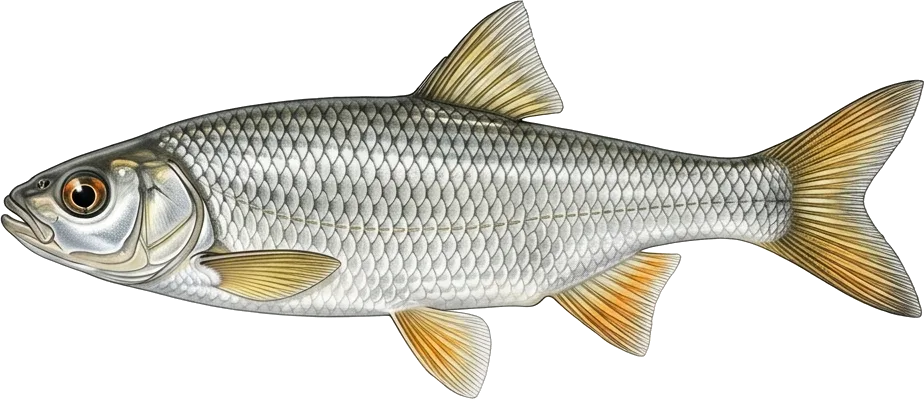
Common Dace Common dace (Leuciscus leuciscus) is an active, rheophilic cyprinid fish in the family Leuciscidae inhabiting clean gravel streams, riffles, and fast river shallows across Eurasia. The species features a slender spindle-like body, a concave grey anal fin, a pale yellow iris, and weight up to 400 g. Anglers catch dace trotting with light float tackle, dry flies, and nymphs.
Dace is the supreme test of trotting finesse. It demands constant, subtle line hold-back so the bait flutters just ahead of the float above the gravel, fine 0.08–0.10mm hooklengths, and small caddis larvae or bloodworms.
- ✅ You want to master classic river trotting with controlled hold-back on Bolognese or match gear.
- ✅ You want to distinguish dace from chub and roach with 100% accuracy using anal fin curvature and eye color.
- ✅ You need proven baits for clear streams: caddis larvae, mayflies, bloodworms, and beadhead nymphs.
- ✅ You seek calibrated lightweight tackle for lightning-fast reactions to snappy current takes.
- ✅ You want to master dace current dynamics and feeding stations in 'Volga 2026'.
Ichthyology & Adaptations: Biological Profile of Leuciscus leuciscus
The common dace (*Leuciscus leuciscus*) is an aquatic torpedo in the family Leuciscidae, engineered to thrive against fierce stream currents:
A sub-cylindrical, spindle-shaped cross-section gives dace minimal hydrodynamic drag. It can hold stationary in powerful river currents behind bed obstructions with nominal muscular effort.
The posterior margin of the anal fin is distinctly concave (curving inward), tinted greyish-yellow. This represents the primary anatomical key separating dace from round-finned chub.
Dace eyes exhibit a characteristic straw-yellow iris. Unlike roach's blood-red eyes, dace vision is tuned to intercept small insect silhouettes drifting rapidly through illuminated surface riffles.
A pharyngeal formula of 2.5–5.2 with sharp hooked tips is adapted to snag and crush caddis cases, stonefly nymphs, and chitinous exoskeletons of terrestrial beetles.
Common Dace vs European Chub vs Common Roach: Identification Guide
Anglers frequently confuse juvenile chub, dace, and roach on river riffles. Here are conclusive identification markers:
- Anal fin: distinctly CONCAVE (inward curved), grey or pale yellowish.
- Mouth: narrow, subterminal (small with delicate lips).
- Eyes: iris is PALE YELLOW or straw-colored.
- Body: slender, sub-cylindrical, 47–53 scales along lateral line.
- Habitat: fast clean currents, rocky and gravel river riffles.
- Anal fin: distinctly CONVEX (rounded outward), VIBRANT BRIGHT RED.
- Mouth: enormous, wide, terminal with thick fleshy lips.
- Eyes: greenish-yellow, large.
- Body: robust, wide flat head; large scales (44–46) with black-edged lattice.
- Habitat: riffles, deep pools, current lines beneath overhanging willows.
- Eyes: iris is BLOOD RED or bright orange with a dark dorsal fleck.
- Body: distinctly deeper and laterally compressed (not cylindrical).
- Fins: pelvic and anal fins are bright red or orange.
- Scales: larger (40–45 in lateral line), easily detached.
- Habitat: quiet bays, slow glides, weedy margins.
Take Dynamics & River Trotting Hold-Back Physics
Stationed behind a stone, dace spots drifting food, launches a lightning interception, and turns back to its station. The float registers this with a crisp, sudden plunge lasting only fractions of a second.
The primary error is free-drifting. Surface currents run faster than benthic boundary layers; an unretarded float drags the bait ahead of the flow, triggering suspicion and refusals.
The Hold-Back Technique: Angler feather-brakes line peeling off the spool. The float slows, water pressure lifts the bait just off bottom, presenting it ahead of the float in an irresistible flutter.
Seasonal Habitats & Stream Staging for Common Dace
Common dace is an obligate rheophil with migrations linked to tributaries and riffles:
Early Spring (April): Immediately following ice-out at +6...+10°C, dace mass into gravel tributaries for early spawning. Foraging is voracious in eddy seams on bloodworms and worms.
Summer (May – August): Shoals disperse across riffles, island tails, and gravel glides (0.5–1.5m). Mornings and evenings feature surface rise frenzies on falling terrestrial insects.
Autumn (September – November): Declining temperatures push dace into deeper glides and channel margins (2.0–3.5m). Schools coalesce and grow wary, responding best to stealthy long-range trotting.
Winter (December – March): Overwinters in flowing pools (2.5–5.0m) with clean gravel and ample dissolved oxygen. Taken through ice on small tungsten jigs fished with gentle cadences.
Dace Menu: Caddis, Bloodworms, Insects & Groundbait
1. Natural Animal Baits (Prime Choice)
Caddis larva (case-caddis / 'shitik') is the all-time premier dace bait; fresh bloodworms (1–2 larvae); small pinkies; houseflies and mayflies during summer hatches.
2. Plant Offerings
Steamed pearl barley, wheat grains, and firm rye bread punch. In midsummer on heavily fished rivers, single barley grains select for the largest specimen dace.
3. River Current Attractors
In swift currents, sweet dips wash away uselessly. Lean into pungent spices: crushed coriander, fennel, aniseed, and roasted hempseed meal.
4. Heavy Current Groundbait Dynamics
The mix must be dense and inert: coarse breadcrumbs, biscuit, heavy river clay, and up to 50% gravel. It must pin to the bed, releasing a steady carpet without buoyant flakes.
Tackle: Bolognese Trotting, Match & Fly Rigs
Tackling dace requires rigs offering surgical line mending and trotting control:
Bolognese Trotting System (5–6m)
Light 5.0–6.0m fast-action Bolognese rod. 2500 spinning reel or smooth Centrepin reel. Floating mainline 0.12–0.14mm, hooklength 0.08–0.10mm (25–35cm). Body-up trotting float (1.5–3.0g).
Match Rod with Stick Float
3.9–4.2m match rod with raised guides preventing wet line from adhering to the blank. Optimized for stick floats in shallow running water at 15–25m ranges.
Fly Angling: Dry Flies & Euro-Nymphing
#3–4wt fly rod, floating WF line, 2.7m tapered leader (0.10mm tippet). Patterns: Red Tag, Adams, Elk Hair Caddis, and tungsten Pheasant Tail nymphs on #16–20 hooks.
Debunking Common Dace Myths
Fact: Completely distinct species! Dace features a concave grey-yellow anal fin, small mouth, and straw-yellow iris. Chub has a convex bright red anal fin and an enormous terminal mouth.
Fact: Dace is a benthic-planktonic feeder. Up to 70% of its annual diet consists of bottom-dwelling caddis and mayfly nymphs scavenged directly off gravel.
Fact: Without controlled hold-back, dace rarely connects. Subtle line retardation causes the bait to flutter ahead of the float, triggering confident takes.
Scientific Research on Leuciscus leuciscus
'The dace is a swift, agile, and handsome fish... It loves clean, fresh, and cold water, staging on fast currents and riffles with sand or fine gravel beds... The prime angling method is float trotting near bottom, or dry surface fishing with insects.'
'Leuciscus leuciscus: spindle body contour minimizes drag in high-velocity stream cores. A biserial pharyngeal formula of 2.5–5.2 with hooked crowns is biomechanically optimized to grip and crush armored trichopteran cases and aquatic beetles.'
'Leuciscus leuciscus: early spring spawning at +6...+10°C on clean gravel ridges. Mature length spans 15–20 cm (reaching 30–40 cm in Siberian rivers). An obligate rheophil displaying acute fidelity to silt-free benthic substrates.'
4 Tactical Current Strategies for Common Dace
Trot the float down current, feathering the line every 1–2m. The hookbait flutters up off the stones, prompting an immediate strike.
Collect caddis larvae from stream stones before fishing. Thread onto a fine-wire size 16–18 hook behind the dark collar.
At dusk, target riffles with Red Tag or Elk Hair Caddis on a 0.10mm tippet, maintaining a drag-free dead drift.
Target dace in 2–3m pool transitions below current. Fish a small tungsten jig tipped with bloodworm on a gentle rhythmic lift.
Seasonal Matrix: Depths, Optimal Times, Baits & Rigs
| Season | Peak Feeding Time | Depth Zone | Top Baits | Tackle System |
|---|---|---|---|---|
| Spring (April – May) | 08:00 – 17:00 (Sunny hours) | 0.5 – 1.2 m (Tributaries, seams) | Bloodworm, caddis, worm | 5m Bolognese, trotting |
| Summer (June – August) | 05:00 – 09:00, 18:00 – 21:30 | 0.4 – 1.5 m (Riffles, glides) | Caddis, grasshopper, flies, pinkie | Bolognese, fly rod #3/4 |
| Autumn (Sept – Nov) | 10:00 – 16:00 (Midday warmth) | 1.5 – 3.0 m (Glides, drop-offs) | Bloodworm, small maggot | Match with stick float, Bolognese |
| Winter (Ice Fishing) | 09:00 – 15:00 (Thaws) | 2.0 – 4.5 m (Flowing winter pools) | Bloodworm on micro-jig | Winter ice rod with sensitive nod |
Angling Diagnostic: Identify What's Impeding Your Dace Catch
Select the symptoms you are experiencing for instant technical adjustments:
Common Dace in 'Volga 2026' Simulator
In 'Volga 2026', common dace is simulated with authentic streamflow drag and trotting hold-back mechanics. Weight spectrum spans 0.05 to 0.40 kg. It demands surgical terminal control in running water.
Key in-game locations: 'Rocky Riffle', 'Fast Channel', 'Island Run', 'Forest Creek Mouth'.
Dace is featured in quests 'River Trotting School', 'Secrets of the Riffle', and 'Silver Sprint', unlocking tournament Bolognese rods.
Frequently Asked Questions About Common Dace
How can you distinguish dace from juvenile chub with 100% certainty?
Examine the anal fin: dace has a CONCAVE (notched) grey-yellow fin and a narrow mouth. Chub features a CONVEX (rounded) BRIGHT RED anal fin, wider head, and large mouth.
What is the essence of trotting with hold-back?
The angler gently brakes line peeling off the spool. The float slows, allowing water pressure to carry the hookbait ahead of the float in an enticing flutter.
What hookbait is considered most effective for dace?
Fresh caddis larvae gathered from stream rocks. Dace intercepts natural caddis without hesitation throughout the open-water season.
Can common dace be targeted with spinning tackle?
Yes, dace readily attacks micro-spoons (0.8–1.5g) and spinners #00–000 on fast riffles fished with ultralight rods and thin #0.2 PE braid.
Where does dace migrate in winter?
In winter, dace vacates shallow riffles, wintering in 2.0–4.5m flowing pools with gravel-sand beds, feeding actively during thaws.
Authoritative Ichthyological Sources & Literature: FishBase — Leuciscus leuciscus (Linnaeus, 1758) Species Summary · IUCN Red List of Threatened Species — Leuciscus leuciscus · Л. П. Сабанеев — «Жизнь и ловля пресноводных рыб» (Викитека) · Институт биологии внутренних вод им. И. Д. Папанина РАН (ИБВВ РАН)
Prepared by the Volga 2026 Editorial Board in strict adherence to aquatic biology and sport angling standards. Volga 2026 Editorial Methodology.