Coregonid Ecology & Deepwater Finesse Angling · Volga 2026 Encyclopedia
Common Whitefish
Coregonus lavaretus (Linnaeus, 1758)
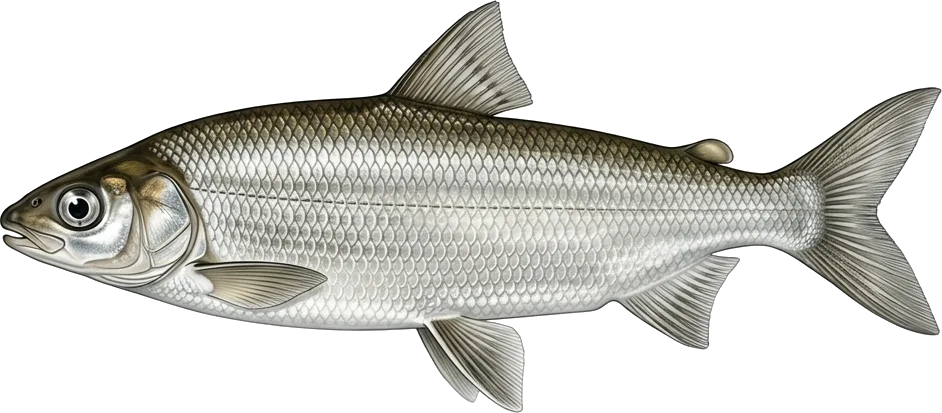
Common Whitefish Common whitefish (Coregonus lavaretus) is a cold-water salmonid fish inhabiting deep oligotrophic lakes and subarctic river basins across northern Eurasia. The species features an adipose fin, deciduous silvery cycloid scales, 20–40 dense gill rakers, and weight up to 8 kg. Anglers catch whitefish on finesse bottom feeder rigs, nymphs, and vertical winter spoons.
Whitefish demands jeweler-level finesse: deploying 3–5 dropper nymph rigs (Hégène), hairline 0.12–0.14mm monofilament, precision bottom baiting with bloodworms via dump-feeders, and silky-smooth fight handling.
- ✅ You want to definitively distinguish common whitefish from vendace and peled by its subterminal mouth and blunt snout.
- ✅ You want to master deepwater ice and boat angling using multi-nymph Hégène dropper rigs in 12–25m depths.
- ✅ You need proven offerings: luminous glow-jigs, micro-treble tungsten beads, nymph droppers, and fat bloodworms.
- ✅ You want to explore coregonid science: sparsely vs densely rakered morphs, Pontoporeia amphipod diet, and oxyphily.
- ✅ You want to master whitefish mechanics and deep lake quests in 'Volga 2026'.
Ichthyology & Adaptations: Biological Profile of Coregonus lavaretus
Common whitefish (*Coregonus lavaretus*) is an evolutionarily plastic salmonid displaying unique morphological traits:
The mouth is subterminal and toothless, with the upper snout protruding prominently over the lower jaw like a blunt nose. This definitively separates it from vendace, which possesses a superior upturned mouth.
Whitefish diverges into distinct trophic morphs: sparsely-rakered (16–30 rakers) benthophages feeding on bottom clams/scuds, and densely-rakered (35–65 rakers) planktivores filtering open pelagic waters.
Whitefish stays locked to the benthic zones of deep oligotrophic lakes at +4...+12°C. It bears easily shed silver scales and the signature salmonid adipose fin.
Mouth membranes are paper-thin and fragile. Harsh, aggressive hooksets instantly tear through the jaw, requiring soft, sweeping sets and continuous rod elasticity.
Common Whitefish vs European Vendace vs Peled: Coregonid Guide
Comparative anatomical guide for three premier coregonid species:
- Mouth: SUBTERMINAL (blunt snout overhangs the mouth).
- Body: elongated, moderately deep with slightly humped back.
- Diet: benthic fauna (clams, amphipods, bloodworms) and plankton.
- Size: 0.8–2.5 kg (trophies reaching 4–6 kg).
- Habitat: 12–30m deep trenches of cold lakes and northern rivers.
- Mouth: SUPERIOR (lower jaw projects upward beyond upper jaw).
- Body: herring-like, strongly compressed laterally.
- Diet: micro-zooplankton filtered in open pelagic waters.
- Size: small (15–22 cm, 50–150g).
- Scales: delicate, intensely silvery, shedding on touch.
- Mouth: TERMINAL (both jaws equal in length).
- Body: DEEP-BODIED with pronounced dorsal hump.
- Gill rakers: 49–68 extremely dense, long rakers.
- Size: 1.0–2.5 kg.
- Habitat: lakes and floodplain waters of northern Eurasia.
Mechanics of the Upward Lift-Take & Preserving Fragile Lips
Hovering inches above the deep lake floor, whitefish spots the suspended Hégène droppers. Gently vacuuming in a beadhead nymph, it rises slightly. On the long, sensitive mylar indicator, this registers as a slow, deliberate upward lift ('weightless take').
Strike with a smooth, short upward wrist sweep rather than a vicious snap. During the 20m ascent, whitefish executes frantic spins and head-shakes. The 0.12–0.14mm monofilament must absorb every pulse to prevent tearing the delicate mouth tissue!
Seasonal Habitats: Deepwater Plateaus, Drop-Offs & Ice Deeps
Whitefish movements follow cold hypolimnion water layers and oxygen gradients:
🌱 Spring (Ice-Out Shallows): During late ice and immediate ice-out, schools move onto 4.0–8.0m sandy shelves, gorging on ascending midge pupae and caddis.
☀️ Summer (Hypolimnion Refuge): Surface warming drives whitefish into the icy hypolimnion—deep plateaus and drop-offs (14.0–28.0m). Fished strictly from boats on Hégène rigs at dawn (4:30–8:00 AM).
🍂 Autumn (Gravel Spawning Run): In October–November at +4...+6°C, schools stage over 1.5–4.5m clean gravel shoals and rocky bars to spawn.
❄️ Winter (Peak Ice Season): Pods gather on 12.0–22.0m deep silty-sand plateaus. Feeds aggressively all daylight hours (9:00 AM–4:30 PM) on ice Hégène droppers.
Whitefish Tackle: Hégène Droppers, Glow Beads, Bloodworms & Nymphs
1. Top Natural Baits
Fat bloodworms (1–2 larvae hooked through the head); mini white maggots (pinkies); caddis larvae; finely minced river clam meat.
2. Micro-Jigs & Tungsten Droppers
2.0–2.5mm tungsten teardrops with luminescent glow coating; micro-treble ice jigs tipped with white/yellow glass beads; epoxy nymph droppers.
3. Multi-Nymph Hégène Dropper Program
Epoxy-bodied micro-nymphs (#14–18) in purple, wine-red, and olive with silver ribbing and white beads, imitating ascending chironomid pupae.
4. Fine Bloodworm Spot Program
Pure live small bloodworms deposited on the lake floor via a brass cone dump-feeder in small 30–50g top-ups every 2 hours.
Tackle: Winter Long-Tip Rods, Sensitive Mylar Indicators & Hégène Rigs
Deepwater whitefish angling demands high-sensitivity indicators and supple mainline elasticity:
Winter Ice Rod with Extended Mylar Tip (15–20cm)
Lightweight ice rod with warm cork handle and smooth-drag reel. Long tapered mylar/spring indicator calibrated precisely for upward lift-bites.
Supple 0.12–0.14mm Monofilament Mainline
Premium cold-proof monofilament with low memory and generous stretch to cushion whitefish head-shakes during deep retrieves.
Hégène 5-Dropper Rig on 0.12mm Fluorocarbon (15g Lead)
2.0m fluorocarbon leader (0.12mm) featuring 4–5 micro-nymphs on 3–4cm short droppers spaced 35cm apart, anchored by a 10–18g bottom pear lead.
Debunking Common Whitefish Myths
Fact: Whitefish is a noble member of the salmonid family (Salmonidae), possessing the signature adipose fin and prized delicate white flesh.
Fact: In summer, whitefish is actively targeted from boats using vertical Hégène dropper rigs over 16–25m thermocline breaks.
Fact: Whitefish possesses a small, toothless mouth adapted strictly for micro-plankton, small clams, amphipods, and bloodworms.
Scientific Research on Coregonus lavaretus
'The whitefish is one of the most delicate, delicious, and beautiful fishes of northern lakes... Dwelling in cold abyssal depths, it requires pristine oxygenated water.'
'Coregonus lavaretus sensu lato comprises a complex polymorphic cluster of sympatric ecotypes differentiated by gill raker counts, growth rates, and bathymetric depth partitioning.'
'Coregonus lavaretus: maximum recorded weight exceeds 10kg, length 73cm, lifespan 25 years. Subterminal mouth is optimized for harvesting benthic amphipods (Pontoporeia).'
4 Tactical Deepwater Strategies for Common Whitefish
Smoothly elevate the rig 1 meter off the bottom at 5 cm/sec with subtle tip oscillations, pause for 5 seconds, and slowly lower.
Recharge luminous beads with UV light every 30 minutes. Gentle greenish glow in 20m abyss pulls curious pods from afar.
Trigger a brass dump-feeder 40cm above the lake floor to carpet a tight feeding spot that holds whitefish for hours.
Wind the fish up smoothly from 20 meters without pumping jerks. Maintain steady line tension to avoid tearing fragile mouth tissue.
Seasonal Matrix: Depths, Optimal Times, Baits & Rigs
| Season | Peak Feeding Time | Depth Zone | Top Baits | Tackle System |
|---|---|---|---|---|
| Spring (April – May) | 06:00 – 11:30 & 16:30 – 19:30 | 4.0 – 9.0 m (Sand shelves, late ice) | Bloodworm bunch, caddis, micro-jig | Ice rod or light picker rod |
| Summer (June – August) | 04:30 – 08:30 & 19:00 – 22:00 (Dawn/Dusk) | 14.0 – 28.0 m (Icy hypolimnion deeps) | Hégène nymphs (purple/wine), bloodworm | Boat Hégène rod 1.8–2.4m |
| Autumn (Sept – Nov) | 08:30 – 16:30 (All daylight) | 2.0 – 6.0 m (Gravel spawning shoals) | Pinkies, bloodworms, glow beads | Drift float rig, light feeder |
| Winter (Ice Season) | 09:00 – 16:30 (Peak ice activity) | 12.0 – 22.0 m (Deep lake plateaus) | Gang of glow micro-jigs with bloodworms | 18cm Mylar-tip winter ice rod |
Angling Diagnostic: Identify What's Impeding Your Whitefish Catch
Select the symptoms you are experiencing for instant technical adjustments:
Common Whitefish in 'Volga 2026' Simulator
In 'Volga 2026', common whitefish is simulated with realistic 15–25m deepwater bathymetry, sensitive upward lift-take physics, and fragile lip-tissue dynamics. Weight spectrum spans 0.4 to 3.2 kg. Inhabits deep glacial plateaus and cold northern reaches.
Key in-game locations: 'Cold Reach', 'Deep Fairway', 'Northern Bay', 'Winter Rapid'.
Whitefish crowns the northern ice questline ('Silvery Aristocrat of the Deeps', 'Secret of the Hégène', 'Lake Barometer'), unlocking precision mylar-tip ice rods and glow-jig kits.
Frequently Asked Questions About Common Whitefish
How do you distinguish common whitefish from European vendace?
Key difference is mouth orientation: whitefish has a SUBTERMINAL mouth with a blunt overhanging snout; vendace has a SUPERIOR upturned mouth (lower jaw extends past upper). Whitefish also grows much larger (2–4 kg vs 100g for vendace).
What is a Hégène rig and how does it function?
Hégène is a vertical leader carrying 3–5 micro-nymphs or beadhead droppers on short 3–5cm snells spaced 30–40cm apart with a 10–20g terminal sinker, efficiently probing multiple water layers.
Why does a winter whitefish bite typically register as an upward lift?
Whitefish feeds hovering above the bottom. Vacuuming in the dropper, it rises slightly, relieving tension from the indicator so it straightens smoothly upward.
What is the single best bait for common whitefish?
Fresh fat bloodworms (1–2 hooked through the head) on glow/tungsten micro-jigs, as well as epoxy Hégène nymphs in purple and wine-red with white beadheads.
Why must whitefish be played with extreme softness?
Whitefish has paper-thin, fragile lip tissue. Sharp jerks immediately tear the hook out. Supple 0.12–0.14mm monofilament and a flexible rod tip are essential.
Authoritative Ichthyological Sources & Literature: FishBase — Coregonus lavaretus Biological Summary · IUCN Red List of Threatened Species — Coregonus lavaretus · Л. П. Сабанеев — «Жизнь и ловля пресноводных рыб» (Викитека) · Институт биологии внутренних вод им. И. Д. Папанина РАН (ИБВВ РАН)
Prepared by the Volga 2026 Editorial Board in strict adherence to aquatic biology and sport angling standards. Volga 2026 Editorial Methodology.