Osmerid Biology & High-Speed Luminous Ice Angling · Volga 2026 Encyclopedia
European Smelt
Osmerus eperlanus (Linnaeus, 1758)
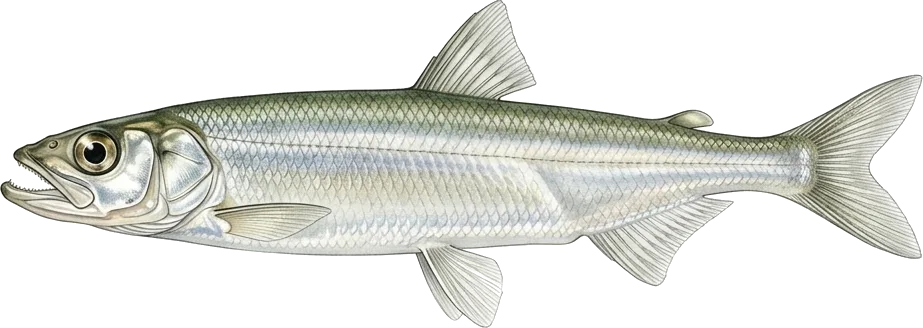
European Smelt European smelt (Osmerus eperlanus) is a schooling anadromous and lacustrine forage fish of the family Osmeridae native to coastal waters and deep lakes of Northern Europe. The species is famous for its distinct fresh cucumber aroma, glossohyal fang teeth, adipose fin, and weight up to 200 g. Anglers catch smelt through the ice with multi-hook luminous jig rigs.
Smelt requires high-speed battery tactics: deploying 3–5 specialized ice rods loaded with UV-charged glow jigs, tipped with fresh fish cubes (or smelt itself), and keeping lures brilliantly illuminated.
- ✅ You want to definitively distinguish smelt from vendace and bleak by prominent jaw fangs and cucumber aroma.
- ✅ You want to master high-volume ice angling deploying multi-rod batteries of luminous glow jigs.
- ✅ You need proven baits: fresh crucian strips, carp fillets, eelpout, and the classic 'smelt-on-smelt' cannibale cut.
- ✅ You want to explore the biochemistry of cucumber aldehydes and the predatory ecology of Osmerus eperlanus.
- ✅ You want to master European smelt mechanics and winter tournament runs in 'Volga 2026'.
Ichthyology & Adaptations: Biological Profile of Osmerus eperlanus
European smelt (*Osmerus eperlanus*) is a distinct predatory osmerid displaying remarkable sensory adaptations:
The distinct cucumber scent is generated by volatile *trans-2-cis-6-nonadienal* (cucumber aldehyde) secreted by dermal glands. This enzyme serves as a powerful antimicrobial barrier protecting delicate scales in sub-zero waters.
Unlike toothless whitefishes or bleaks, smelt's jaws, palate, vomer, and tongue bristle with sharp, recurved predatory fangs. Smelt readily engulfs forage fish up to half its own body length.
In 10–25m depths, smelt eyes are exquisitely tuned to green/cyan photons (490–520nm). The soft glow of phosphor beadheads is interpreted as dense clusters of bioluminescent mysid shrimp.
The species divides into two distinct morphs: large anadromous/river smelt (15–28 cm, 60–180g) and freshwater dwarf lake smelt / snirt (*morpha spirinchus*, 6–10 cm, 8–15g) populating deep cold lakes.
European Smelt vs European Vendace vs Bleak: Identification Guide
Comparative anatomical guide for three slender silvery schooling species:
- Aroma: VIVID, INTENSE FRESH CUCUMBER SCENT.
- Teeth: PROMINENT SHARP FANGS on jaws, vomer, and tongue.
- Fins: ADIPOSE FIN PRESENT behind the dorsal fin.
- Body: semi-translucent with silver-green iridescent hue.
- Size: 10–25 cm (30–150g).
- Aroma: fresh fish scent (cucumber odor COMPLETELY ABSENT).
- Mouth: SUPERIOR (lower jaw curves upward like a scoop).
- Teeth: absent (toothless coregonid mouth).
- Fins: adipose fin present (salmonid family).
- Size: 12–22 cm.
- Adipose fin: COMPLETELY ABSENT (cyprinid family).
- Scales: shed effortlessly at touch ('silver dust').
- Teeth: pharyngeal only (jaws entirely toothless).
- Aroma: neutral freshwater fish scent.
- Size: 10–18 cm.
Mechanics of the Aggressive Take & High-Speed Hauling
Cruising in dense schools along 8–20m deep benthic shelves, smelt zeroes in on glowing phosphor beadheads and fresh fish scents. Striking aggressively, its toothed jaws lock solidly over the hook. On the spring-wire neon ball indicator, this registers as an abrupt, solid downward plunge.
Strike immediately with a crisp upward arm sweep. Frequently, during the 15-meter retrieve, secondary and tertiary droppers are ambushed by trailing smelts, producing multi-hookup doubles and triples. Fast hand-over-hand hauling on sturdy 0.16–0.18mm lines lands scores of fish in minutes!
Seasonal Habitats: Deepwater Drop-Offs, Sandbars & Ice Runs
Smelt is primarily a winter ice and early spring migratory target:
🌱 Spring (Massive Spawning Run): Massive runs from deep lakes into river estuaries and shallow gravel bars (1.0–3.5m) at +4...+8°C water temperatures.
☀️ Summer (Abyss Refuge): Retreats into the deepest 16.0–30.0m hypolimnion trench floor to escape summer heat. Angling halts.
🍂 Autumn (Pre-Winter Feeding): Cooling waters trigger feeding migrations across 8.0–15.0m sandy shoals and channel drops, gorging on mysids and small fry.
❄️ Winter (Peak Ice Battery Season): Enormous schools blanket 10.0–25.0m fairway shelves and sand flats. Feeds all day with ferocious peaks at dawn (8:00–11:00 AM) and late dusk.
Smelt Tackle: Luminous Phosphor Jigs, Fresh Cutbait & UV Glow
1. Fresh Fish Strip Baits
Tiny 3x3mm cubes of fresh crucian, carp, zander, eelpout, or smelt itself (with skin intact); mini white and fluorescent red maggots.
2. Phosphor Luminous Droppers (Glow in the Dark)
Tear-drop and spherical poly-resin glow jigs (emitting bright green, chartreuse, and UV-cyan hues) on long-shank #14–16 hooks.
3. UV Flashlight Recharging
High-power 395nm UV flashlight used to blast luminescent pigment every 15–20 minutes prior to dropping down the hole.
4. No Groundbait (Active Scouting)
Smelt is not groundbaited with grains. Success relies entirely on tracking roaming schools via sonar and teasing them with glowing jigs.
Tackle: Kobylka Ice Rods, Spring-Wire Ball Indicators & 0.16mm Lines
High-speed, deepwater smelt hauling requires tangle-free, stiff terminal rigging:
Foam Kobylka Ice Rod
Ultra-light spoolless foam rod with built-in line winder that stands upright on ice. 20–30cm stiff fiberglass tip.
Spring-Wire Neon Ball Indicator
Coiled steel spring with high-vis fluorescent orange/chartreuse foam ball. Clearly visible from 5–10m away when any rod in the spread trips.
Stiff 0.16–0.18mm Monofilament Rig with 25–35g Pear Lead
Stiff 0.16–0.18mm mono (tangle-resistant in wind), 2–3 glow jigs on rigid 2cm side-droppers (0.20mm) spaced 30cm apart, anchored by a 25–35g bottom lead.
Debunking Common European Smelt Myths
Fact: Smelt is a predatory piscivore. The cucumber scent is caused by *trans-2-cis-6-nonadienal* produced by protective dermal glands, not its diet.
Fact: Smelt strikes ferociously without line shyness. Stiff 0.16–0.18mm mono is mandatory to prevent wind tangles during rapid hand retrieves from 15m.
Fact: Snirt (*morpha spirinchus*) is a distinct, sexually mature dwarf lacustrine ecotype of European smelt reproducing at lengths of just 6–8cm.
Scientific Research on Osmerus eperlanus
'The smelt ranks among the most celebrated and flavorful fishes... It is distinguished by a remarkable cucumber aroma, semi-translucent body, and sharp predatory fangs.'
'Osmerus eperlanus is a highly plastic euryhaline pelagic predator. Secretion of trans-2-cis-6-nonadienal by epidermal glands performs bacteriostatic protection during dense spawning runs.'
'Osmerus eperlanus: maximum recorded weight 350g, length 30cm, lifespan 10 years. Optical pigments are tuned for maximal sensitivity in cyan-green deepwater spectral bands.'
4 Tactical High-Volume Ice Strategies for Smelt
Every 15 minutes, cycle through your rods, blasting the phosphor beadheads with a UV torch to maintain maximum underwater luminescent pull.
Slice fresh crucian or smelt into 3x8mm strips with skin intact. Hook through one end so the tail flutters attractively in bottom currents.
Strike firmly and haul line hand-over-hand with wide rhythmic motions, casting line downwind behind your back to eliminate snarls.
Drill 5 holes stepped across 12 to 18 meters. Identify the main corridor of the passing school and consolidate remaining rods onto that contour.
Seasonal Matrix: Depths, Optimal Times, Baits & Rigs
| Season | Peak Feeding Time | Depth Zone | Top Baits | Tackle System |
|---|---|---|---|---|
| Winter (Dec – Feb) | 08:30 – 11:30 & 14:30 – 17:30 (Dawn/Dusk) | 10.0 – 22.0 m (Deep lake shelves) | Fresh crucian cutbait, smelt strip | Battery of Kobylka ice rods, 0.16mm |
| Spring (March – April) | 07:00 – 18:00 (All daylight) | 4.0 – 10.0 m (Estuary staging) | Fish strips, glow beadheads, worms | Late-ice gang rigs |
| Spring (May, Open Water) | 20:00 – 03:00 (Night spawning) | 1.0 – 3.5 m (River sand bars) | Small worms, bloodworms, dip nets | Drift float rod, light picker |
| Summer – Autumn (June – Nov) | Abyssal feeding (Sporadic takes) | 16.0 – 30.0 m (Lake floor deeps) | Fish strips on boat dropper rigs | Boat Hégène or vertical jigger |
Angling Diagnostic: Identify What's Impeding Your Smelt Catch
Select the symptoms you are experiencing for instant technical adjustments:
European Smelt in 'Volga 2026' Simulator
In 'Volga 2026', European smelt is simulated with high-speed multi-rod battery mechanics, luminous glow physics, multi-hookup doubles, and high-volume session pacing. Weight spectrum spans 25 to 220 g. Inhabits deep northern bays and sandbanks.
Key in-game locations: 'Northern Bay', 'Cold Reach', 'Winter Rapid', 'Island Reach'.
Smelt crowns the high-speed ice questline ('Cucumber Frenzy', 'Secret of the Luminous Semaphore', 'Winter Century Club'), unlocking competition Kobylka rods and UV torches.
Frequently Asked Questions About European Smelt
Why does freshly caught smelt smell strongly of cucumbers?
Epidermal glands secrete volatile *trans-2-cis-6-nonadienal* (cucumber aldehyde). This organic compound provides a powerful bacteriostatic barrier protecting thin scales in dense winter schools.
How do you distinguish European smelt from European vendace?
Key differences: 1) Teeth: smelt bristles with sharp fangs on jaws, vomer, and tongue (vendace is toothless); 2) Aroma: smelt smells vividly of fresh cucumber, absent in vendace; 3) Mouth: vendace features an upturned superior scoop mouth.
What is the single best bait for ice fishing European smelt?
Fresh fish cutbait: 3x3mm cubes of crucian, carp, zander, or smelt itself ('smelt-on-smelt') with skin attached for firm hook hold.
Why are luminous glow jigs essential for smelt angling?
In 12–25m depths under ice, semi-darkness reigns. The soft green/cyan glow of phosphor jigs mimics bioluminescent mysid shrimp, pulling schools from across the basin.
What is 'snirt' and how does it relate to European smelt?
Snirt (*morpha spirinchus*) is the resident freshwater dwarf ecotype of European smelt native to deep lakes. It matures at just 6–10cm (8–15g) while retaining predatory fangs and the signature cucumber scent.
Authoritative Ichthyological Sources & Literature: FishBase — Osmerus eperlanus Biological Summary · IUCN Red List of Threatened Species — Osmerus eperlanus · Л. П. Сабанеев — «Жизнь и ловля пресноводных рыб: Снеток» (Викитека) · Институт биологии внутренних вод им. И. Д. Папанина РАН (ИБВВ РАН)
Prepared by the Volga 2026 Editorial Board in strict adherence to aquatic biology and sport angling standards. Volga 2026 Editorial Methodology.