Anadromous Clupeid Biology & Mainstream Fast-Current Tactics · Volga 2026 Encyclopedia
Volga Herring
Alosa kessleri volgensis (Berg, 1913)
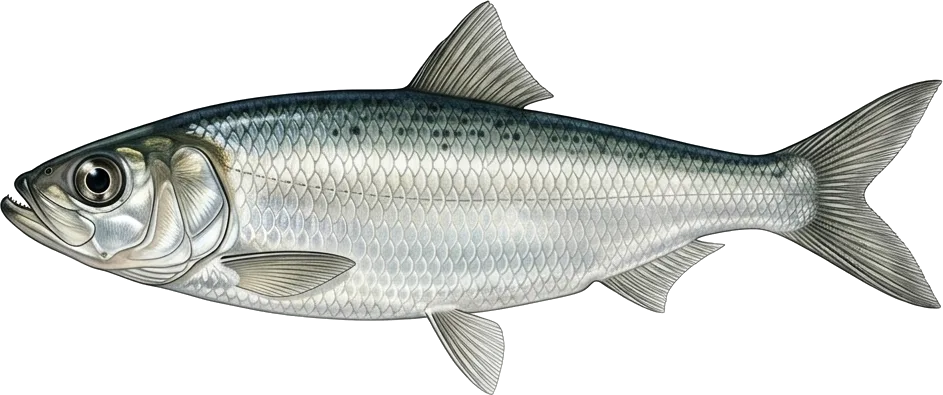
Volga Herring Volga herring (Alosa kessleri volgensis) is an anadromous schooling clupeid fish of the family Clupeidae migrating upstream from the Caspian Sea into Volga tributaries. The species features a serrated ventral abdominal keel, 60–80 fine gill rakers, high lipid content, and weight up to 600 g. Anglers catch migrating herring using multi-lure sabiki rigs, white tubes, and small casting spoons.
Volga herring demands fast-paced active tackle: 2.4–2.7m light spinning rod (3–15g rating), slender Kastmaster spoons (5–10g), Flashabou streamers, or traditional bottom shock-cord rigs rigged with 4–5 white vinyl quills on short droppers.
- ✅ You want to definitively distinguish Volga herring from giant Blackback shad and round herrings by ventral keel scutes and gill rakers.
- ✅ You want to master high-speed spinning retrieves with Kastmasters, micro-pilkers, and tandem fly droppers.
- ✅ You need the proven shock-cord rig setup: elastic tension tuning, fluorocarbon droppers, and glow-in-the-dark vinyl tubes.
- ✅ You want to explore anadromous biology: thermal migration triggers (+12...+18°C), diurnal depth stratification, and hydrodynamics.
- ✅ You want to master Volga herring mechanics and shoaling quests in 'Volga 2026'.
Ichthyology & Anadromous Migratory Adaptations: Profile of Alosa kessleri volgensis
Volga herring (*Alosa kessleri volgensis*) is an anadromous pelagic clupeid engineered for distance river runs:
A sharp ridge of 30–34 serrated scutes spans the belly from throat to vent. It slices through heavy upstream river currents, minimizing turbulent drag during rapid swimming.
The first branchial arch bears 90–140 long, slender rakers forming a dense sieve. Volga herring filters pelagic crustaceans (mysids, copepods) and preys on small fish fry.
In spring as water temperatures hit +12...+14°C, massive shoals ascend from the Caspian Sea into the Volga and Akhtuba to spawn over sand-gravel flats, covering 30–50 km per day.
Equipped with large eyes and adipose eyelids, herring reacts instinctively to silver and white flashes in mid-water, aggressively attacking narrow spoons, vinyl tubes, and flashy flies.
Volga Herring vs Blackback Shad vs Caspian Round Herring: Identification Guide
Comparative anatomical guide for three Caspian-Volga clupeid species:
- Body: streamlined, elongated, laterally compressed.
- Gill rakers: 90–140 DENSE SLENDER RAKERS.
- Color: grey-green back, silver flanks, 1 dark spot behind opercle.
- Belly: sharp serrated keel (30–34 scutes).
- Size: 25–40 cm (200–600g, rare to 900g).
- Size: COLOSSAL (up to 55 cm, weight 1.2–2.0+ kg).
- Back: PITCH-BLACK or dark violet-black.
- Gill rakers: 60–90 coarse, rigid rakers.
- Mouth: strong teeth on jaws (active piscivore).
- Fat content: record lipid levels (up to 20%).
- Body: VERY DEEP, rounded, compressed ('pot-bellied').
- Gill rakers: 70–150 fine rakers.
- Spots: ROW OF 4–8 DARK SPOTS along flank.
- Size: small (15–22 cm, 50–150g).
- Habitats: brackish bays and delta shallows.
Mechanics of the Fast-Current Take & High-Speed Fight
Moving in a dense school against the current at 2m depth, the herring spots a flashing Kastmaster spoon or white vinyl quill on a shock-cord rig. Intercepting the lure at full sprint, the strike transmits a crisp, electric snap through the blank, followed instantly by high-frequency vibrating headshakes.
The mouth tissues of herring are delicate and papery. Overly aggressive winching or locked drags tear the hook free instantly. Deploy moderate-fast (Regular-Fast) parabolic rods and supple 0.18mm mono to absorb frantic leaps and thrashing in heavy flow!
Seasonal Habitats: River Fairways, Sand Spits & Harbor Reaches
Volga herring is a strictly seasonal anadromous spring migrant:
🌱 Spring (Peak Anadromous Run): The absolute golden season! Massive shoals push upstream through Volga/Akhtuba channels along sand spits (1.5–4.0m). Prime bites occur at dawn and dusk.
☀️ Summer (Post-Spawning Downstream Drift): Spent herring drifts downstream toward the Caspian Sea. Lingers in lower delta channels and harbor zones (3.0–6.0m).
🍂 Autumn (Caspian Sea Feeding Grounds): Feeds in open Caspian waters. Only isolated stray schools linger in deep lower delta trenches (4.0–8.0m).
❄️ Winter (Caspian Overwintering): Overwinters in deep southern basins of the Caspian Sea. Completely absent from upper Volga waters.
Volga Herring Baits: Kastmasters, White Vinyl Quills, Flashabou Streamers & Maggots
1. Natural Animal Baits
Cluster of white and red maggots (3–4 on hook); tiny topmouth gudgeon fry; slender strip of fresh silvery fish skin.
2. Spoons & Micro-Pilkers (5–12g)
Slender casting spoons: Acme Kastmaster (5–10g), Hayabusa Jack Eye pilkers, and Mepps Aglia Long inline spinners #1–2 with silver blades.
3. Vinyl Quill Shock-Cord Rigs & Streamers
White, pearlescent, and glow-in-the-dark vinyl quills (12–15mm) slipped over hook shanks #6–8; white bucktail/Flashabou fly streamers.
4. No Groundbait (Visual Stalking)
Groundbait is not used. Herring runs continuously; anglers track shoals by surface boils and diving gulls, fan-casting the main current seam.
Tackle: Light Spinning Rods (3–15g), 0.18mm Mono & Shock-Cord Rigs
Angling for fast pelagic herring in heavy flow requires responsive, long-casting gear:
Light Spinning Rod 2.4–2.7m (3–15g Rating, Regular-Fast)
Long, responsive blank punching 7–10g spoons 60–75 meters and cushioning headshakes from papery lips in fast current.
High-Speed Reel 2500–3000 (5.8:1–6.2:1 Gear Ratio)
High-speed spinning winch retrieving lures rapidly through the upper water column. Spooled with 0.18mm mono or PE #0.6 braid with a 0.16mm leader.
Traditional Shock-Cord Rig (15–20m Elastic Shock-Cord)
2.5mm heavy elastic shock-cord, 400g lead anchor, 0.30mm mainline trace fitted with 4–5 short 0.16mm droppers (10cm) bearing white vinyl quills.
Debunking Common Volga Herring Myths
Fact: Volga herring is an obligate anadromous species. It matures in the Caspian Sea, ascending Volga rivers only for a few weeks in spring to spawn.
Fact: Herring runs strictly in the upper 1.5–3m water column and ignores plant paste, demanding flashy moving lures in fast current.
Fact: Blackback shad is significantly larger (up to 2 kg) with a black back and teeth; Volga herring is smaller (up to 600g) with fine gill filters.
Scientific Research on Alosa kessleri volgensis
'The Volga herring runs in spring in countless shoals... Slicing the water with its sharp belly, it voraciously strikes anything flashing, representing one of our fastest river migrants.'
'Alosa kessleri volgensis is an anadromous clupeid. Characterized by 90–140 slender gill rakers and 30–34 ventral scutes. Spawning migration triggers at water temperatures of +12.0°C.'
'Alosa volgensis: maximum recorded weight 0.9–1.0kg, length 42cm, lifespan 6–7 years. Pelagic planktivore with high cruising sprint velocities up to 1.8 m/s.'
4 Tactical High-Speed Strategies for Volga Herring
Cast the slender spoon cross-current. Execute rapid steady retrieves with sharp rod-tip twitches inside the 1.5–2.0m sub-surface zone.
Rig a 5cm dropper with a white feather/Flashabou fly 35cm ahead of the main spoon. Herring routinely attacks both offerings in doubles!
Deploy a 50m shock-cord setup into the channel. Smoothly pump and release the 5-quill trace, simulating a frantic school of darting fry.
Step onto the sand bar at 4:30 AM. At dawn, herring rises to the surface, creating foaming feeding frenzies in the current seams.
Seasonal Matrix: Depths, Optimal Times, Baits & Rigs
| Season | Peak Feeding Time | Depth Zone | Top Baits | Tackle System |
|---|---|---|---|---|
| Spring (Peak Run) | 05:00 – 09:30 & 17:30 – 21:00 (Dawn/Dusk) | 1.5 – 3.5 m (Sand fairway spits) | 7g Kastmaster, white quills, flies | 2.7m Light spin (3–15g) or shock-cord |
| Summer (Downstream Drift) | 06:00 – 10:00 & 18:00 – 20:30 | 3.0 – 6.0 m (Harbor channels) | 10g Micro-pilkers, maggots on float | Spinning with PE #0.6, 0.16mm trace |
| Autumn (Delta Outflow) | 11:00 – 16:00 (Stray delta schools) | 4.0 – 8.0 m (Lower delta pits) | 14g Pilkers, fish strip bait | Jig rod or vertical jigging |
| Winter (Caspian Seas) | Sea overwintering (Absent in river) | Deep Caspian marine basins | River angling inactive | Angling closed |
Angling Diagnostic: Identify What's Impeding Your Volga Herring Catch
Select the symptoms you are experiencing for instant technical adjustments:
Volga Herring in 'Volga 2026' Simulator
In 'Volga 2026', Volga herring is simulated as an explosive schooling sprinter ('a shoaling silver migrant') featuring high-speed current interception, frantic high-frequency headshakes, Kastmaster spoons, vinyl quills, and fly streamers. Weight spectrum spans 120 to 900 g. Inhabits open fairway riffles, harbor channels, and swift current runs.
Key in-game locations: 'Volga Expanses', 'Harbor Pier', 'Sandy Spit', 'Old Riverbed'.
Volga herring crowns the spring high-speed questline ('Silvery Runner of the Flood', 'Secret of the Shock-Cord Rig', 'High-Speed Fairway Double'), unlocking long-casting light spinning rods and artisan micro-pilker kits.
Try Catching Volga Herring in Current in Volga 2026 Simulator →
Frequently Asked Questions About Volga Herring
Where does the Volga herring come from in spring?
Volga herring is an anadromous migrant. It matures in the Caspian Sea, ascending hundreds of kilometers upstream into the Volga and tributaries during May–June strictly to spawn.
How does Volga herring differ from the legendary giant Blackback shad (zalom)?
Blackback shad (Alosa kessleri kessleri) reaches 2 kg with a jet-black back and predatory teeth. Volga herring is smaller (250–600g) with an olive back and fine plankton filter of 90–140 gill rakers.
How is the traditional Volga shock-cord herring rig constructed?
A 400g lead anchor connects to 15–20m of rubber shock-cord, followed by a 0.30mm trace bearing 4–5 short 0.16mm fluorocarbon droppers (8–10cm) fitted with white vinyl quills, attached to the mainline.
What is the single best spinning lure for Volga herring?
A slender silver Acme Kastmaster spoon (7–10g) retrieved at high velocity within the 1.5–2.5m sub-surface depth zone.
Why do herrings frequently pull off during the fight?
Herrings possess thin, delicate, papery mouth membranes. Stiff leverage or locked drags rip the hook free easily; a soft parabolic blank and light drag setting are mandatory.
Authoritative Ichthyological Sources & Literature: FishBase — Alosa kessleri Biological Summary · IUCN Red List of Threatened Species — Alosa kessleri · Л. П. Сабанеев — «Жизнь и ловля пресноводных рыб» (Викитека) · Институт биологии внутренних вод им. И. Д. Папанина РАН (ИБВВ РАН)
Prepared by the Volga 2026 Editorial Board in strict adherence to aquatic biology and sport angling standards. Volga 2026 Editorial Methodology.