Ponto-Caspian Gobiid Biology & Coastal Rockfishing · Volga 2026 Encyclopedia
Sea Goby
Neogobius melanostomus (Pallas, 1814)
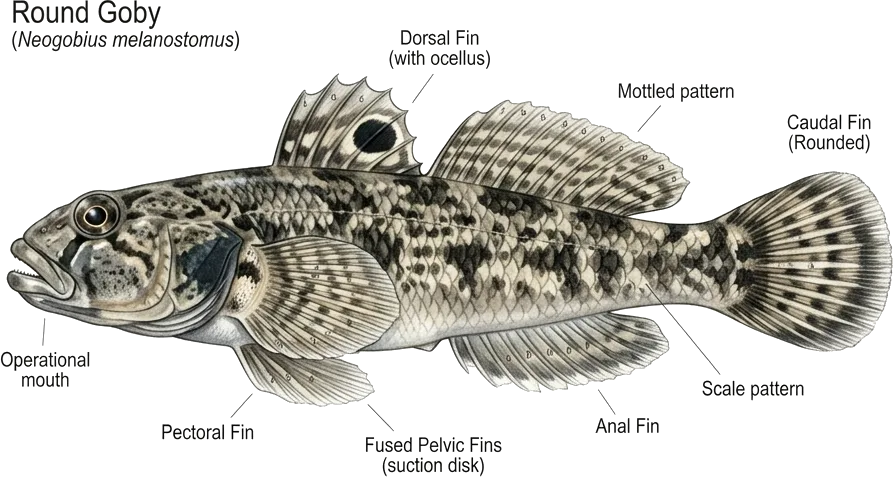
Sea Goby Round goby (Neogobius melanostomus) is a prolific benthic fish of the family Gobiidae native to the Ponto-Caspian basin and European waterways. The species features fused pelvic fins forming a ventral suction disc, a prominent black ink spot on the first dorsal fin, and weight up to 350 g. Anglers catch goby with light ledger rigs and micro-jigs baited with worms.
Sea goby demands snag-resistant coastal gear: 2.1–2.4m rockfishing rod (1–10g, Solid Tip), 0.18–0.22mm abrasion-resistant fluorocarbon trace (protecting against razor-sharp mussel shells), 4–8g Tiroler Hölzl or drop-shot, Long Shank #8–10 hook, and prime baits: fresh shrimp, mussel meat, or nereis worm.
- ✅ You want to definitively understand round goby biology: pelvic suction mechanics, malacophagous shell-crushing habits, and pharyngeal teeth.
- ✅ You want to master rockfishing techniques among concrete tetrapods, granite breakwaters, harbor piers, and shallow marine reefs.
- ✅ You need top baits: fresh coastal mussel meat, peeled shrimp, nereis seaworms, and scented micro-silicone grubs.
- ✅ You want to eliminate snagged sinkers in boulder crevices using Tiroler Hölzl buoyant sticks and offset drop-shot rigs.
- ✅ You want to master sea goby mechanics and breakwater quests in 'Volga 2026'.
Ichthyology & Coastal Benthic Adaptations: Profile of Neogobius melanostomus
Round sea goby (*Neogobius melanostomus*) is a benchmark benthic survivor engineered for turbulent coastal shoals:
Pelvic fins are fused into a compliant suction cup. Generating negative hydrostatic pressure, the goby anchors securely to vertical granite walls and concrete tetrapods amidst crashing breakers.
The posterior edge of the first spiny dorsal fin bears a prominent black oval spot with a pale halo. This is the definitive diagnostic marker of *Neogobius melanostomus* separating it from all other gobies.
Specialized for eating bivalves (mussels, Dreissena). Heavy pharyngeal bones studded with molariform teeth effortlessly crush hard calcareous shells like a nutcracker.
During spawning, males transform entirely: the body and fins turn pitch-black with a stark white-cream dorsal fin margin. The male aggressively guards the egg clutch deposited under flat rocks.
Round Goby vs Toad Goby (Martovik) vs Monkey Goby: Identification Guide
Comparative anatomical guide for three common ponto-caspian gobiids:
- Fin: BOLD BLACK OVAL SPOT on rear of first dorsal fin.
- Head: rounded, convex forehead, blunt snout.
- Suction cup: powerful, circular disc.
- Size: medium (12–22 cm, weight 50–380g).
- Biotope: rocky breakwaters, piers, mussel beds.
- Size: COLOSSAL (lengths to 35–40 cm, weight 600–900g).
- Head: ENORMOUS, broad, depressed like a toad.
- Dorsal spot: COMPLETELY ABSENT.
- Mouth: cavernous predatory maw with sharp teeth.
- Habitats: deep offshore rock ledges and reefs.
- Color: PALE, yellowish-grey matching clean sand.
- Dorsal spot: ABSENT (lacks the dark ocellus).
- Body: more elongated and slender.
- Biotope: CLEAN SANDY BEACHES and flats.
- Size: small (10–16 cm, weight 30–120g).
Mechanics of the Breakwater Crevice Strike & Instant Lift
Perched inside a deep crevice between concrete tetrapods, the sea goby tracks the descending offering. The moment the fresh shrimp or plump mussel touches bottom, the goby launches a sudden ambush dash, clamping down with crushing jaws. The sensitive solid tip registers a sharp staccato rattle ('tap-tap-tap') transitioning into a sudden downward bend.
Strike WITHOUT DELAY! Within a split second of the take, the goby attempts to reverse into its rock hole, flaring its opercular spines to wedge immovably inside the crack. Lift the fish 30–50cm off bottom with a decisive upward sweep and reel up swiftly. A Long Shank hook allows effortless 2-second disgorging!
Seasonal Habitats: Breakwater Rocks, Harbor Pilings & Shell Reefs
Round sea goby congregates strictly over hard rocky and bivalve-encrusted seabed:
🌱 Spring (Shallow Spawning Rocks): Moves onto shallow 0.5–2.5m boulders and reefs. Pitch-black courting males fiercely attack any bait.
☀️ Summer (Peak Coastal Rockfishing): Inhabits breakwater shadows, tetrapod crevices, and harbor piers (1.5–5.0m). Feeds all day with dusk peaks.
🍂 Autumn (Deep Shell Reefs): Drops to 4.0–10.0m outer breakwater slopes and mussel beds. Produces the plumpest 380g trophy specimens.
❄️ Winter (Deep Offshore Plateaus): Retreats offshore to 10.0–25.0m depths. Targeted from boats using deep-water drop-shot rigs.
Sea Goby Baits: Fresh Shrimp, Mussels, Nereis Seaworm & Scented Micro-Silicone
1. Fresh Natural Marine Baits
Segment of fresh raw shrimp; fresh coastal mussel meat (pierced through the tough foot); nereis seaworm; 2cm salted squid strip.
2. Scented Micro-Silicone (Light Rock Fishing)
Marukyu Power Isome, Berkley Gulp Sandworm, Crazy Fish Cruel Crustacean 1.5'' rigged on 3–5g micro-cheburashka jig heads.
3. Amino-Acid Marine Attractants
Liquid shrimp extract, concentrated crab oil, and squid essence, enticing gobies out from the deepest tetrapod caverns.
4. Crushed Mussel Chumming
Smash 5–6 fresh mussels directly over your target crevice. Descending crushed shell fragments establish an intense feeding magnet.
Tackle: 2.1–2.3m Rockfish Blank (Solid Tip), 0.20mm Line & Tiroler Hölzl
Fishing amongst jagged tetrapods requires sensitive yet tough, snag-resistant rockfishing gear:
2.1–2.3m Rockfishing Rod (1–10g Rating, Solid Tip)
Ultra-sensitive solid carbon tip registering delicate micro-taps, backed by a stiff butt section to haul fish out of rock holes.
Size 2000–2500 Spinning Reel with PE #0.4–0.6 Braid
Smooth, compact reel providing precise line lay for surgical vertical drops between massive breakwater blocks.
4–8g Tiroler Hölzl + 0.18–0.22mm Hard Fluorocarbon Leader
Buoyant Tiroler stick prevents sinker wedging, while heavy abrasion-resistant fluorocarbon resists razor-sharp barnacles and mussels.
Debunking Common Sea Goby Myths
Fact: Round goby is an active malacophagous predator feeding on live mussels, shrimps, seaworms, and juvenile fish.
Fact: The suction disc is formed by fused pelvic fins on the belly, while the mouth functions strictly for food capture.
Fact: Deploying a buoyant Tiroler Hölzl or drop-shot rig virtually eliminates snag losses in rock rubble.
Scientific Research on Neogobius melanostomus
'The round goby sits under every shoreline boulder... Its pelvic sucker holds so tenaciously that the fish is difficult to pry off smooth granite.'
'Neogobius melanostomus exhibits broad euryhaline tolerance (0 to 25 PSU salinity). The pelvic disc generates 12–18 kPa suction tenacity via epithelial microvilli and flexible marginal fin rims.'
'Neogobius melanostomus: maximum recorded weight 350–380g, length 22–25cm, lifespan 4–6 years. Serves as a prime bio-controller of Dreissena and Mytilus bivalves.'
4 Tactical Breakwater Rockfishing Strategies for Sea Goby
Drop a Tiroler Hölzl rig vertically into pockets between concrete blocks. Deliver gentle taps on the stone followed by 3-second pauses.
Cut a 1.5cm shrimp tail segment and thread onto a Long Shank #8 hook. The pungent crustacean scent provokes instantaneous strikes.
On the first strike impulse, execute a brisk 40cm rod lift, preventing the goby from wedging its opercular spines beneath stones.
Deploy scented Marukyu Isome worms or 1.5'' craws on articulated micro-jigs. Subtle bottom crawling temps the largest trophy specimens.
Seasonal Matrix: Depths, Optimal Times, Baits & Rigs
| Season | Peak Feeding Time | Depth Zone | Top Baits | Tackle System |
|---|---|---|---|---|
| Spring (Spawning Shallows) | 08:00 – 19:00 (Full daylight) | 0.5 – 2.5 m (Littoral boulders & reefs) | Mussel meat, raw shrimp, nereis | 2.1m Rockfish rod, drop-shot rig |
| Summer (Breakwater Peak) | 06:00 – 11:30 & 17:30 – 21:30 (Dusk) | 1.5 – 5.0 m (Tetrapods & pier pilings) | Shrimp, mussel, Power Isome | 5g Tiroler Hölzl, 0.20mm fluorocarbon |
| Autumn (Deep Outer Reefs) | 10:00 – 16:30 (Warm calm window) | 4.0 – 10.0 m (Outer mussel banks) | Mussel meat, squid strip, nereis | 8–12g Drop-shot with Long Shank |
| Winter (Offshore Depths) | 11:00 – 15:00 (Boat offshore) | 10.0 – 25.0 m (Deep offshore plateaus) | Squid chunk, firm mussel meat | Boat casting rod with micro-pilker |
Angling Diagnostic: Identify What's Impeding Your Sea Goby Catch
Select the symptoms you are experiencing for instant technical adjustments:
Sea Goby in 'Volga 2026' Simulator
In 'Volga 2026', sea goby is simulated as a classic coastal benthic resident ('hides among the breakwater rocks and bites short, as if testing your patience') featuring worm, shrimp, shell, and seaworm tactics across saltwater and breakwater environments. Weight spectrum spans 40 to 380 g. Inhabits breakwaters, piers, sand-rock seabed, and coastal lagoons.
Key in-game locations: 'Marine Breakwater', 'Harbor Pier', 'Mussel Shell Bank', 'Salt Lagoon'.
Sea goby unlocks the coastal rockfishing questline ('Sentinel of the Stone Breakwater', 'Secret of the Pelvic Sucker', 'Master of the Tiroler Hölzl'), unlocking Rockfish Pro rods and artisan Tiroler Master sinker sets.
Frequently Asked Questions About Sea Goby
Why does the sea goby have a suction disc on its belly?
Fused pelvic fins form an adhesive suction disc allowing the goby to anchor firmly onto slick boulders and tetrapods during pounding surf surges.
What is the best bait for catching sea goby from a pier?
A segment of fresh raw shrimp and fresh crushed mussel meat hooked through the tough dark foot on a Long Shank #8–10 hook.
How do you avoid snags in rocks when fishing for gobies?
Deploy a buoyant Tiroler Hölzl stick rig or drop-shot setup tied with stiff 0.20mm fluorocarbon trace material.
How do you distinguish round goby from other marine gobies?
Round goby (*Neogobius melanostomus*) always possesses a distinct dark oval spot with a pale halo on the posterior edge of its first dorsal fin.
What maximum weight can a round sea goby attain?
Round sea goby reaches 350–380g at lengths up to 22–25 cm (averaging 80–180g and 14–18 cm), remaining a thick, meaty rockfishing prize.
Authoritative Ichthyological Sources & Literature: FishBase — Neogobius melanostomus Biological Summary · IUCN Red List of Threatened Species — Neogobius melanostomus · Л. П. Сабанеев — «Жизнь и ловля пресноводных рыб» (Викитека) · Зоологический институт РАН (ЗИН РАН)
Prepared by the Volga 2026 Editorial Board in strict adherence to aquatic biology and sport angling standards. Volga 2026 Editorial Methodology.