Pleuronectid Ecology & Coastal Beach Surfcasting · Volga 2026 Encyclopedia
European Flounder
Platichthys flesus (Linnaeus, 1758)
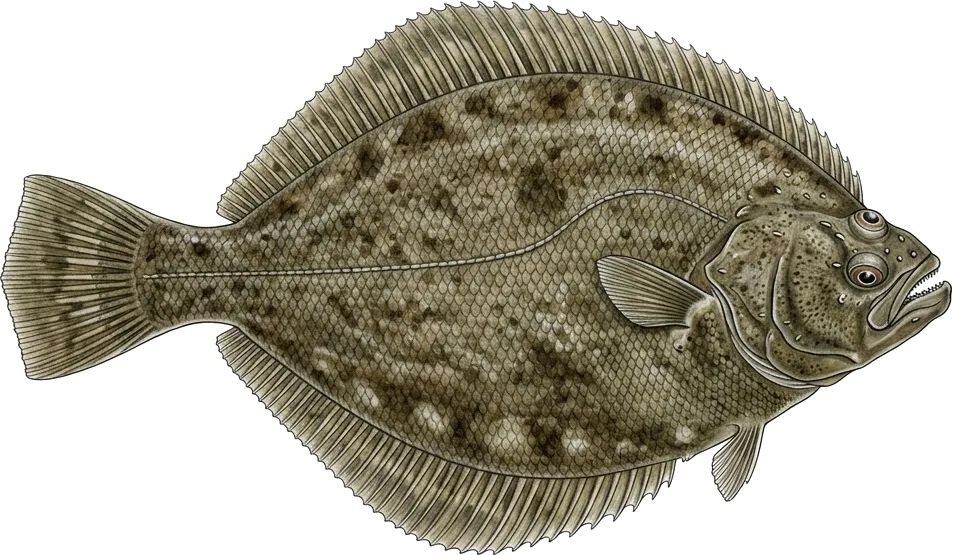
European Flounder European flounder (Platichthys flesus) is a highly adaptable flatfish of the family Pleuronectidae inhabiting coastal sandy shoals and migrating far upstream into freshwater rivers. The species features an asymmetric flattened body with both eyes on the right side, dynamic chromatosome camouflage, and weight up to 3 kg. Caught on surfcasting rigs using ragworms, shrimp, and fish strips.
Flounder demands powerful coastal surfcasting gear: 3.9–4.2m beach rod (80–150g rating), size 6000–8000 Long Cast reel, 0.50mm shock leader, 0.28–0.32mm fluorocarbon snoods with luminescent glow beads, Baitholder #2–6 hooks, and top baits: fresh nereis worms, sprat strips, or raw shrimp.
- ✅ You want to definitively understand flounder biology: chromatosome skin camouflage, periscope eye articulation, and sand-burrowing kinetics.
- ✅ You want to master coastal surfcasting from sandy beaches, rocky headlands, and outer breakwater moles at 80–130m distances.
- ✅ You need top baits: fresh nereis/lugworms, oily fish strips (sprat, anchovy), mussel meat, and raw shrimp tails.
- ✅ You want to tie high-catch flounder rigs fitted with luminescent glow beads, sequins, and floating attractor pearls.
- ✅ You want to master flounder mechanics and sea surf quests in 'Volga 2026'.
Ichthyology & Benthic Camouflage Adaptations: Profile of Platichthys flesus
European flounder (*Platichthys flesus*) represents a masterpiece of benthic specialization:
The ocular side skin is packed with thousands of pigment-shifting chromatosomes. Within 2–5 minutes, the flatfish mirrors the exact pattern of sand grains, pebbles, or crushed shells, vanishing from sight even at 20cm range.
Both eyes sit on the ocular flank elevated on muscular periscope pedestals. The fish buries itself completely under sediment, leaving only two sharp eyes scanning overhead waters independently.
Rows of fine, sharp osseous tubercles run along the lateral line and dorsal/anal fin bases. Stroking the fish against the grain reveals a distinct sandpaper-like roughness unique to *Platichthys flesus*.
Descending to the seabed, the flatfish executes undulating ripples with its marginal fins. The stirred-up sediment settles cleanly over its back in 3 seconds, seamlessly masking its silhouette.
European Flounder vs European Plaice vs Black Sea Turbot (Kalkan): Identification Guide
Comparative anatomical guide for three commercial coastal flatfishes:
- Skin: ROUGH with sharp bony tubercles along lateral line.
- Color: greenish-brown or sandy with dark marbling.
- Shape: elongated oval, compressed.
- Size: 20–45 cm (weight 200g – 2.8 kg).
- Biotope: sandy surf beaches, estuaries, lagoons.
- Spots: VIVID ORANGE or brick-red circular spots.
- Skin: PERFECTLY SMOOTH, lacking rough tubercles.
- Head: 4–7 bony ridges behind eyes.
- Size: larger (to 50–60 cm, weight 1.5–4.5 kg).
- Biotope: open marine sand beds at 10–50m depths.
- Shape: NEARLY CIRCULAR, broad disc-like frame.
- Skin: studded with LARGE CONICAL BONY SPINES.
- Eyes: strictly left-sided (sinistral).
- Size: MASSIVE (to 70–90 cm, weight 5.0–15.0+ kg).
- Predator: feeds on fish (mackerel, red mullet).
Mechanics of the Surf Strike & Hydraulic Seabed Suction
A heavy 120g beach bomb anchors firmly over an outer sandbar past the second breaker line. Spotting the undulating nereis worm or sprat strip illuminated by a glowing bead, the buried flounder rises and inhales the bait via powerful hydraulic vacuum. The flexible fluorescent tip of the 4.2m surf rod registers two deliberate downward bends ('the nodding dip') before line slacks slightly.
Set the hook with a wide, rhythmic sweeping pull. For the initial seconds it feels like hauling a deadweight carpet: the flounder turns broadside to the current and suctions against the seabed, generating massive hydraulic drag (depth-lock). Pump the fish steadily without slacking line until the mottled flat disc slides through foaming beach breakers!
Seasonal Habitats: Sandbar Breakers, Tidal Flats & Marine Estuaries
European flounder congregates over sandy, silty, and crushed-shell seabed shoals:
🌱 Spring (Post-Spawning Beach Shallows): Moves into 1.0–3.0m surf shoals for intensive spring feeding. Smashes nereis worms and shrimp on sunny days.
☀️ Summer (Breaker Sandbars & Night Surf): Holds along outer sand ridges (2.5–6.0m). Prime window: night hours (10:00 PM to 4:00 AM) and moderate 2–3 ball surf.
🍂 Autumn (Peak Specimen Surf Season): Plump 1.5–2.8kg trophy flatfish pack onto 3.0–8.0m sandbar drop-offs. High feeding all day long.
❄️ Winter (Offshore Shelf Depths): Drops offshore to 15.0–40.0m sandy-silt plateaus. Fished from charter boats with heavy marine ledger rigs.
Flounder Baits: Nereis Seaworm, Oily Fish Strips, Raw Shrimp & Luminous Attractors
1. Prime Natural Marine Baits
Fresh nereis or lugworm threaded via a bait needle; fresh 1x4cm strip of oily sprat, anchovy, or herring; fresh raw shrimp tail; mussel meat.
2. Glow Attractor Beads & Sequins
Luminescent green and pink Glow-in-the-Dark beads (6–8mm), floating Pop-Up pearls, and reflective mother-of-pearl sequins rigged above the hook.
3. Marine Amino-Acid Attractants
Menhaden/herring oil, concentrated shrimp and crab extract soaked into foam beads, creating a persistent scent trail in surf currents.
4. Minced Fish Surf Sinker Feeder
Hollow surf lead packed with minced anchovy or sprat paste, calling flounders from expansive sandy flats.
Tackle: 3.9–4.2m Surf Rod (80–150g), 6000 Long Cast Reel, 0.50mm Shock Leader & Baitholder Hooks
Coastal beach fishing in pounding surf breakers demands specialized long-range surf artillery:
3.9–4.2m 3-Piece Coastal Surfcasting Rod (80–150g Rating)
High-power carbon blank with a sensitive hi-vis fluorescent tip and wide anti-tangle SiC guides engineered for 100+ meter power beach launches.
Size 6000–8000 Surfcasting Reel with Conical Long Cast Spool
Saltwater-sealed chassis spooled with 0.28–0.32mm main mono coupled to a 15-meter 0.28–0.55mm tapered shock leader.
100–130g Breakaway Wire Grip Sinker + Baitholder #2–6 Hooks
Breakaway wire grip lead holds bottom in heavy surf currents, while dual-barbed hook shanks keep worms from bunching.
Debunking Common Flounder Myths
Fact: Flounder larvae hatch symmetrical and swim upright; the skull metamorphosis and eye migration occur after 4–6 weeks of pelagic life.
Fact: When ambushing prey or escaping, flounder executes explosive high-speed sprints up to 15 meters with astonishing agility.
Fact: European flounder regularly enters the crashing surf zone in 1.0–2.5m depths, making beach surfcasting exceptionally productive.
Scientific Research on Platichthys flesus
'The flounder burrows into sand with such artistry that only its protruding eyes remain visible... It thrives in pure sea water as well as deep up freshwater river mouths.'
'Platichthys flesus is an amphidromous euryhaline teleost. Physiological osmoregulatory mechanisms enable adults to migrate deep into freshwater river deltas (<0.5 PSU salinity).'
'Platichthys flesus: maximum recorded specimen weight 2.8–3.2kg, length 50–60cm, lifespan 12–15 years. Integumentary chromatosomes are modulated by the sympathetic nervous system within seconds.'
4 Tactical Coastal Surfcasting Strategies for Flounder
Deliver a power cast with a 4.2m surf blank beyond the frothing white breaker line. The 120g grip lead anchors the rig on the calm outer sand terrace.
Slide 2 green luminous phosphor beads onto the snood above the hook and charge with a UV torch. The glow draws curious flatfish from expansive sand flats.
Peak feeding occurs when surf waves scour bivalves and worms from the sand. Deploy wire-grip breakaway leads to prevent current drifting.
Rest rods on tall beach tripods at night (10:00 PM to 3:30 AM). Clip chemical glow sticks to tips to detect subtle nodding pull-downs.
Seasonal Matrix: Depths, Optimal Times, Baits & Rigs
| Season | Peak Feeding Time | Depth Zone | Top Baits | Tackle System |
|---|---|---|---|---|
| Spring (Post-Spawning Inshore) | 09:00 – 18:00 (Sunny calm) | 1.0 – 3.0 m (Beach sandy shallows) | Nereis seaworm, fresh shrimp | 3.9m Surf rod, 100g lead, 0.28mm trace |
| Summer (Night Surf & Breakers) | 22:00 – 04:00 (Night) & surf surge | 2.5 – 6.0 m (Gullies past sandbars) | Nereis, fresh sprat/anchovy strip | 4.2m Surf (80–150g), glow beads |
| Autumn (Peak Trophy Season) | 07:00 – 21:00 (All day & evening) | 3.0 – 8.0 m (Outer sandbar drops) | Herring strip, nereis, mussel | Heavy surf rod with 130g grip lead |
| Winter (Deep Offshore Shelf) | 11:00 – 15:30 (Boat fishing) | 15.0 – 40.0 m (Deep marine shelf) | Firm fish strips, squid strips | Heavy boat ledgering rig |
Angling Diagnostic: Identify What's Impeding Your Flounder Catch
Select the symptoms you are experiencing for instant technical adjustments:
Flounder in 'Volga 2026' Simulator
In 'Volga 2026', flounder is simulated as a benthic flatfish resident ('a flat shadow on the sand that comes alive with a heavy pull') featuring hydraulic depth-lock mechanics, shrimp, shell, seaworm, and small-spoon tactics across saltwater sandbars and breakwaters. Weight spectrum spans 180g to 2.8 kg. Inhabits sandbars, breakwaters, coastal beaches, and marine estuaries.
Key in-game locations: 'Sandy Sea Spit', 'Marine Breakwater', 'Tidal Estuary', 'Salt Lagoon'.
Flounder unlocks the coastal surfcasting questline ('Master of Sand Camouflage', 'Secret of the Glow Bead', '2.8kg Surf Breaker Trophy'), unlocking Surf Master Pro blanks and artisan Glow Surf terminal tackle rigs.
Frequently Asked Questions About European Flounder
How does the flounder change color so rapidly to match the seabed?
The skin contains specialized pigment cells called chromatosomes. Processing visual signals from periscope eyes, the nervous system redistributes pigments in 2–5 minutes to replicate sand or gravel textures.
What is the single most productive bait for surf flounder?
Fresh nereis or lugworm threaded via a baiting needle, fresh oily fish strips (sprat/anchovy), and raw shrimp tails.
Why are luminescent glow beads used on flounder rigs?
Flounder possesses intense visual curiosity. Glowing phosphor beads in murky surf churn call fish from broad distances directly to the baited hook.
How does European flounder differ from Black Sea turbot (kalkan)?
European flounder has an elongated oval frame, fine tubercles along the lateral line, and right-sided eyes. Turbot/kalkan is nearly circular, massive (up to 15 kg), and strictly left-eyed.
What maximum weight can a European flounder attain?
European flounder attains weights of 2.5–2.8 kg (rarely 3.2 kg) at lengths up to 45–50 cm (averaging 300–900g and 25–35 cm), serving as an exquisite coastal sport prize.
Authoritative Ichthyological Sources & Literature: FishBase — Platichthys flesus Biological Summary · IUCN Red List of Threatened Species — Platichthys flesus · Л. П. Сабанеев — «Жизнь и ловля пресноводных рыб» (Викитека) · Зоологический институт РАН (ЗИН РАН)
Prepared by the Volga 2026 Editorial Board in strict adherence to aquatic biology and sport angling standards. Volga 2026 Editorial Methodology.