Gadoid Deep-Sea Ecology & Heavy Marine Vertical Jigging · Volga 2026 Encyclopedia
Atlantic Cod
Gadus morhua (Linnaeus, 1758)
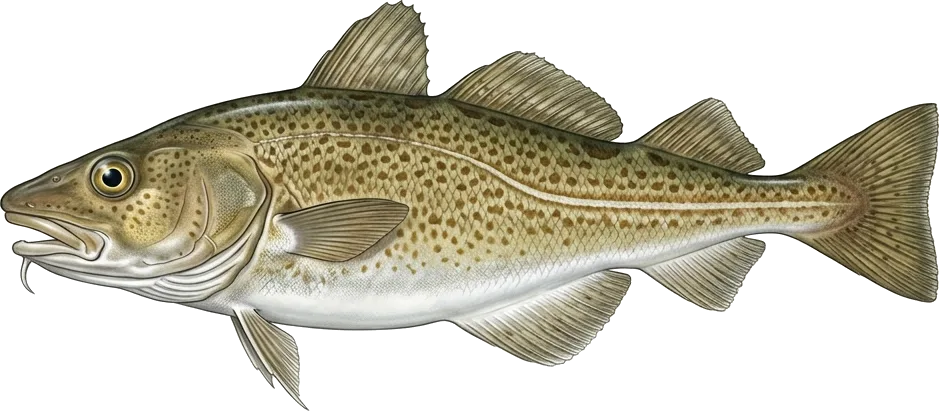
Atlantic Cod Atlantic cod (Gadus morhua) is a benthopelagic marine predator of the cod family (Gadidae) inhabiting cold continental shelves and deep rocky banks. The species features three distinct dorsal fins, two anal fins, a pale curved lateral line, a sensory chin barbel, and weight exceeding 40 kg. Anglers catch cod using heavy vertical boat jigs, chrome Swedish pilkers, and squid strips.
Atlantic cod demands rugged offshore boat tackle: 1.8–2.2m boat rod (100–300g rating or 20–30 lb class), heavy-duty marine multiplier or saltwater 5000–6000 spinner, 8-strand PE #2.5–3.5 braid, 0.8–1.0mm mono shock leader (resisting rock abrasion), and prime lures: 120–250g chrome Swedish Pilkers, 15–20cm giant soft shads on 150g heads, and fresh squid strips.
- ✅ You want to definitively understand Atlantic cod biology: sensory chin barbel function, 3 dorsal fins, and pale curved lateral line anatomy.
- ✅ You want to master offshore vertical jigging and pilker-fluttering cadences over 40–100m submerged plateaus.
- ✅ You need top lures: 150–250g Sølvkroken chrome pilkers, Savage Gear Cutbait Herring shads, fresh squid strips, and glowing octopus assist rigs.
- ✅ You want to properly calibrate offshore multiplier drag settings to pump 8–15kg specimen cod without frying friction washers.
- ✅ You want to master cod mechanics and deep sea quests in 'Volga 2026'.
Ichthyology & Deep-Sea Benthopelagic Adaptations: Profile of Gadus morhua
Atlantic cod (*Gadus morhua*) is a quintessential cold-water apex predator of the Gadidae family:
The lower jaw bears a stout single barbel packed with thousands of gustatory and tactile receptors. Gliding 20cm above the seabed in pitch darkness, the barbel probes sediments to detect buried crabs, bivalves, and sandeels by touch and taste.
Features three distinct dorsal fins and two anal fins. This segmented fin layout provides exceptional stabilization and pitch control during explosive vertical ascents from the seabed.
A continuous, contrasting pale lateral line sweeps in a smooth arch above the pectoral fin. It acts as an acoustic radar detecting the low-frequency vibrations of passing herring and capelin schools up to 30 meters away.
With a broad head and deep shoulders, a hooked cod flares its opercles and wedges against the water column, delivering heavy rhythmic surges straight toward the abyss ('the concrete block effect').
Atlantic Cod vs Haddock vs Saithe (Pollock): Identification Guide
Comparative anatomical guide for three commercial gadoid species:
- Lateral line: PALE, WHITE, smoothly arched over pectoral fin.
- Color: olive-green or brownish with dense dark mottling.
- Barbel: STOUT, PROMINENT on chin.
- Size: LARGE (50–120 cm, weight 2.5–15.0+ kg).
- Biotope: benthic rock reefs and deep canyon drops.
- Lateral line: JET-BLACK, DARK (opposite of cod).
- Spot: LARGE DARK OVAL BLOTCH ('St. Peter's thumbprint') above pectoral fin.
- Barbel: tiny, rudimentary.
- Size: medium (40–70 cm, weight 1.2–4.5 kg).
- Mouth: small, subterminal.
- Jaws: LOWER JAW PROTRUDES FORWARD (undershot bite).
- Color: dark charcoal-green or coal back.
- Barbel: PRACTICALLY ABSENT.
- Lateral line: straight, pale stripe.
- Behavior: fast pelagic hunter of open midwater.
Mechanics of the 60-Meter Chasm Strike & Multiplier Pumping
Drifting aboard a boat over a 55–80m deep submerged reef, the angler executes vertical pilker jigging with a 200g chrome lure: a crisp 1-meter upward sweep followed by a free-flutter drop and 2-second bottom pause. On the flutter fall, a massive strike slams the rod into a horseshoe bend, and the multiplier drag yields 10 meters of braid in a single heavy surge.
Pumping an 8–15kg specimen cod requires rhythmic full-body technique: lifting the rod with both hands and rapidly reeling down on the drop. The fish resists with heavy downward headshakes, but within the final 15 meters, swim bladder expansion brings the mottled titan floating to the surface, ready for the gaff!
Seasonal Habitats: Offshore Banks, Chasm Drop-Offs & Fjord Drops
Atlantic cod congregates strictly in cold marine depths (+2 to +8°C) over structured bottom:
🌱 Spring (Post-Spawning Shelf Banks): Voracious feeding over 35.0–70.0m submerged banks pursuing capelin. Smashes 150–200g chrome pilkers.
☀️ Summer (Deep Offshore Reefs): Holds on 50.0–100.0m outer banks with cold currents. Active all day and midnight sun on giant soft shads.
🍂 Autumn (Peak Trophy Cod Season): Massive 15+ kg behemoths move onto 40.0–80.0m rocky ridges. Prime feeding unfolds during overcast, choppy seas.
❄️ Winter (Pre-Spawning Deep Chasm): Gathers in 60.0–120.0m deep channels. Targeted via heavy boat gear with 250–400g pilkers.
Cod Lures: 150–250g Chrome Pilkers, Giant Soft Shads, Fresh Squid & Herring
1. Heavy Chrome Pilkers (150–250g)
Sølvkroken Svenskepilk 150–250g (chrome/nickel); Banana-style fluttering jigs in hot orange and glow finishes; Kinetic Herring pilkers.
2. Giant Marine Soft Shads (15–23cm)
Savage Gear Cutbait Herring 20cm (150–270g heads); Storm WildEye Giant Jigging Shad 18cm; soft shads in Glow, Pink, and Blue Mackerel patterns.
3. Natural Baits & Luminous Octopuses
Fresh squid strips; whole herring or capelin on deadbait rigs; strings of luminous soft octopus teasers rigged above the main pilker.
4. Sinker Acoustic Rock Thumping
Rhythmic thumping of the heavy chrome pilker on bottom stones. The metallic acoustic pulse calls curious cod from 50 meters away.
Tackle: 1.9–2.1m Boat Rod (100–300g / 30 lb), Multiplier Reel, PE #3.0 Braid & 1.0mm Mono Leader
Offshore deep-sea jigging for powerhouse cod amidst jagged reefs demands an indestructible boat setup:
1.9–2.1m Offshore Vertical Boat Blank (100–300g / 20–30 lb Class)
Unbreakable 1-piece or 1.5-piece thick-walled carbon blank featuring heavy-duty saltwater guides (or spiral Acid Wrap) for multiplier reels.
Heavy-Duty Saltwater Multiplier with Lever Drag
Solid machined aluminum multiplier with 12–15kg drag capacity and high-torque gearing designed for cranking 250g jigs from 80m depths.
PE #3.0–3.5 Braid (40–50 lb) + 3-Meter 0.8–1.0mm Heavy Mono Leader
Dense 8-strand braid coupled to a thick 1.0mm mono trace, preventing catastrophic cut-offs on razor-sharp reef ledges.
Debunking Common Atlantic Cod Myths
Fact: Cod is a dynamic apex predator executing vertical sprints to hunt live herring, capelin, and squid.
Fact: Specimen cod weighing 8–15 kg fight with tremendous downward torque, stripping heavy drag and testing angler endurance.
Fact: Cod is widely distributed across the North Atlantic, Baltic, and White Sea shelves at depths from 20 to 200 meters.
Scientific Research on Gadus morhua
'The cod is the primary sustainer of northern seas... Its power in the deep is astonishing, and jigging with heavy spoons demands immense physical stamina.'
'Gadus morhua executes daily vertical migrations up to 80 meters tracking Clupea harengus and Mallotus villosus. The chin barbel packs up to 24,000 taste buds per mm².'
'Gadus morhua: maximum recorded specimen weight 40–50kg, length 180–200cm, lifespan up to 25 years. Optimal foraging thermal window sits at +2 to +7°C.'
4 Tactical Offshore Vertical Jigging Strategies for Cod
Drop a 200g pilker to the seabed, lift 50cm, and execute 1-meter sweeps with 2-second flutter pauses. 80% of strikes happen on the drop.
Tip the pilker assist hook with a fresh 2x8cm squid strip. The persistent natural scent induces positive strikes even during slack tides.
Slowly swim a giant 20cm shad on a 180g head 1–3 meters above the seabed. This technique selectively targets the biggest behemoths.
Pump the fish using rhythmic upward rod sweeps, reeling down on the descent. Never give slack, preventing the heavy jig from dislodging.
Seasonal Matrix: Depths, Optimal Times, Baits & Rigs
| Season | Peak Feeding Time | Depth Zone | Top Baits | Tackle System |
|---|---|---|---|---|
| Spring (Post-Spawning Banks) | 06:00 – 14:00 (Morning flood tide) | 35.0 – 70.0 m (Submerged banks & plateaus) | 150–200g Sølvkroken, herring strip | 2.1m Boat rod (100–250g), multiplier |
| Summer (Deep Outer Shoals) | 24h (Midnight sun 23:00 – 04:00) | 50.0 – 100.0 m (Deep drop-offs) | 20cm Cutbait Herring shads, squid | 30 lb Marine jigging, PE #3.0 braid |
| Autumn (Peak Trophy Run) | 07:00 – 17:30 (Overcast choppy sea) | 40.0 – 80.0 m (Rocky reefs & banks) | 200–250g Heavy pilkers, Glow octopuses | Heavy boat rod with 1.0mm leader |
| Winter (Abyssal Channels) | 10:30 – 15:00 (Short daylight window) | 60.0 – 120.0 m (Abyssal winter basins) | 300–400g pilkers with squid strips | Heavy marine deep-drop jigging rig |
Angling Diagnostic: Identify What's Impeding Your Cod Catch
Select the symptoms you are experiencing for instant technical adjustments:
Atlantic Cod in 'Volga 2026' Simulator
In 'Volga 2026', Atlantic cod is simulated as a formidable deep-sea benthic predator ('holds the depths and tests how honestly your bottom tackle is built') featuring continuous downward deadweight fight dynamics, jig, pilker, shrimp, and squid strip tactics across deep saltwater plateaus. Weight spectrum spans 0.6 to 8.5 kg (up to 15+ kg in specimen events). Inhabits open sea, cold abyssal banks, and marine canyons.
Key in-game locations: 'Deep Sea Bank', 'Marine Canyon', 'Open Sea', 'Tidal Strait'.
Cod unlocks the master deep-sea offshore questline ('Sovereign of the Cold Abyss', 'Secret of the Chin Barbel', '80-Meter 15kg Chasm Duel'), unlocking Marine Jig Master blanks and Svenskepilk Pro pilker sets.
Frequently Asked Questions About Atlantic Cod
Why does Atlantic cod possess a chin barbel?
The chin barbel is densely covered in chemoreceptors and tactile sensors, allowing cod to locate buried crabs, clams, and sandeels in pitch-black chasm depths by taste and touch.
What is the optimal pilker weight for offshore boat cod jigging?
Depending on depth and boat drift velocity, optimal solid metal pilker weights range from 120 to 250 grams (at 40–90m depths).
How does Atlantic cod differ from haddock?
Cod has a PALE WHITE lateral line, mottled olive body, and a stout barbel. Haddock has a JET-BLACK lateral line and a distinct large dark thumbprint blotch above its pectoral fin.
Why does deep-water cod float to the surface during the final meters?
Due to the rapid hydrostatic pressure drop, the cod's physoclistous swim bladder expands, giving the fish positive buoyancy during the final 15 meters of ascent.
What maximum weight can an Atlantic cod attain?
Atlantic cod reaches 30–40+ kg at lengths up to 1.5–1.8 m (with 3–12 kg fish common in sport angling), representing one of the greatest benthopelagic prizes in the ocean.
Authoritative Ichthyological Sources & Literature: FishBase — Gadus morhua Biological Summary · IUCN Red List of Threatened Species — Gadus morhua · Л. С. Берг — «Рыбы пресных и солоноватых вод СССР» (ЗИН РАН) · Полярный филиал ВНИРО (ПИНРО им. Н. М. Книповича)
Prepared by the Volga 2026 Editorial Board in strict adherence to aquatic biology and sport angling standards. Volga 2026 Editorial Methodology.