Carangid Pelagic Ecology & Japanese Ajing Light Game · Volga 2026 Encyclopedia
Atlantic Horse Mackerel
Trachurus trachurus (Linnaeus, 1758)
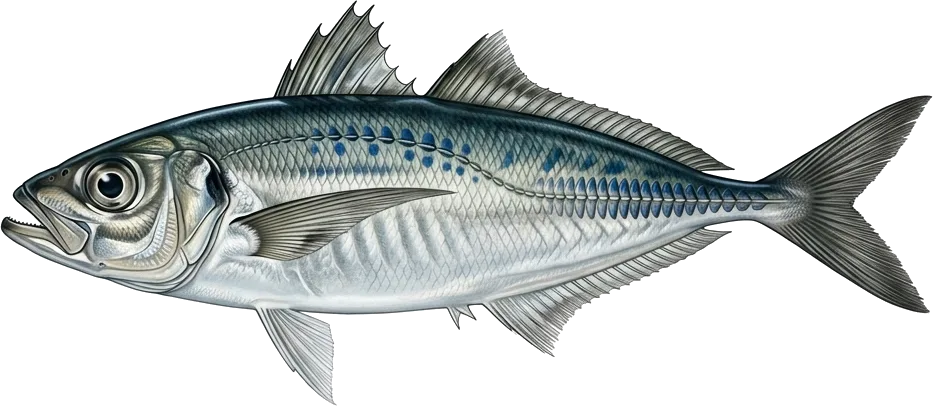
Atlantic Horse Mackerel Atlantic horse mackerel (Trachurus trachurus, or scad) is an energetic schooling pelagic fish of the family Carangidae roaming coastal waters. The species is recognized by a continuous lateral line armored with sharp raised bony scutes, bifurcated dorsal fins, and weight up to 2 kg. Anglers target horse mackerel with light rockfishing metals, soft plastics, and sabiki flasher rigs.
Horse mackerel demands dynamic Ajing tackle: 2.0–2.3m rod (0.5–5.0g, Extra Fast action with crisp Solid/Tubular tip), size 2000 shallow-spool reel, micro-thin PE #0.2–0.3 braid with 0.12–0.14mm fluorocarbon leader, 3–7g micro-pilkers, and glow-in-the-dark scented worms rigged on 1.0–2.5g tungsten heads.
- ✅ You want to definitively understand horse mackerel biology: hydrodynamic scute function, circular schooling maneuvers, and nocturnal light attraction.
- ✅ You want to master Japanese Ajing philosophy with micro-pilkers, assist hooks, and glow-scented worms from illuminated night piers.
- ✅ You need top lures: Major Craft Jigpara Micro 3–7g, Smith Metal Minnow, Maria Aji Flare, Reins Aji Ringer worms, and sabiki rigs.
- ✅ You want to master High-Tempo Darting and twitch-and-fall cadences to maintain contact with passing pelagic schools.
- ✅ You want to master horse mackerel mechanics and open sea quests in 'Volga 2026'.
Ichthyology & High-Velocity Pelagic Adaptations: Profile of Trachurus trachurus
Atlantic horse mackerel (*Trachurus trachurus*) is a benchmark pelagic speedster of the Carangidae family:
The lateral line is armed with a continuous armored row of 68–79 sharp bony scutes forming a rigid keel near the tail. Scutes minimize hydrodynamic turbulence during high-speed cruising while providing puncture defense.
Forages in synchronized shoals numbering hundreds to tens of thousands of fish. The pack enters an instant feeding frenzy upon seeing an accelerating lure, demanding precise high-cadence darting retrieve controls.
Eyes are finely adapted for crepuscular and nocturnal hunting. At night, shoals gather directly inside harbor floodlight beams where micro-krill, anchovies, and sprats swarm.
The mouth extends into a vacuum tube to inhale plankton and fry, but the lip membranes are papery thin. Forcing the retrieve tears the hook out, necessitating a feather-light micro-drag setting!
Horse Mackerel vs Atlantic Mackerel vs Bluefish: Identification Guide
Comparative anatomical guide for three popular coastal pelagic predators:
- Flanks: CONTINUOUS ROW OF SHARP BONY SCUTES along lateral line.
- Spot: distinct dark spot on edge of operculum.
- Tail: deeply forked, slender keeled peduncle.
- Size: 15–35 cm (weight 80g – 1.4 kg).
- Hunting: pack blitzing in midwater under floodlights.
- Back: VIVID TIGER-STRIPED BLUE-BLACK ZEBRA BARS.
- Bony scutes: COMPLETELY ABSENT (velvety smooth skin).
- Finlets: 5 small supplementary finlets near tail.
- Size: larger (25–45 cm, weight 300g – 1.8 kg).
- Family: Scombridae (true mackerels).
- Teeth: RAZOR-SHARP TRIANGULAR CUTTING TEETH in jaws.
- Color: blue-green back, brilliant silver belly.
- Body: robust, muscular, heavy-shouldered.
- Size: FORMIDABLE PREDATOR (60–100 cm, 2.0–12.0+ kg).
- Behavior: slices leaders and shreds baitfish.
Mechanics of the Midwater Pelagic Strike & Finesse Ajing Retrieve
Working a 5g micro-pilker or scented worm on a 1.5g tungsten head through midwater (3–6m depth), the angler applies crisp rhythmic upward tip twitches (High-Tempo Darting). On the 1-second flutter pause, the lure tumbles, throwing light flashes. In that instant, a cruising horse mackerel intercepts the lure at full sprint: the rod tip transmits an electric staccato buzz ('bzzz-tap-tap').
Set the hook with a delicate wrist snap—never ripping the hook through thin lip membranes. During the fight, horse mackerel delivers frantic high-frequency tail thrashes, bending the Ajing blank into a parabolic curve. A whispering light micro-drag cushions sharp headshakes, guiding the gleaming silver prize straight into hand!
Seasonal Habitats: Harbor Piers, Tidal Headlands & Coastal Open Seas
Horse mackerel migrates in pelagic shoals throughout coastal marine zones:
🌱 Spring (Inshore Return): Approaches coastal shallows (5.0–15.0m). Forages intensely in daylight and sunset on micro-spoons and sabiki rigs.
☀️ Summer (Peak Night Ajing Season): Massive shoals pack under pier floodlights (2.0–8.0m). Prime window: 10:00 PM to 4:00 AM.
🍂 Autumn (Specimen Pelagic Season): Jumbo 800–1400g specimens patrol 10.0–30.0m headland drops. Smashes 7–12g micro-pilkers all day.
❄️ Winter (Offshore Abyss Shoals): Retreats offshore into 30.0–80.0m canyons. Targeted from sea charters with heavy deep-drop sabiki strings.
Horse Mackerel Baits: 3–7g Micro-Pilkers, Ajing Silicone, Sabiki Strings & Raw Shrimp
1. Metal Micro-Pilkers (3–7g)
Major Craft Jigpara Micro 3–7g (Silver/Pink/Glow); Smith Metal Minnow 5g; Duo Tetra Works Toto; Halco Twisty 5g, rigged with a tinsel assist hook.
2. Ajing Scented Micro-Worms (Glow & UV)
Maria Aji Flare 1.8'', Reins Aji Ringer, Tict Brilliant 1.5'' in Ultra Glow, Chartreuse, and Pink UV mounted on 1.0–2.5g tungsten heads.
3. Sabiki Flasher Rigs (5–6 Hooks)
Japanese Hayabusa Sabiki rigs crafted with real fish skin, pink flashabou, and luminous bead heads on #10–14 hooks, taking 4–6 fish per drop.
4. Fresh Raw Shrimp & Squid Strips
Tiny segment of fresh shrimp or a 1.5cm sliver of squid tipped onto the micro-pilker assist hook for natural taste and scent.
Tackle: 2.0–2.3m Ajing Blank (0.5–5g), 2000 Reel, PE #0.2 Braid & 0.14mm Leader
Targeting high-velocity horse mackerel on micro-lures demands a specialized Japanese Ajing rod setup:
2.0–2.3m Ajing Specialist Rod (0.5–5g Rating, Extra Fast)
Ultra-crisp high-modulus carbon blank fitted with a sensitive Solid carbon tip engineered to register micro-taps on the flutter fall.
Size 2000 Shallow-Spool High-Speed Reel with Micro-Drag
Featherweight 150–170g chassis featuring a butter-smooth micro-click drag tuned to a delicate 250–300g release threshold.
Ultra-Thin PE #0.2–0.3 Braid + 0.12–0.14mm Fluorocarbon Leader
Hair-thin braid catapults 2g micro-heads 35 meters out, while the fluorocarbon trace prevents abrasion against sharp lateral scutes.
Debunking Common Horse Mackerel Myths
Fact: They belong to separate families (Carangidae vs Scombridae); horse mackerel is defined by sharp armored bony keel scutes.
Fact: Shore-based Ajing micro-jigging from lit night piers is one of the most thrilling and rapidly growing sport fisheries globally.
Fact: The scutes contain zero venom, but are needle-sharp and can puncture careless fingers during handling.
Scientific Research on Trachurus trachurus
'The horse mackerel roams in dense shoals through open marine waters... Its speed is astonishing, and fishing with spoons and sabikis delivers rare sport.'
'The osseous scutes of Trachurus trachurus act as boundary layer turbulators, reducing form drag during cruising speeds up to 2.4 m/s. The species shows sharp phototaxis to 4000–6000K light sources.'
'Trachurus trachurus: maximum recorded specimen weight 1.4–1.8kg, length 45–55cm, lifespan 14–16 years. Muscle tissues contain a rich 18–22% concentration of omega-3 fatty acids.'
4 Tactical Pelagic Ajing Strategies for Horse Mackerel
Execute 3 rapid snappy tip twitches with a micro-pilker followed by a 1.5-second pause. Horse mackerel strikes on the flutter fall.
Cast a Glow-charged worm into the dark water beyond the illuminated circle and retrieve toward the beam. Trophy specimens ambush along the shadow line.
Horse mackerel is lined with sharp bony scutes. Use a plastic Gar Grip to safely secure and unhook the thrashing fish without slicing fingers.
Count seconds on the fall (count of 5, 10, 15). Once you get a strike, lock your retrieve cadence to that exact depth on subsequent casts.
Seasonal Matrix: Depths, Optimal Times, Baits & Rigs
| Season | Peak Feeding Time | Depth Zone | Top Baits | Tackle System |
|---|---|---|---|---|
| Spring (Inshore Return) | 06:00 – 10:00 & 18:00 – 21:00 | 3.0 – 8.0 m (Coastal headlands & piers) | 3–5g Micro-pilkers, Hayabusa sabiki | 2.1m Ajing rod (0.5–5g), PE #0.2 braid |
| Summer (Night Pier Lights Peak) | 22:00 – 04:00 (Pier floodlight dark) | 1.5 – 5.0 m (Illuminated midwater) | Glow/UV scented worms, fresh shrimp | Ultralight Ajing with 1.5g tungsten head |
| Autumn (Specimen Offshore Drops) | 07:00 – 19:30 (All daylight hours) | 8.0 – 20.0 m (Deep headland drops) | 7–12g Heavy micro-pilkers, Smith Metal | 2.3m Rod (1–10g), 0.16mm fluorocarbon |
| Winter (Deep Marine Chasm) | 11:00 – 15:00 (Boat offshore) | 30.0 – 80.0 m (Open marine abyss) | Heavy sabiki strings with 60–100g lead | Offshore boat casting rod |
Angling Diagnostic: Identify What's Impeding Your Horse Mackerel Catch
Select the symptoms you are experiencing for instant technical adjustments:
Horse Mackerel in 'Volga 2026' Simulator
In 'Volga 2026', horse mackerel is simulated as a high-velocity pelagic pack predator ('a shoaling sea speedster — great for learning retrieve tempo') featuring cadence-sensitive retrieve kinetics, micro-spoon, fly, shrimp, and Kastmaster tactics across open saltwater surfaces. Weight spectrum spans 80g to 1.4 kg. Inhabits open sea, marine breakwaters, piers, and heavy coastal currents.
Key in-game locations: 'Open Sea', 'Illuminated Pier', 'Marine Headland', 'Tidal Strait'.
Horse mackerel unlocks the pelagic Ajing questline ('Silver Lightning of the Shelf', 'Secret of the Keel Scutes', 'Night Pier Floodlight Storm'), unlocking Ajing Master Pro blanks and artisan Jigpara Light micro-pilker collections.
Try Catching Horse Mackerel in Open Sea in Volga 2026 Simulator →
Frequently Asked Questions About Atlantic Horse Mackerel
Why does horse mackerel have sharp bony scutes along its flanks?
The row of bony scutes forms a rigid hydrodynamic keel stabilizing the chassis during sharp turns at velocities up to 2.4 m/s while protecting the caudal peduncle from predators.
What is the Japanese Ajing angling style?
Ajing (from Japanese 'Aji'—horse mackerel) is a specialized Japanese ultralight spinning discipline deploying Extra Fast 0.5–5g rods, hair-thin PE #0.2 braids, and glow silicone on micro-tungsten heads.
Why do pilkers work in daytime while scented silicone excels at night?
By day, horse mackerel visually locks onto the metallic flash of long-cast pilkers, while at night it homes in on UV glow illumination and concentrated amino acid scent trails.
How does horse mackerel differ from Atlantic mackerel?
Horse mackerel features a continuous row of sharp bony scutes along its lateral line and an opercular black dot. Atlantic mackerel has smooth skin with tiger-like zebra stripes across its back.
What maximum weight can an Atlantic horse mackerel attain?
Atlantic horse mackerel reaches 1.2–1.4 kg (rarely 1.8 kg) at lengths up to 45–50 cm (averaging 150–400g and 20–28 cm), serving as a premier ultralight fighter.
Authoritative Ichthyological Sources & Literature: FishBase — Trachurus trachurus Biological Summary · IUCN Red List of Threatened Species — Trachurus trachurus · Л. С. Берг — «Рыбы пресных и солоноватых вод СССР» (ЗИН РАН) · Зоологический институт РАН (ЗИН РАН)
Prepared by the Volga 2026 Editorial Board in strict adherence to aquatic biology and sport angling standards. Volga 2026 Editorial Methodology.