Amelanistic Monster Genetics & Heavy Big-Game River Artillery · Volga 2026 Encyclopedia
Albino Wels Catfish
Silurus glanis (рыба-альбинос; редкая цветовая форма)
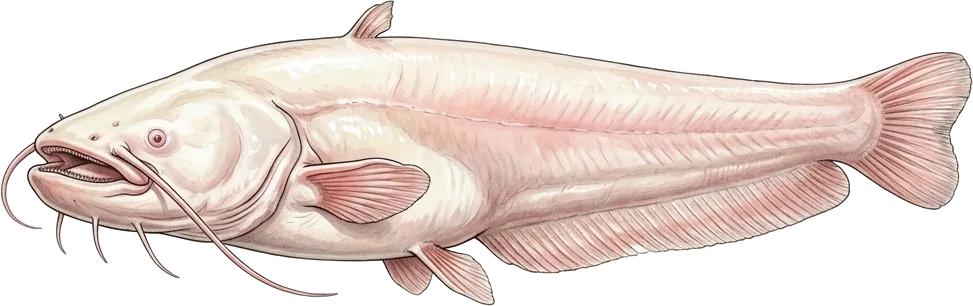
Albino Wels Catfish Albino wels catfish (Silurus glanis morpha alba) is a rare amelanistic chromatic morph of the European catfish (Siluridae) occurring in selective fisheries and wild rivers. The morph is identified by complete melanin deficiency resulting in cream-white skin, light-sensitive pink pupils, and weights up to 100 kg. Anglers catch trophy albino wels using heavy boat gear, clonk rigs, and livebaits.
Albino wels catfish demands heavy-duty Big Game tackle: 1.8–2.1m solid-carbon boat rod (300–600g rating), all-metal multiplier reel, PE #8.0–10.0 braid (80–120 lb), 1.2mm kevlar leader, and baits featuring large livebaits (500–800g) or 30-lobworm bouquets.
- ✅ You want to definitively understand albino catfish genetics (OCA2 gene mutation) and its distinction from pale color morphs.
- ✅ You want to master deepwater clonk (kwok) angling across 18–28m chasms utilizing real-time live sonar tracking.
- ✅ You need proven big baits: 25–35 lobworm bouquets with mole crickets, 600g live bream, singed bird carcasses, and fresh mussel clusters.
- ✅ You want to explore sensory compensation: how blindness is offset by hypertrophied ampullae of Lorenzini and 6 sensory barbels.
- ✅ You want to master albino catfish mechanics and legendary leviathan quests in 'Volga 2026'.
Ichthyology & Extreme Deepwater Adaptations: Profile of the Albino Wels Catfish
Albino wels catfish (*Silurus glanis morpha alba*) is a rare recessive genetic mutation of the apex river predator:
An autosomal-recessive mutation completely disables tyrosinase enzyme synthesis, blocking melanin production. The skin is devoid of pigment, displaying a snow-white or pale cream-pink tone with visible capillaries.
The iris and choroid lack protective melanocytes, causing the eyes to glow ruby-red. Direct sunlight causes acute photophobia, locking the albino giant permanently in the pitch-black security of 20m+ trenches.
Reduced optical acuity is heavily offset by hypertrophied ampullary electroreceptors and lateral line canals. It detects bioelectric pulses down to 0.01 uV/cm and acoustic clonk shockwaves up to 100 meters away.
Albino catfish avoids sunlit shallows entirely. Its habitat is restricted to deep fairway trenches, undercut clay caverns, and massive submerged hardwood logjams in 18–28m depths.
Albino Wels vs Standard Wels vs Brown Bullhead: Identification Guide
Comparative anatomical guide for three distinct siluriform predators:
- Color: SNOW-WHITE, creamy, unpatterned (complete amelanism).
- Eyes: RUBY-RED fiery globes with acute photophobia.
- Barbels: 6 PURE WHITE BARBELS (2 long maxillary, 4 mandibular).
- Anal fin: EXTREMELY LONG (continuous toward caudal).
- Size: 15–70+ kg (lengths to 2.2m, legendary rarity).
- Color: DARK OLIVE-GREEN, brownish with dark mottled camouflage.
- Eyes: dark, small with black pupils.
- Barbels: 6 dark barbels.
- Body: massive, scaleless, heavy mucus coat.
- Size: 10–100+ kg (records exceeding 200 kg).
- Barbels: 8 BARBELS (4 mandibular, 2 maxillary, 2 nasal).
- Fins: ADIPOSE FIN PRESENT and sharp serrated pectoral spines.
- Size: small (20–35 cm, 300–900g).
- Tail: broad, rounded distinct paddle.
- Color: muddy mottled brown.
Mechanics of the Abyssal Vacuum Strike & Heavy Big-Game Fight
Rising to the rhythmic pops of the clonk toward the 12m suspended bait, the albino titan sweeps the lobworm cluster with its barbels. Instantly flaring its cavernous mouth, it generates an immense hydrodynamic vacuum, engulfing the payload alongside 30 liters of water. A bone-jarring thud slams into the rod, followed by an unstoppable freight-train descent.
Strike with maximum two-handed force to drive the forged 8/0 hook through the dense cardiform rasp tooth pad. In the fight, the 50kg white leviathan braces vertically, delivering violent head-hammer surges while diving hard for bottom snags. Only a solid-carbon 400g blank and a 15kg-locked friction drag can halt this abyssal steamroller!
Seasonal Habitats: Abyssal Fairway Chasms & Sunless Trenches
Albino wels catfish is strictly confined to the deepest, most lightless river canyons:
🌱 Spring (Post-Torpor Ascent): Awakens as water hits +14...+16°C, staging near pit exits at 12.0–18.0m depths. Targeted on heavy bottom ledger rigs baited with worm bouquets.
☀️ Summer (Peak Clonk Season): Holds at the bottom of 18–26m abyssal trenches, aggressively lifting into mid-water on clonk vibrations during calm hot days (10:00 AM – 5:00 PM) and midnight hours.
🍂 Autumn (Deep Pre-Winter Gorging): Concentrates in the absolute deepest 20.0–28.0m canyons. Targeted with 20cm giant soft swimbaits on heavy jigs and livebait ledgers.
❄️ Winter (Wintering Torpor): Rests motionless in 20–28m pits in a dense mucus shield. Completely inactive.
Albino Catfish Baits: Clonk Rigs, Giant Lobworm Clusters, 600g Livebait & Mole Crickets
1. Giant Live Baits
Live crucian carp or bream (400–800g) hooked through the back; bouquet of 25–35 fat lobworms; live mole crickets (3–5 grubs on hook); giant brook lamprey ammocoetes.
2. Scented Protein Payloads
Flame-singed small bird carcass (releasing scorched feather aroma); sun-aged beef or poultry liver; giant clump of freshly shucked river clam meat.
3. Sound Instrument: Traditional Hardwood Clonk
Handcrafted hardwood clonk (bog oak or applewood) with a 38–42mm convex/flat heel, generating an intense acoustic cavitation boom that reverberates into 25m canyons.
4. Natural Blood Trail Scent Column
Suspending a mesh chum bag filled with minced liver and fresh fish blood in upper water layers, creating an irresistible descending amino trail.
Tackle: 300–600g Solid-Carbon Blanks, Big Game Multipliers & 100 lb Braid
Vertical battles against 50kg abyssal titans demand marine-grade heavy gear:
Boat Clonk Rod 1.8–2.1m (300–600g Rating, Solid Carbon)
Short, solid-carbon blank with heavy-duty triple-leg Alps/SIC roller guides, delivering massive hook-driving leverage and withstanding 30kg deadlift loads.
Big Game Multiplier / Heavy Power Winch (Drag 20+ kg)
All-metal multiplier size 30–50W with machined stainless steel gearing and multi-disc carbon matrix drag resisting extreme thermal friction during freight-train runs.
8-Strand PE #8.0–10.0 Braid (80–120 lb) + 1.2mm Kevlar Snell
Heavy-duty 0.50–0.60mm PE #10 braid, rubber-coated 150–250g torpedo lead, 1.2mm braided kevlar leader, and forged Owner Monster Cat hooks #8/0–10/0.
Debunking Common Albino Catfish Myths
Fact: Albino catfish is an authentic European wels (*Silurus glanis*) carrying a rare recessive genetic mutation preventing melanin synthesis (amelanism).
Fact: Their eyes function but suffer from photophobia. In the abyss, albino catfish hunts with surgical precision using electroreception and 6 sensitive barbels.
Fact: In raw muscle power, stamina, and ferocity, albino catfish equals any standard wels, easily shattering inferior tackle and straightening forged steel hooks.
Scientific Research on Silurus glanis morpha alba
'The wels catfish is the greatest predator of our freshwaters... Occasionally in deep chasms, snow-white albino catfish with pink eyes occur, inspiring mythical awe among river folk.'
'Silurus glanis morpha alba exhibits complete oculocutaneous albinism (OCA2). Natural occurrence frequency is under 1 in 100,000. Sensory compensation involves increased density of ampullary electroreceptors.'
'Silurus glanis: maximum recorded weights exceed 100+ kg, lengths to 2.5m. Ampullary electroreceptors register low-frequency bioelectric fields of prey in the 0.5–25 Hz spectrum.'
4 Tactical Specimen Deepwater Strategies for Albino Catfish
Deliver 3 resonant clonk pops followed by a 15–20 second pause, drifting directly along the canyon drop-off contour while tracking rising sonar arcs.
Thread 30 fat lobworms pinned by 2 live mole crickets onto an 8/0 forged hook. The writhing mega-bouquet generates intense bioelectric and acoustic pulses.
Rig a 1.2mm braided kevlar leader. Kevlar resists the intense abrasive friction of the catfish's cardiform rasp teeth during grueling prolonged fights.
On the take, drive a full-body two-handed strike upward. Prevent the leviathan from turning its head down—aggressively pump it into mid-water!
Seasonal Matrix: Depths, Optimal Times, Baits & Rigs
| Season | Peak Feeding Time | Depth Zone | Top Baits | Tackle System |
|---|---|---|---|---|
| Spring (May – June) | 11:00 – 16:00 & 22:00 – 02:00 | 12.0 – 18.0 m (Canyon exits) | 30-Lobworm bouquet, 500g livebait | 2.1m Solid rod (400g), 80 lb braid |
| Summer (July – August) | 10:00 – 17:00 (Clonk) & 23:00 – 04:00 | 18.0 – 26.0 m (Clonk mid-water 10m) | Singed bird, mole cricket, live carp | Hardwood clonk, Big Game multiplier |
| Autumn (Sept – Oct) | 12:00 – 16:30 (Warm midday) | 20.0 – 28.0 m (Abyssal canyon floors) | 20cm giant swimbait, 700g bream | Heavy 60–100g jig, 100 lb braid |
| Winter (Torpor) | Dormancy in pits (Angling inactive) | 20.0 – 28.0 m (Wintering trenches) | Non-feeding winter dormancy | Angling closed (wintering reserve) |
Angling Diagnostic: Identify What's Impeding Your Albino Catfish Catch
Select the symptoms you are experiencing for instant technical adjustments:
Albino Wels Catfish in 'Volga 2026' Simulator
In 'Volga 2026', albino wels catfish is simulated as a mythical leviathan with authentic 25m clonk sonar ascent kinematics, sunlight photophobia, bone-jarring vertical takes, and ultimate Big Game tackle endurance tests. Weight spectrum spans 12.0 to 65.0 kg. Inhabits the deepest abyssal fairway trenches and lightless canyons.
Key in-game locations: 'Deep Fairway', 'Old Riverbed', 'Stony Headland', 'Volga Expanses'.
Albino catfish crowns the legendary leviathan questline ('White Phantom of the Volga Abyss', 'Secret of the 25m Clonk', '65kg Leviathan Duel'), unlocking titanium boat rods and 50W Big Game multiplier reels.
Frequently Asked Questions About Albino Wels Catfish
How rare is an albino wels catfish in the wild?
A true albino wels with complete amelanism and ruby eyes occurs at a frequency of less than 1 in 100,000 specimens, representing one of the rarest genetic mutations in freshwater ichthyology.
Why does albino catfish dwell in depths exceeding 20 meters?
Due to the total lack of melanin in eyes and skin, the fish suffers extreme photophobia (sunlight blindness and skin sensitivity). Pitch-black 20–25m abyssal chasms provide total darkness and sanctuary.
How does albino catfish hunt in complete darkness without functional vision?
Albino catfish relies on hypertrophied sensory compensation: 6 barbels (taste/touch), ampullae of Lorenzini (electroreception of prey bio-potentials), and the Weberian hearing apparatus registering clonk pops up to 100m away.
What is the single best bait for catching albino catfish on clonk?
A massive bouquet of 25–35 fat lobworms tipped with live mole crickets, a 600g lively crucian carp, and an open-fire singed chicken carcass with scorched feather aroma.
Why is a braided kevlar leader essential for wels angling?
The catfish jaws are lined with thousands of fine cardiform rasp teeth. During a protracted battle, this rasp saws through monofilament or fluorocarbon; only 1.2mm braided kevlar withstands the intense abrasion.
Authoritative Ichthyological Sources & Literature: FishBase — Silurus glanis Biological Summary · IUCN Red List of Threatened Species — Silurus glanis · Л. П. Сабанеев — «Жизнь и ловля пресноводных рыб: Сом» (Викитека) · Институт биологии внутренних вод им. И. Д. Папанина РАН (ИБВВ РАН)
Prepared by the Volga 2026 Editorial Board in strict adherence to aquatic biology and sport angling standards. Volga 2026 Editorial Methodology.