Ichthyology & Specialized Carp Angling · Volga 2026 Encyclopedia
Grass Carp
Ctenopharyngodon idella (Valenciennes, 1844)
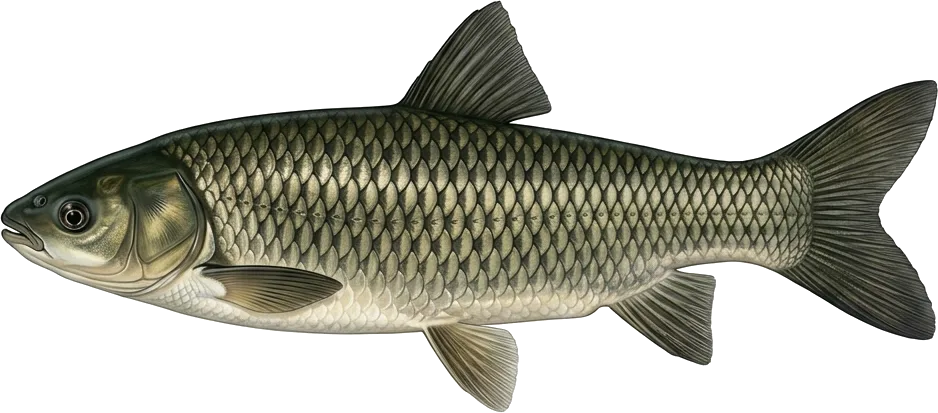
Grass Carp Grass carp (Ctenopharyngodon idella, or white amur) is a large herbivorous cypriniform fish in the family Xenocyprididae introduced to Eurasian river basins for macrophyte bio-control. The species features biserial comb-like serrated pharyngeal teeth for slicing tough reeds, cylindrical profile, and weight up to 40 kg. Anglers target grass carp on Zig-Rigs using reed shoots, cucumber, and pop-ups.
Grass carp exhibits a pelagic macrophyte feeding regime unlike benthic carp. Success demands mid-water Zig-Rig presentations tipped with bright Zig-Aligner foam or natural green baits (fresh reed shoots, cucumber batons) dropped along weedbeds, paired with relaxed drag control at the landing net.
- ✅ You want to master catching specimen 10–25+ kg grass carp on reservoirs and tranquil channels.
- ✅ You want to master adjustable Zig-Rigs fishing suspended mid-water beneath spod clouds.
- ✅ You seek proven natural baits: peeled reed shoots, fresh cucumber cubes, and sweet fruit boilies.
- ✅ You want to understand grass carp adaptations (biserial comb-like teeth, smooth barbel-free lips).
- ✅ You want to master grass carp reedline sprint dynamics in 'Volga 2026'.
Ichthyology & Adaptations: Biological Profile of Ctenopharyngodon idella
The grass carp (*Ctenopharyngodon idella*) is a specialized macrophyte herbivore in the family Xenocyprididae with unique digestive adaptations:
Lateral-compressed pharyngeal teeth feature sharply serrated comb crests that shear against a keratinized cranial pad, acting as a natural guillotine to slice rigid reeds.
Lacking endogenous cellulase, nutrient absorption relies on mechanical cell rupturing. The intestinal tract extends 2.5–3 times total body length to optimize nutrient transit.
At water temperatures of +22...+28°C, adult grass carp consume 100–120% of their body weight in aquatic weeds daily, making them premier biological bio-meliorators.
Armed with sharp vision, grass carp may track docilely toward the bank initially, only to launch an explosive 30–50m panic sprint the instant it sights the landing net frame.
Grass Carp vs Black Carp vs Silver Carp: Asian Cyprinid Keys
Identification matrix for three introduced East Asian giants in the Volga basin:
- Diet: obligate macrophyte herbivore (reeds, pondweed, filamentous algae).
- Teeth: biserial serrated comb-like saws for slicing plants (2.5–4.2).
- Color: greenish-grey back, golden-yellow flanks, light cream belly.
- Mouth: terminal, directed forward-down, smooth lips without barbels.
- Eyes: standard size, positioned on the cranial midline.
- Diet: benthic mollusk specialist (zebra mussels, ramshorns, bivalves).
- Teeth: massive smooth molariform grinding plates for crushing shells.
- Color: pitch-black to dark charcoal back, dark slate fins.
- Scales: very large, dark pigmented margins on every scale.
- Status: rare protected Red Book species dwelling in deep river channels.
- Diet: microscopic phytoplankton filtered through fused gill rakers.
- Mouth: cavernous, superior, directed vertically upward like a scoop.
- Eyes: positioned EXTREMELY LOW (beneath mouth level), looking downward.
- Scales: fine, silver; sharp abdominal keel runs from throat to anus.
- Behavior: pelagic surface schooler filtering open reservoir expanses.
Mid-Water Takes & Violent Net Reaction
During warm months, grass carp cruise suspended in mid-water (0.5–2.0m below surface) patrolling reed margins. Sighting a buoyant Zig-Rig foam or cucumber cube, the fish intercepts the target at cruising velocity without breaking stride.
Takes on suspended Zig-Rigs register as a gradual, irresistible rod-tip pull-down or rapid bobbin rise. With the lead anchored on the bed and hooklinks spanning 1.5–3.5m, the carp covers distance before feeling full bolt pressure.
Fighting mechanics are notoriously deceptive: the fish often permits itself to be reeled 20–30m toward the bank docilely. However, the instant it sights the angler or landing net rim, it unleashes 100% caudal thrust in a violent 30–50m torpedo surge.
Seasonal Habitats & Macrophyte Staging for Grass Carp
Grass carp activity is intimately bound to water warmth and aquatic plant growth:
Spring (May – June): Water warming to +16...+18°C brings grass carp into 0.8–1.8m shallows to graze on succulent new reed shoots. Excellent action on tender reed piths, boiled maize, and sweet boilies.
Summer (July – August): Peak metabolic feeding at +22...+28°C. Grass carp feed throughout daylight hours. Supreme sport with suspended Zig-Rigs and floating cucumber batons along reed walls.
Autumn (September – October): Dying macrophytes and temperatures falling below +14°C push fish toward 3.0–5.5m channel drop-offs. Diets shift to dense grains (maize, steamed peas, sweet plum pellets).
Winter (November – April): Foraging halts entirely below +8...+10°C. Fish congregate in 7–12m wintering holes coated in dense protective slime, entering torpor until spring.
Grass Carp Nutrition: Reed Shoots, Fresh Cucumber, Zig Foam & Maize
1. Natural Green Flora Offerings
Peeled white cores of young reed shoots; fresh cucumber batons with firm rind attached; tender dandelion leaves; sweet fresh pea pods; water clover sprigs.
2. Buoyant Zig-Rig Artificials
High-density buoyant Zig Foam in high-contrast two-tone patterns (black/yellow, black/red, fluro green) seated in Zig-Aligners, triggering aggressive visual strikes.
3. Sweet Fruit & Herbaceous Attractors
Grass carp demonstrate a profound preference for sweet fruit and fresh green scents: Plum Royale, Pineapple, Scopex, Tutti-Frutti, freshly cut lawn grass, and cucumber juice.
4. Suspended Spod Cloud Strategy
Zig-Rig angling relies on a perpetual suspended cloud: powdered milk, sweet condensed milk, crushed creamed maize, fine bran, and tiger nut meal spodded overhead every 15–20 minutes.
Grass Carp Tackle: 3.5 lb Blanks, Zig-Rig Systems & Heavy Spods
Taming high-speed grass carp requires specialized tackle architecture:
Specimen Carp Rods (12–13ft, 3.5 lb Test Curve)
Progressive Toray carbon blanks combining an authoritative lower blank to steer fish away from reed beds with a supple upper third to cushion frantic bankside lunges.
Adjustable Zig-Rig System
Adjustable sub-surface Zig-Float or fixed long clear monofilament hooklink (0.23–0.26mm) spanning 1.5 to 4.0m. Short-shank forged Wide Gape hooks #8–10 equipped with Zig-Aligners.
Spodding Arsenal (5.0–5.5 lb Spod Rod & Spomb)
Heavy-duty baiting rod engineered for repeated deployment of Spomb Midi/Large rockets, laying down persistent suspended clouds directly above suspended hookbaits.
Debunking Common Grass Carp Myths
Fact: Grass carp are predominantly pelagic and surface foragers, spending up to 80% of warm days cruising in the upper 1.5–2m feeding on overhanging foliage.
Fact: Zig-Rigs with high-viz two-tone foam represent one of the deadliest tournament tactics globally, triggering instantaneous reflex strikes in feeding clouds.
Fact: Docile long-range retrieval is merely a prelude to an explosive fury at the net rim, where the fish unleashes maximum kinetic torque that snaps rods.
Scientific Research & Acclimatization History of Ctenopharyngodon idella
'Ctenopharyngodon idella: in its native Amur basin and upon acclimatization across southern reservoirs, it exhibits a unique trophic niche... Biserial pharyngeal teeth with serrated comb ridges and a robust masticatory pad pulverize 100–120% of the fish's body weight in aquatic macrophyte biomass daily at +22...+28°C.'
'Ichthyological studies on grass carp digestion demonstrate that the lack of endogenous cellulase is compensated by mechanical cellular disruption via comb teeth and rapid chyme transit through an elongated alimentary tract measuring 2.5–3 times total body length.'
'Ctenopharyngodon idella: maximum documented length 150 cm, weight up to 45.0 kg. Biserial pharyngeal teeth formula 2.5–4.2 or 2.4–5.2 with deep folds and serrated ridges. Short dorsal fin without spine (III/7). Wide thermal range from 0°C to 38°C.'
4 Weed-Margin Tactical Strategies for Grass Carp
Suspend a black/yellow Zig-Aligner foam 1.0–1.5m below surface. Spod a clouding suspension mix overhead every 15 minutes.
Thread a 1.5cm cucumber cube onto a hair rig. Drop the setup 2 meters off the reedline over a shallow warm plateau.
Drift peeled white reed pith downwind along weed fringes. The take erupts in a heavy surface boil and audible crunch.
When leading the fish to the net, feather the spool and prepare for instant drag release during its explosive last-ditch charge.
Seasonal Matrix: Depths, Optimal Times, Baits & Rigs
| Season | Peak Feeding Time | Depth Zone | Top Baits | Tackle System |
|---|---|---|---|---|
| Spring (May – June) | 10:00 – 16:30 (Sunny midday) | 0.8 – 1.8 m (Reed shallows) | Young reeds, sweetcorn, sweet pop-ups | 3.5 lb Carp rods, hair rig |
| Summer (July – August) | 06:00 – 19:00 (All daylight) | 1.0 – 3.0 m (Mid-water on Zig-Rig) | Zig foam, fresh cucumber, plum corn | Adjustable Zig-Rig, spod rod |
| Autumn (Sept – Oct) | 11:30 – 15:30 (Warm midday) | 3.0 – 5.5 m (Channel breaks) | Plum & Hemp boilies, steamed peas | 3.5 lb Carp rods, bottom rigs |
| Winter (Ice Season) | Torpor (Feeding ceases) | 7.0 – 12.0 m (Wintering pits) | No feeding (Deep dormancy) | Protected closed season |
Angling Diagnostic: Identify What's Impeding Your Grass Carp Success
Select the symptoms you are experiencing for instant technical adjustments:
Grass Carp in 'Volga 2026' Simulator
In 'Volga 2026', grass carp is simulated with blistering reedline runs and high mid-water activity. Weight spectrum spans 1.2 to 18.0 kg. Inhabiting weed channels, it rewards precision Zig-Rig tuning and drag mastery.
Key in-game locations: 'Reed Lagoon', 'Island Reach', 'Lily Cove', 'Old Channel'.
Grass carp is featured in questlines ('Green Harvester', 'Secret of the Reed Shoot', 'Reed Sprinter'), unlocking specialized Zig-Rig setups and spod rockets.
Frequently Asked Questions About Grass Carp
What does grass carp eat and why is it called the 'water cow'?
Grass carp is our only giant obligate macrophyte herbivore, consuming reeds, cattails, hornwort, and duckweed. Eating 100–120% of its body weight daily earned it the nickname 'water cow'.
What makes Zig-Rig tactics so effective for grass carp?
Grass carp cruise mid-water layers 0.5–2.0m below the surface. Zig-Rigs present buoyant high-viz foam right in the cruising eye-line, triggering instant reflex strikes.
How do you properly rig fresh reed shoots or cucumber cubes?
Peel green reeds down to the tender white inner core, cut into 1.5–2cm batons, and hair-rig with a stopper. Fresh cucumber is diced with skin intact to ensure firm hair-stop grip.
Why do grass carp fight so violently right near the landing net?
Grass carp possess sharp vision. Docile initially, the instant it sights the angler or a raised net frame, it panics into a blistering 30–50m sprint with aerial breaches.
How do you tell grass carp apart from silver carp?
Key differences: 1) Mouth: semi-inferior forward-down on grass carp; cavernous and pointing upward on silver carp; 2) Eyes: set extremely low below mouth corners on silver carp; set on cranial midline on grass carp.
Authoritative Ichthyological Sources & Literature: FishBase — Ctenopharyngodon idella (Valenciennes, 1844) Species Summary · IUCN Red List of Threatened Species — Ctenopharyngodon idella · Институт биологии внутренних вод им. И. Д. Папанина РАН (ИБВВ РАН)
Prepared by the Volga 2026 Editorial Board in strict adherence to aquatic biology and sport angling standards. Volga 2026 Editorial Methodology.