Ichthyology & Heavy Specimen Relict Angling · Volga 2026 Encyclopedia
Russian Sturgeon
Acipenser gueldenstaedtii (Brandt & Ratzeburg, 1833)
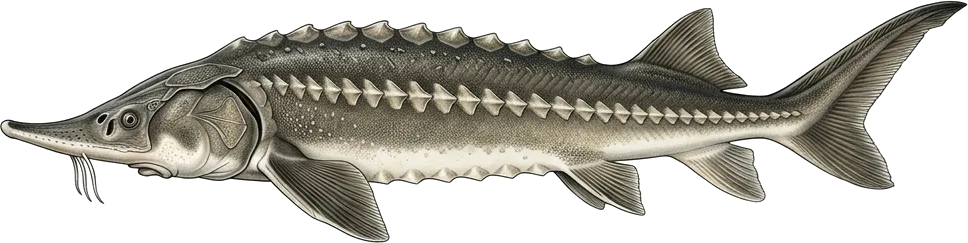
Russian Sturgeon Russian sturgeon (Acipenser gueldenstaedtii, or Danube sturgeon) is a threatened anadromous chondrostean fish of the family Acipenseridae native to the Ponto-Caspian basin. The species is distinguished by five rows of bony scutes, un-fringed barbels set near the snout tip, and weight exceeding 80 kg. Anglers fish licensed catch-and-release waters with heavy bottom gear baited with herring.
Russian sturgeon demands uncompromising heavy tackle: 3.5–4.5 lb specimen blanks, Big Pit reels, abrasion-proof shockleaders against zebra mussels, and baits of fresh herring, clams, or jumbo lobworms.
- ✅ You want to definitively distinguish Russian sturgeon from sterlet, stellate, and beluga by mouth geometry and scute counts (24–44).
- ✅ You want to master heavy river ledger rigs using 120–180g leads on torrential Volga fairway currents.
- ✅ You need proven sturgeon baits: salted/fresh herring cubes, river clam meat, live river gobies, and jumbo worm balls.
- ✅ You want to explore the science of shark-like caudal fins, cartilaginous notochord, and benthic vacuum dynamics.
- ✅ You want to master Russian sturgeon mechanics and relict quests in 'Volga 2026'.
Ichthyology & Ancient Adaptations: Biological Profile of Acipenser gueldenstaedtii
Russian sturgeon (*Acipenser gueldenstaedtii*) is a living Mesozoic relict featuring primitive, highly specialized morphology:
Armor consists of 5 longitudinal rows of heavy enamel plates: 1 dorsal (10–19 large scutes), 2 lateral (24–44 wide separated plates), and 2 ventral rows (8–14 scutes), interspersed with small starry granules.
Four rounded barbels sit on the underside of the blunt rounded snout near the tip. The barbels are completely smooth without fringes (the primary taxonomic difference from sterlet).
The toothless transverse mouth extends downward as a wide muscular vacuum pipe, engulfing dense beds of zebra mussels and benthic amphipods directly from compacted gravel.
The shark-like heterocercal tail generates downforce in swift currents. Maturing late (11–15 years), Russian sturgeon live 50–60 years, reaching colossal weights exceeding 80 kg.
Russian Sturgeon vs Sterlet vs Beluga: Comparative Anatomy
Comparative anatomical guide for three premier Volga acipenserids:
- Snout: short, broad, bluntly rounded ('blunt-nosed sturgeon').
- Barbels: SMOOTH, unfringed, positioned near snout tip.
- Lateral scutes: 24–44 LARGE, widely separated shields.
- Mouth: crescent-shaped, interrupted at lower lip midline.
- Size: 10–35+ kg (records up to 80–100 kg).
- Snout: sharp, pointed, triangular.
- Barbels: FIMBRIATED (covered in delicate fringes).
- Lateral scutes: 56–71 DENSE SMALL scutes.
- Habitat: strictly resident river dweller.
- Size: 0.5–3.0 kg.
- Mouth: CAVERNOUS crescent, occupying the ENTIRE HEAD WIDTH.
- Barbels: flattened, leaf-like with wide sensory flaps.
- Gill membranes: joined across the isthmus forming a free fold.
- Diet: active apex piscivore (preys on herring, roach, zander).
- Size: reaches 500–1,500 kg (largest freshwater fish on earth).
Mechanics of the Heavy Fairway Take & Aerial Breach
Cruising along the fairway shelf, the sturgeon scans the floor. Locating the bait (herring chunk or worm cluster), it projects its mouth funnel and vacuums it. The heavy blank bows in two deliberate pulses before the bite alarm screams into a continuous run.
On the strike, the 25kg titan pins itself to the floor, using caudal downforce to resist. Minutes into the fight, it suddenly rockets to the surface in a thunderous full-body breach. The angler must immediately cushion the landing shock with rod flex without allowing slack line!
Seasonal Habitats: Deep Fairways, Channel Trenches & Mud Flats
Russian sturgeon migrates along deep river fairway channels:
🌱 Spring (Anadromous Spawning Run): Spring migration from the Caspian up the Volga fairway (8.0–16.0m depths). Targeted with heavy river ledgers baited with herring and lobworms.
☀️ Summer (Benthic Foraging): Stages over deep 6.0–14.0m mussel beds and silty fairway flats. Peak feeding concentrates during dark midnight hours (11:00 PM–4:30 AM) and dawn.
🍂 Autumn (Winter Run Staging): Autumn migrants enter rivers to winter, staging around 12.0–22.0m channel abyss entrances. Active all daylight hours.
❄️ Winter (Wintering Sanctuaries): Rests in 14.0–28.0m deep wintering pits in dense dormant clusters. Foraging ceases entirely (strictly protected).
Sturgeon Baits: Herring Chunks, Clam Meat, Live Gobies & Lobworms
1. Top Animal Baits
Fresh or salted herring/kilka cubes (2x2cm); fresh river clam/mussel meat; live river gobies; cluster of 10–15 jumbo lobworms; boiled cocktail shrimp.
2. Plant Baits (Not Viable)
Russian sturgeon is an obligate benthic zoophage/piscivore. Plant offerings (corn, dough, sweet boilies) are completely ineffective.
3. Heavy Marine Attractors
Garlic essence, pure fish oils, squid extract, liquid krill hydrolysate. Heavy oily attractors broadcast far downflow.
4. Heavy Fishmeal Pellet Program
Heavy river clay loaded with 30% Halibut pellets (14–20mm), diced herring chops, and chopped worms to carpet mussel beds.
Tackle: Specimen Carp Rods 4.0 lb, Big Pit Reels & Leadcore
Taming a 30–50kg sturgeon on heavy river current demands heavy-duty specimen tackle:
Specimen Blanks 3.6–3.9m (3.5–4.5 lb)
High-modulus carbon blanks with heavy backbone, capable of launching 150–200g leads 100+ meters and absorbing massive torque.
Big Pit 10000–14000 Long-Cast Reels
Heavy-duty reels with 15–20kg max drag. Mainline 0.38–0.42mm mono or PE #3.0–4.0 braid paired with a 0.35–0.60mm tapered shockleader (15m).
45 lb Leadcore Running Rig (140–180g)
80cm 45 lb leadcore, 150g spiked gripper lead, 35 lb coated braid hooklength (25cm), and forged hook #1/0–3/0.
Debunking Common Russian Sturgeon Myths
Fact: Sturgeon is a selective benthic predator feeding on live zebra mussels, amphipods, and small benthic fishes (gobies, sandeels).
Fact: 20–40kg sturgeons frequently launch spectacular full-body breaches, using inertia to throw heavy hooks.
Fact: Modern aquaculture employs non-lethal stripping ('milking') methods that preserve broodstock alive for decades.
Scientific Research on Acipenser gueldenstaedtii
'The sturgeon is the most celebrated and precious fish of our waters... Dwelling in fairway deeps, it feeds on clams and fish, undertaking extensive migrations to Volga spawning beds.'
'Acipenser gueldenstaedtii exhibits classic anadromous migratory cycles. Divergence into spring and autumn races evolved to master extensive fairway migrations in the Volga cascade.'
'Acipenser gueldenstaedtii: maximum recorded weight over 115kg, length 235cm, lifespan 50+ years. Listed on the IUCN Red List as Critically Endangered (CR).'
4 Tactical Heavy Specimen Strategies for Russian Sturgeon
Deploy 150–180g spiked gripper leads on leadcore. The rig must anchor solidly on mussel drop-offs without drifting in heavy flow.
Bind a 2x2cm herring cube to the hook with elastic bait thread. Withstands 100m power casts while broadcasting an oily scent trail.
Position rigs on the entrance shelf of a 14m fairway trench from 11 PM to 4 AM. Heavy sturgeon cruise shelves at night for mussels.
When the sturgeon breaches, dip the rod tip toward the water and keep drag responsive to cushion the landing impact of the 30kg body.
Seasonal Matrix: Depths, Optimal Times, Baits & Rigs
| Season | Peak Feeding Time | Depth Zone | Top Baits | Tackle System |
|---|---|---|---|---|
| Spring (April – May) | 06:00 – 11:30 & 16:00 – 20:00 | 8.0 – 16.0 m (Fairway channels) | Fresh herring, lobworms, clam meat | 4.0 lb Carp rods, 160g lead |
| Summer (June – August) | 23:00 – 04:30 (Night) & 05:00 – 08:00 | 6.0 – 14.0 m (Mussel shelves) | Garlic herring, live goby, shrimp | Heavy Big Pit ledger kit, leadcore |
| Autumn (Sept – Oct) | 09:00 – 17:00 (All daylight) | 10.0 – 20.0 m (Hole entrances) | Fish fillets, Halibut pellets, worms | Extra-Heavy 4.5 lb ledger rod |
| Winter (Ice Season) | Torpor (Feeding halts) | 14.0 – 28.0 m (Wintering pits) | Strictly protected in wintering pits | Protected closed season |
Angling Diagnostic: Identify What's Impeding Your Sturgeon Catch
Select the symptoms you are experiencing for instant technical adjustments:
Russian Sturgeon in 'Volga 2026' Simulator
In 'Volga 2026', Russian sturgeon is simulated with massive bottom-hugging torque, rare nocturnal herring strikes, and thunderous fairway breaches. Weight spectrum spans 3.0 to 38.0 kg (giants reaching 60+ kg). Inhabits deep channel fairways.
Key in-game locations: 'Deep Fairway', 'Volga Expanses', 'Old Dam', 'Stony Headland'.
Russian sturgeon crowns elite specimen questlines ('Royal Patriarch of the Volga', 'Secret of Relict Scutes', 'Fairway Titan'), unlocking 4.5 lb blanks and Big Pit 14000 reels.
Try Catching Relict Russian Sturgeon in Volga 2026 Simulator →
Frequently Asked Questions About Russian Sturgeon
How do you distinguish Russian sturgeon from sterlet?
Key differences: 1) Barbels: smooth on Russian sturgeon; fringed on sterlet; 2) Snout: blunt rounded on sturgeon; sharp pointed on sterlet; 3) Scutes: 24–44 large separated lateral scutes on sturgeon; 56–71 dense small scutes on sterlet.
What is the single best bait for Russian sturgeon?
A chunk of fresh or salted herring secured with bait elastic, fresh river clam meat, or a bunch of jumbo lobworms dipped in garlic.
How long does Russian sturgeon live and what is its conservation status?
Russian sturgeon lives 50–60 years (males mature at 11–13, females at 14–16 years). Listed in the Red Data Book of Russia and IUCN Red List as Critically Endangered (CR). Wild take is strictly forbidden under Russian criminal law (Art. 258.1 CC RF); modeled under licensed sport simulations in-game.
Does Russian sturgeon have true bones?
No. The skeleton is completely cartilaginous. True vertebrae are replaced by a flexible notochord (viziga); bony tissue exists only in external scutes and cranium plates.
Why are sturgeon scutes dangerous during landing?
The edges of dorsal and lateral scutes are razor-sharp. During violent thrashing, scutes can easily slice taut braided lines or cut unprotected hands.
Authoritative Ichthyological Sources & Literature: FishBase — Acipenser gueldenstaedtii Biological Summary · IUCN Red List of Threatened Species — Acipenser gueldenstaedtii · Л. П. Сабанеев — «Жизнь и ловля пресноводных рыб: Осётр_русский» (Викитека) · Институт биологии внутренних вод им. И. Д. Папанина РАН (ИБВВ РАН)
Prepared by the Volga 2026 Editorial Board in strict adherence to aquatic biology and sport angling standards. Volga 2026 Editorial Methodology.