Relict Caspian Salmonid Biology & High-Speed Salmon Spinning · Volga 2026 Encyclopedia
Volga Salmon
Salmo trutta caspius (Kessler, 1877)
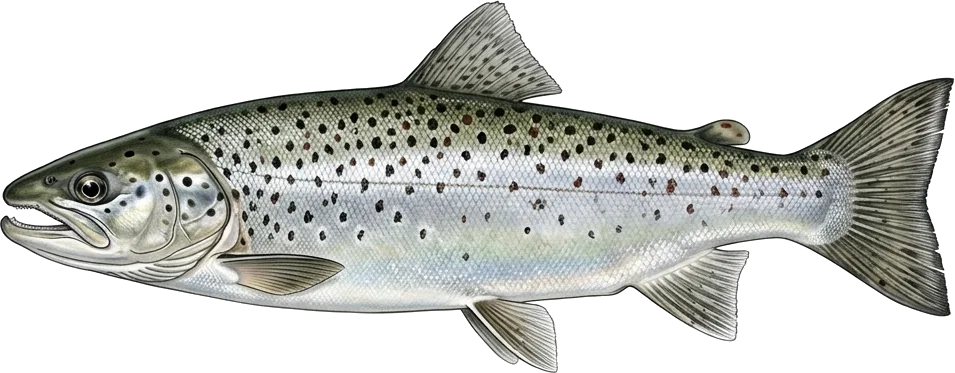
Volga Salmon Caspian salmon (Salmo trutta caspius, or Volga trout) is the largest subspecies of brown trout (Salmonidae) native to the Caspian basin, ascending river rapids to spawn. The subspecies features a silver frame with X-shaped black spots, an adipose fin, and historical weights exceeding 35 kg. Anglers target this prize fish with heavy fly gear and salmon spoons.
Volga salmon demands dedicated heavy tackle: 2.7–3.0m progressive-action salmon rod (12–45g rating), size 4000 reel holding 200m of PE #1.5–2.0 braid, 0.35–0.40mm fluorocarbon shock trace, heavy spoons (Mepps Syclops 17–26g), fast-sinking minnows (Smith D-Contact 85), and Sunray Shadow tube flies.
- ✅ You want to definitively understand Salmo trutta caspius biology (X-shaped markings, adipose fin, karyotype, 2000km upstream runs).
- ✅ You want to master high-velocity spinning and fly-fishing techniques across roaring boulder rapids and canyon runs.
- ✅ You need proven salmon lures: Mepps Syclops 26g spoons, Kuusamo Professor, sinking Smith D-Contact 85 minnows, and Woolly Bugger flies.
- ✅ You want to master fight dynamics: cushioning 80m 'long-run' backing surges, killing aerial leaps, and safe Catch & Release protocol.
- ✅ You want to master Volga salmon mechanics and legendary relict quests in 'Volga 2026'.
Ichthyology & Anadromous Sprint Adaptations: Profile of Salmo trutta caspius
Volga salmon (*Salmo trutta caspius*) is a majestic relict anadromous salmonid of the Caspian basin:
A hydrodynamically flawless fusiform frame is armored in fine mirror-silver scales. Flanks above the lateral line feature dense X-shaped and crescent dark crosses, flanked by a fleshy adipose fin.
Jaws, palatines, vomer, and tongue bristle with sharp recurved teeth. In spawning season, mature males develop a formidable hooked lower jaw (kype) used in fierce dominance duels over gravel beds.
Maturating in the open Caspian Sea, spawners ascend the Volga into mountain tributaries of the Kama, Belaya, and Ufa, scaling roaring rapids with water velocities exceeding 3 m/s.
Hooked, it triggers anaerobic white fast-twitch muscle fibers, accelerating up to 8 m/s. It rips off 80m 'long-run' blistering surges interspersed with acrobatic cartwheels above the foaming foam.
Volga Salmon vs Stream Brown Trout vs Atlantic Salmon: Identification Guide
Comparative anatomical guide for three members of the genus Salmo:
- Body: robust, muscular torpedo, pure mirror-silver with X-crosses.
- Caudal peduncle: DEEP, MUSCULAR, broad base.
- Fins: steely-grey; fleshy adipose fin lacking red spots.
- Behavior: blistering 60–100m 'long-run' backing runs.
- Size: 1.5–9.0+ kg (historically to 15–20 kg).
- Color: VIBRANT, speckled with RED AND BLACK spots ringed in white halos.
- Habitats: small forest brooks and mountain streams.
- Adipose fin: bright orange or crimson-edged.
- Lifestyle: resident non-migratory dwarf stream predator.
- Size: small (150–800g, rare to 1.5kg).
- Caudal peduncle: VERY SLENDER ('hand-wrist grip' anatomy).
- Caudal fin: deeply forked V-shape.
- Spots: sparse black X-spots ONLY ABOVE lateral line.
- Basin: Arctic and Atlantic oceanic river systems.
- Size: 3.0–15.0+ kg.
Mechanics of the Rapids Strike, 'Long-Run' Surges & Leap Control
Stationed behind a giant granite boulder in roaring rapids flow, the Volga salmon spots a heavy Mepps Syclops 26g spoon swinging cross-current. Launching from cover at 8 m/s, the predator smashes the spoon head-on. The strike hits like an immovable snag ('as if hooking a sunken freight train'), detonating half a second later into a screaming drag.
Tearing out of the rapids chute, the salmon powers downstream in a blistering 70m sprint ('long-run'), culminating in multiple aerial cartwheels high above the frothing white foam ('surface-break'). The angler must maintain a 60-degree rod angle to let the carbon absorb frantic headshakes, running downbank along the shore to keep backing on the spool!
Seasonal Habitats: Granite Rapids, Boulder Cascades & Oxygen Flumes
Volga salmon is strictly restricted to cold, oxygen-saturated boulder rapids:
🌱 Spring (Floodwater Tributary Inflow): Ascends rivers during high water, holding behind island eddies (2.0–4.5m). Strikes heavy 20–28g spoons and deep minnows.
☀️ Summer (High-Oxygen Rapids Season): Occupies foaming boulder flumes and gravel riffles (1.5–3.5m). Peak feeding windows: dawn (4:30–7:30 AM) and late dusk.
🍂 Autumn (Peak Spawning Ascension): Packs into shallow 1.0–3.0m gravel riffles in upper tributaries. Flanks darken as males sport massive jaw kypes.
❄️ Winter (Post-Spawn Deep Flumes): Post-spawners rest in deep 3.5–7.0m rocky plunge pools with open, ice-free flowing current.
Volga Salmon Baits: Heavy Syclops Spoons, D-Contact Sinking Minnows & Tube Flies
1. Natural Live Baits
Large caddis larvae cluster; live minnow or dace on a single-hook harness; large black horse leech.
2. Heavy Salmon Casting Spoons (17–28g)
S-curved heavy casting spoons: Mepps Syclops #3 (26g), Kuusamo Professor 75/12, Blue Fox Vibrax Salmon, and Abu Garcia Toby 20–28g in silver/copper finishes.
3. Heavy Sinking Minnows & Salmon Tube Flies
Fast-sinking river minnows: Smith D-Contact 85 (14.5g), Duo Spearhead Ryuki 80S, ZipBaits Rigge 90S; tube flies Sunray Shadow and black Woolly Bugger.
4. No Groundbait (Active Upstream Stalking)
Groundbait is strictly prohibited. The angler wades upstream, systematically fan-casting through boulder pockets and tailouts.
Tackle: 2.7–3.0m Salmon Rods (12–45g), Size 4000 Reels & PE #1.5 Braid
Taming an 8kg silver rocket in roaring white rapids requires tournament-grade salmon gear:
Salmon Spinning Rod 2.7–3.0m (12–45g Rating, Regular-Fast Progressive)
Long parabolic carbon blank delivering maximum shock absorption, continuously cushioning wild aerial leaps and heavy headshakes in torrential rapids.
Heavy-Duty Size 4000 Reel with Carbon Matrix Drag (10–12kg Rating)
All-metal spinning winch spooled with 200m+ of PE #1.5–2.0 braid (25–35 lb), boasting ultra-smooth line release during high-speed surges.
1.5m 0.35–0.40mm Fluorocarbon Shock Leader + Owner S-125 Single Hook
Heavy abrasion shock trace protecting against jagged granite boulders, fitted with a barbless forged salmon single hook.
Debunking Common Volga Salmon Myths
Fact: Caspian/Volga salmon is a historic apex native of the basin, historically migrating 2000 km upstream into the Kama, Belaya, and Ufa rivers.
Fact: Adult salmon is an obligate piscivore. It attacks strictly moving spoons, minnows, and tube flies mimicking fleeing forage.
Fact: Brute winching snaps lines or tears hooks. Salmon must be played patiently, relying on smooth drag and blank parabolic flex.
Scientific Research on Salmo trutta caspius
'The Volga salmon, or Caspian trout, is the most noble fish of our rivers... The power and velocity of its surges are astonishing: scaling huge rapids like an arrow.'
'Salmo trutta caspius is characterized by a 2n = 80–82 karyotype, 40–55 pyloric caeca, and acute natal homing to gravel flumes with dissolved oxygen levels exceeding 9.0 mg/L.'
'Salmo trutta caspius: historical maximum recorded weights reach 15.0–22.0kg, lengths over 120cm. Sprint velocity peaks at 8.2 m/s backed by colossal anaerobic stamina.'
4 Tactical High-Velocity Salmon Strategies for Volga Salmon
Cast Mepps Syclops 26g at 45° downstream. Impart slow rod-tip pulses, letting the current swing the spoon tight past sunken boulders.
Cast a heavy sinking minnow into frothing whitewater. Execute sharp erratic twitches with 1-second pauses to trigger aggressive reaction strikes.
When the salmon detonates on an 80m downstream sprint, never clamp the drag! Run downbank along the shore, reeling rapidly to retrieve backing.
Use a knotless silicone net. Cradle the salmon facing into the current for 2–3 minutes until fully revived before releasing it back into the wild.
Seasonal Matrix: Depths, Optimal Times, Baits & Rigs
| Season | Peak Feeding Time | Depth Zone | Top Baits | Tackle System |
|---|---|---|---|---|
| Spring (Inflow Ascension) | 06:00 – 11:00 & 16:30 – 19:30 | 2.0 – 4.5 m (Eddies behind islands) | 26g Syclops, 90mm minnows, caddis | 2.7m Salmon rod (15–50g), PE #2 |
| Summer (High-Oxygen Rapids) | 04:30 – 07:30 (Dawn) & 20:30 – 22:30 | 1.5 – 3.5 m (Granite rapids flumes) | Smith D-Contact 85, Kuusamo, flies | 2.8m Regular-Fast, 0.35mm leader |
| Autumn (Peak Spawning Run) | 08:00 – 16:00 (Overcast cool days) | 1.0 – 3.0 m (Gravel spawning riffles) | Heavy 28g spoons, Sunray tube flies | Heavy salmon spin to 60g with single |
| Winter (Deep Pool Refugia) | 10:30 – 14:30 (Midday sun) | 3.5 – 7.0 m (Deep ice-free plunge pools) | 30g Pilkers, sinking minnows | Jig-spinning with 0.35mm mono |
Angling Diagnostic: Identify What's Impeding Your Volga Salmon Catch
Select the symptoms you are experiencing for instant technical adjustments:
Volga Salmon in 'Volga 2026' Simulator
In 'Volga 2026', Volga salmon is simulated as the legendary 'silver rocket of clean water' featuring explosive 'long-run' backing runs, 'surface-break' rapids leaps, 26g heavy spoons, D-Contact minnows, and tube flies in white rapids. Weight spectrum spans 1.2 to 9.0 kg. Inhabits clear boulder riffles, roaring flumes, and highland canyon runs.
Key in-game locations: 'Mountain Riffle', 'Volga Expanses', 'Karst Chasm', 'Rocky Point'.
Volga salmon crowns the elite salmonid questline ('Silver Rocket of the Rapids', 'Secret of the 100m Sprint', '9kg Salmon Duel'), unlocking Regular-Fast Heavy casting rods and artisan Japanese sinking minnow sets.
Try Catching Volga Salmon in Rapids in Volga 2026 Simulator →
Frequently Asked Questions About Volga Salmon
Does the Volga salmon still exist today or is it an extinct species?
Volga/Caspian salmon (*Salmo trutta caspius*) is an endangered relict subspecies. Isolated populations survive in pristine tributaries of the Kama, Belaya, and Ufa, supported by conservation hatchery programs.
How does Volga salmon differ from Atlantic salmon (Salmo salar)?
Volga salmon has a deep, muscular caudal peduncle, dense X-markings spanning above and below the lateral line, and a fully toothed vomer. Atlantic salmon has a narrow 'wrist-like' peduncle and sparse spots only above the lateral line.
What is the benchmark spinning spoon for Volga salmon?
The heavy Mepps Syclops #3 spoon (26g) in silver-red finish rigged with a forged Owner S-125 #1/0 single hook.
How do you arrest a salmon's violent downstream sprint?
Never lock down the drag—the line will snap! Hold the blank at a 60° angle, regulate drag smoothly, and sprint downstream along the shoreline.
What maximum weight can a Volga salmon reach?
In modern times, Volga salmon reaches 8–9+ kg at lengths over 90 cm, while historic leviathans reached 15–20 kg, making it a true legend of Russian ichthyology.
Authoritative Ichthyological Sources & Literature: FishBase — Salmo trutta Biological Summary · IUCN Red List of Threatened Species — Salmo trutta · Л. П. Сабанеев — «Жизнь и ловля пресноводных рыб» (Викитека) · Институт биологии внутренних вод им. И. Д. Папанина РАН (ИБВВ РАН)
Prepared by the Volga 2026 Editorial Board in strict adherence to aquatic biology and sport angling standards. Volga 2026 Editorial Methodology.