Ichthyology & Modern Specimen Carp Angling · Volga 2026 Encyclopedia
Mirror Carp
Cyprinus carpio morpha specularis (Lacepède, 1803)
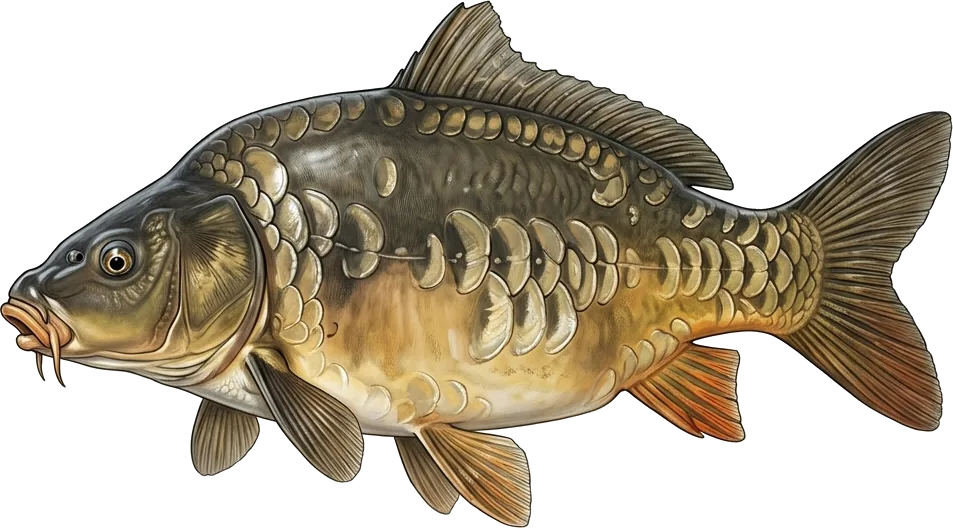
Mirror Carp Mirror carp (Cyprinus carpio morpha specularis) is a cultivated scale-mutation variety of common carp in the family Cyprinidae widespread in European fisheries and reservoirs. The morph is identified by large, irregular mirror-like scales scattered along smooth flanks, heavy girth, and weight exceeding 30 kg. Anglers target mirror carp with modern hair rigs using boilies, pop-ups, and PVA bags.
Mirror carp is the crown jewel of lake and reservoir angling. It demands presentation precision over silt: Helicopter rigs with critically balanced wafters or Ronnie Rig pop-ups ensure the hookbait never buries in sediment, while PVA mesh bags eliminate tangles during distance casting.
- ✅ You want to master landing specimen 10–20+ kg mirror carp on big reservoirs and commercial fisheries.
- ✅ You want to master silt-compatible presentations (Helicopter Rig, Ronnie Rig, Chod Rig).
- ✅ You seek scientifically calibrated sweet feeding campaigns utilizing wafters, Spomb rockets, and hemp.
- ✅ You want to understand carp scale genetics (S and N gene loci, mirror vs linear carp).
- ✅ You want to master mirror carp fight acrobatics and drag management in 'Volga 2026'.
Ichthyology & Scale Genetics: Biological Profile of Specular Carp
The mirror carp (*Cyprinus carpio morpha specularis*) represents centuries of European lake breeding and genetic fixation:
Scale patterning is controlled by two autosomal gene pairs: S (Scale) and N (Neural). Mirror carp possess the homozygous recessive genotype ssnn, restricting scale follicle distribution and prompting hypertrophic growth of giant mirror plates.
Centuries of breeding in tranquil, eutrophic lakes developed a deep-bellied, humped profile capable of storing 25–35% more metabolic lipid reserves than river-dwelling wild carp.
At water temperatures exceeding +18°C, mirror carp ingest 10–15% of their total body weight daily. Their triple-row molars (1.1.3–3.1.1) continuously crush boilies, pellets, and maize.
Unlike river wild carp that maintain low-trajectory freight-train runs along the substrate, mirror carp regularly vault entirely out of the water to flush gill rakers and shake the hook.
Mirror Carp vs Wild Carp vs Linear Carp: Scale Pattern Identification
Genetic breakdown of the four primary Cyprinus carpio scale variations:
- Scales: giant mirror-like scales scattered along dorsal line, tail, and flanks.
- Skin: majority of flanks covered by smooth, leathery scaleless skin.
- Body: deep-bodied, broad girth with an abrupt hump behind the head.
- Habitat: rich reservoirs, managed fisheries, and tranquil backwaters.
- Scales: 100% complete, uniform scale armor (35–40 in lateral line).
- Body: elongated, torpedo-like, low cylindrical profile.
- Behavior: relentless linear freight-train runs along the riverbed.
- Habitat: flowing river timber, channel shelves with brisk current.
- Scales: a single, uninterrupted neat row running straight along the lateral line.
- Skin: flanks above and below the lateral line are entirely bare and leathery.
- Genetics: carries lethal gene N (Nn x Nn cross yields 25% non-viable embryos).
- Habitat: rare specimen strain in managed European carp venues.
Vacuum Inhalation & Wafter Mechanics
Feeding over silt flats, mirror carp hover inches above the lakebed, generating heavy suction that flushes sediment through gill rakers. If a bottom bait is too heavy, it remains stuck in silt while the fish inhales only loose surrounding food particles.
A critically balanced wafter or Ronnie Rig pop-up resolves this challenge. Possessing near-zero effective mass, they shoot into the oral cavity with minimal suction force. The rig immediately pivots hook-down thanks to the quick-change swivel and tungsten putty.
Feeling lead inertia and hook sting, the carp bursts into a panic run. The bite alarm shrieks into a classic sustained tone. The fight against heavy mirror carp features brutal broadside turns and explosive surface rolls near the landing net.
Seasonal Habitats & Plateau Staging for Mirror Carp
Mirror carp movements strictly correlate with water temperature thermoclines:
Spring (May – June): Warming to +15...+18°C pulls mirror carp onto extensive shallow plateaus (1.0–2.5m) along reed margins. Supreme action on bright sweet-scented pop-ups (Pineapple, Plum, Strawberry).
Summer (July – August): Midday heat pushes carp into 2.5–5.5m deep flats; darkness pulls them to shoreline margins. Peak feeding spans 10:30 PM to 4:30 AM on wafters, tiger nuts, and large pellets.
Autumn (September – October): Cooling lakes force fish toward deeper channel ledges (4.5–8.5m). Sweet fruity aromas give way to rich fishmeal profiles (Squid, Octopus, Krill, Halibut).
Winter (November – April): Concentrates in the deepest wintering sanctuaries (8–14m), entering torpor. Foraging ceases entirely.
Mirror Carp Nutrition: Boilies, Wafters, Tiger Nuts & PVA Tactics
1. Critically Balanced Wafters
12–16mm wafters (Pineapple & Butyric, Scopex, White Chocolate); Snowman combinations (20mm bottom + 14mm pop-up); giant maize tipped with an Enterprise buoyant fake corn kernel.
2. High-Attract Pop-Ups for Ronnie Rigs
Ultra-buoyant 12–14mm fluorescent pop-ups (fluro yellow, pink, white). The Ronnie Rig suspends the hook 2–3cm above the silt, keeping it pristine and exposed.
3. Precision PVA Mesh Sticks
PVA mesh loaded with 2–4mm micro-pellets, boilie crumb, and PVA-friendly oil dip. The PVA stick shields the hook point from weed fouling upon bottom impact.
4. Heavy Spod Campaign Strategy
A strategic blend of cooked hempseed, sweetcorn, tiger nuts, and whole 16–20mm boilies. Delivered accurately with Spomb rockets locked tight on distance sticks.
Specimen Carp Tackle: 3.5 lb Blanks, Big Pit Reels & Ronnie Rigs
Targeting specimen mirror carp requires professional carp gear:
Specimen Carp Rods (12–13ft, 3.25–3.5 lb Test Curve)
Toray high-modulus carbon blanks with 50mm SiC guide arrays; progressive action engineered to absorb violent near-bank surges and aerial breaches.
Big Pit Long-Cast Reels with Quick Drag
10000–14000 spool capacity with Super Slow Oscillation for flawless line lay of 0.30–0.35mm mono, enabling effortless casts beyond 130–150 meters.
Ronnie Rig (Spinner Rig) Terminal Presentation
Rigged on a 25 lb stiff fluorocarbon boom with a Spinner Swivel and Curve Shank hook #4–6. Delivers 360° rotation and devastating bottom-lip penetration.
Debunking Common Mirror Carp Myths
Fact: Mirror carp is a purebred natural mutation of Cyprinus carpio, completely fertile and capable of wild reproduction in suitable warm water bodies.
Fact: Specimen mirror carp possess enormous muscle mass. Their fights combine heavy low-gear bottom pressure with acrobatic aerial leaps that test any angler's composure.
Fact: Properly prepared boiled maize, tiger nuts, and fresh oilcake catch specimen carp just as effectively as commercial boilies when placed on the correct feeding spot.
Scientific Research on Cyprinus carpio morpha specularis
'Mirror carp differs from wild sazan by extraordinarily large and irregularly positioned scales, which in places are entirely absent, leaving leathery skin... It grows faster, attains colossal girth and weight, but demands warmer, quieter waters teeming with rich food.'
'Scale polymorphism in Cyprinus carpio is regulated by two unlinked autosomal loci: S (Scale) and N (Neural). The mirror carp genotype is the homozygous recessive ssnn, inducing epidermal scale reduction and generating hypertrophic specular plates.'
'Cyprinus carpio morpha specularis: cultivated variety of common carp exhibiting a high condition factor. Four barbels, triple-row pharyngeal teeth 1.1.3–3.1.1. Record specimen weights exceed 45–50 kg in European managed carp fisheries.'
4 Reservoir Tactical Strategies for Mirror Carp
Deploy a Helicopter rig with a 15cm boom and pineapple wafter. The PVA stick ensures tangle-free presentation over soft sediment.
Distance-lock spod and fishing rods around distance sticks. Concentrate 5–7 kg of spod feed in a tight 3x3m table.
Rig a 12mm pop-up on a quick-change spinner swivel. The hook sits point-down, cocked for immediate bottom-lip penetration.
Drop a rig into 1.5–2.0m depths along reed fringes from 10 PM to 3 AM. Heavy mirror carp patrol shoreline shallows at night.
Seasonal Matrix: Depths, Optimal Times, Baits & Rigs
| Season | Peak Feeding Time | Depth Zone | Top Baits | Tackle System |
|---|---|---|---|---|
| Spring (May – June) | 07:00 – 11:30 & 16:00 – 20:00 | 1.2 – 2.5 m (Warm plateaus) | Sweet pop-ups (Pineapple, Plum), corn | 3.5 lb Carp rods, Ronnie Rig |
| Summer (July – August) | 04:00 – 08:30 & 22:30 – 03:30 (Night) | 2.5 – 5.5 m (Drop-offs, silt flats) | 14mm Wafters, tiger nut, Scopex boilies | 3.5 lb Carp kit, Big Pit reels, PVA |
| Autumn (Sept – Oct) | 11:00 – 16:30 (Warm midday) | 4.5 – 8.5 m (Deep channels) | Fishmeal boilies (Squid, Halibut), pellets | Heavy carp setup with leadcore |
| Winter (Ice Season) | Torpor (Feeding ceases) | 8.0 – 14.0 m (Wintering pits) | Protected in wintering sanctuaries | Protected closed season |
Angling Diagnostic: Identify What's Impeding Your Mirror Carp Success
Select the symptoms you are experiencing for instant technical adjustments:
Mirror Carp in 'Volga 2026' Simulator
In 'Volga 2026', mirror carp is simulated with explosive aerial breaches and high silt-presentation selectivity. Weight range spans 1.0 to 16.5 kg (monsters reaching 25+ kg). Inhabits warm bays and managed reservoirs.
Key in-game locations: 'Island Reach', 'Lily Cove', 'Volga Snags', 'Quiet Monastery'.
Mirror carp is featured in elite tournament questlines ('Mirror Lord', 'Wafter Secret', '15kg Specimen'), unlocking Big Pit reels and Spomb delivery rockets.
Frequently Asked Questions About Mirror Carp
Why does mirror carp possess giant polished scales?
It results from a recessive genetic mutation in scale patterning genes (genotype 'ssnn'). This reduces total scale count, causing the remaining scales to expand into giant polished plates.
What is the advantage of a wafter over a standard bottom boilie?
A wafter is critically balanced to neutralize hook weight. When a carp applies vacuum suction, the wafter shoots into the mouth effortlessly, hooking even the wariest feeding fish.
How do you present terminal tackle properly over soft silt?
Use a Helicopter rig with the hooklink positioned 20–30cm above the lead, paired with a PVA mesh stick and a pop-up on a Ronnie Rig. The sinker penetrates silt while the rig rests clean on top.
What flavor profiles work best for mirror carp in summer?
In summer, sweet fruit and creamy profiles dominate: Pineapple with N-Butyric acid, Plum Royale, Scopex, Strawberry Jam, and Banana Cream.
How does mirror carp differ from linear carp?
Mirror carp has irregular scales scattered across back and flanks. Linear carp features a single, uninterrupted line of scales strictly following the lateral line, with bare skin elsewhere.
Authoritative Ichthyological Sources & Literature: FishBase — Cyprinus carpio Biological Summary · IUCN Red List of Threatened Species — Cyprinus carpio · Л. П. Сабанеев — «Жизнь и ловля пресноводных рыб: Карп» (Викитека) · Институт биологии внутренних вод им. И. Д. Папанина РАН (ИБВВ РАН)
Prepared by the Volga 2026 Editorial Board in strict adherence to aquatic biology and sport angling standards. Volga 2026 Editorial Methodology.