Lacustrine Cyprinid Biology & Traditional Quill Float Angling · Volga 2026 Encyclopedia
Crucian Carp (Golden Carp)
Carassius carassius (Linnaeus, 1758)
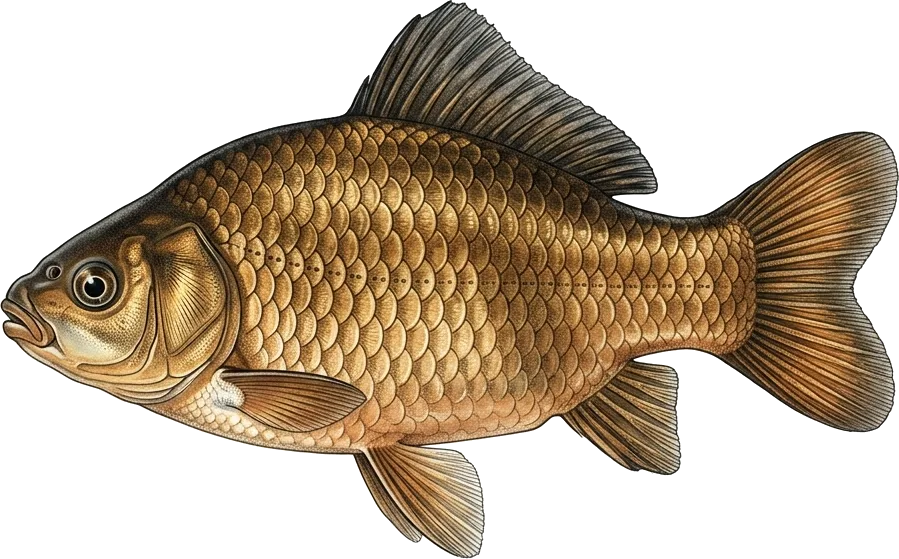
Crucian Carp (Golden Carp) Crucian carp (Carassius carassius, or golden crucian) is a native Eurasian cyprinid fish inhabiting densely vegetated stillwaters, peat bogs, and forest ponds. The species is identified by a deep-bodied rounded frame with dark golden bronze luster, single-row 4-4 pharyngeal teeth, and weight up to 4 kg. Anglers target golden crucian using sensitive float rigs with redworms and bread punch.
Golden crucian requires classic finesse: 5.0–6.0m whip rod, sensitive quill float (1.0–1.5g shotting), 0.12mm hooklink, juicy garlic-scented redworms, rye breadcrumb dough, and steamed pearl barley pre-baiting.
- ✅ You want to definitively distinguish wild golden crucian from silver Prussian carp and aquarium goldfish by scale count and dorsal profile.
- ✅ You want to master traditional bottom lift-method float mechanics in tight lily-pad weed pockets.
- ✅ You need proven baits: garlic-scented redworms, rye bread paste with unrefined sunflower oil, barley, and anise semolina.
- ✅ You want to explore crucian biochemistry: ethanol-producing anaerobic glycogen metabolism during zero-oxygen winter freezing.
- ✅ You want to master golden crucian mechanics and oxbow quests in 'Volga 2026'.
Ichthyology & Extreme Survival Adaptations: Profile of Carassius carassius
Wild golden crucian (*Carassius carassius*) is an ancient native limnophile possessing extraordinary physiological resilience:
Scales are thick, smooth, and cast in antique dark gold or rich copper-bronze. The lateral line bears 33–36 scales (silver Prussian carp has larger scales with only 28–31 rows).
In completely frozen, zero-oxygen ponds, crucian carp switches metabolism: hepatic glycogen breaks down into lactic acid, converted to ethanol and excreted via gills, preventing fatal lactic acidosis.
During drought desiccation or severe freeze-overs, crucian carp burrows 50–70cm into soft peat mud, coating its skin in a thick protective mucus cocoon to survive for months.
The back arches steeply behind the head into a circular disc profile. In waters populated by pike, crucian carp expresses an induced high-backed defense morph that predators cannot swallow.
Golden Crucian vs Prussian Carp vs Tench: Identification Guide
Comparative anatomical guide for three weed-loving lacustrine species:
- Color: COPPER-GOLD, deep bronze with dark brown back.
- Fins: DARK REDDISH or brownish-red, softly rounded.
- Scales: FINE (33–36 scales along lateral line).
- Body: very deep, almost circular, small compact head.
- Size: 20–45 cm (400–1,800g, records to 3.0 kg).
- Color: SILVERY-GREY with steely or greenish iridescence.
- Fins: grey, semi-translucent, slightly yellowish.
- Scales: COARSE (28–31 scales along lateral line).
- Body: more elongated, moderately deep, notched dorsal fin.
- Size: 15–40 cm (200–1,200g).
- Scales: MICROSCOPIC, deeply embedded beneath thick slime.
- Barbels: 2 TINY BARBELS at jaw corners (crucian has zero).
- Eyes: vivid ruby-red fiery globes.
- Color: olive-emerald green with golden sheen.
- Size: 1.0–4.0+ kg.
Mechanics of the Classic Lift Bite & Strike Timing
Foraging along soft peat silt inside lily-pad openings, the golden crucian samples the garlic redworm or rye bread paste with delicate lip touches. On the feather quill float, this registers as a subtle dip or rhythmic tremor.
Then the crucian inhales the bait and rights itself horizontally. The micro-telltale split shot (0.1–0.2g) lifts off the silt, causing the long goose quill to tilt gracefully flat on the water. As the prone float begins gliding toward the lily stems, set the hook with a smooth, sweeping stroke!
Seasonal Habitats: Peat Oxbows, Reeds & Lily Pockets
Golden crucian thrives in shallow, weed-choked oxbows and warm sunlit bays:
🌱 Spring (Shallow Warming Bays): As water reaches +12...+14°C, crucian moves into 0.5–1.2m shallow reed beds. Voracious pre-spawn feeding on bloodworms and tender redworms.
☀️ Summer (Peak Lily-Pad Season): Holds in pockets among water lilies, mare's tail, and water soldiers (1.0–2.0m). Peaks at calm dawn (dawn to 9:30 AM) and evening twilight (6:30–9:30 PM).
🍂 Autumn (Deep Silt Pit Staging): Retreats from cooling shorelines into 2.5–4.5m deep mud holes. Feeds strictly during warm, sunlit midday windows on garlic-dipped redworms.
❄️ Winter (Silt Hibernation): Burrows 40–70cm into bottom peat silt, entering dormant torpor. Completely inactive until spring thaw.
Crucian Baits: Garlic Redworms, Rye Bread Paste, Pearl Barley & Anise Semolina
1. Top Animal Baits
Lively redworm (juicy, scented with crushed garlic or anise); bloodworm bunch; mini red/white maggots; dragonfly nymph (kazarka).
2. Plant Offerings
Fresh rye bread crumb kneaded with unrefined sunflower oil; steamed pearl barley dusted in breadcrumbs; anise semolina paste via syringe.
3. Attractors & Secret Scents
Crushed fresh garlic, star anise, unrefined sunflower oil, wild honey, pure vanilla, and herbal valerian drops.
4. Heavy Coarse Particle Groundbait
Steamed pearl barley, crushed millet, toasted rye breadcrumbs, and 20% molehill soil. Heavy mix settles silently on the peat without creating surface clouds that draw nuisance bleak.
Tackle: 5–6m Carbon Whip, Traditional Goose Quill & 0.12mm Hooklinks
Pocket angling inside heavy lily pad beds requires precise, lightweight whip tackle:
5.0–6.0m Carbon Whip (Ringless, Sub-180g Weight)
Featherlight high-modulus whip with solid carbon tip ('whalebone'). Allows silent, pinpoint vertical drops into tight 50cm lily pad windows.
Traditional Goose Quill Float (1.0–1.5g Shotting)
Natural lacquered goose quill with single bottom silicone eye. Imparts near-zero resistance in water and registers beautiful lift bites.
0.14mm Mainline + 0.12mm Supple Snell (15–20cm)
Supple moss-green monofilament, 0.1g micro-telltale shot placed 6cm above hook, armed with forged round-bend Owner Iseama/Chinu hooks #12–14.
Debunking Common Crucian Carp Myths
Fact: They are two distinct species (*Carassius carassius* and *Carassius gibelio*), differing in scale count (33–36 vs 28–31), body shape, and physiology.
Fact: Crucian carp burrows deeply into mud and produces ethanol to survive anoxic conditions, emerging unharmed upon spring thaw.
Fact: The trademark crucian bite is a gentle lift (quill lies flat on the water) as the fish tilts upright, raising the micro-telltale shot off the silt.
Scientific Research on Carassius carassius
'The golden crucian carp is the native inhabitant of our stagnant waters... Distinguished by extraordinary stamina, it thrives in muddy bogs and bears beautiful bronze-gold scales.'
'Carassius carassius possesses a unique vertebrate metabolic pathway: anaerobic glycogen fermentation converting lactate to ethanol and CO2, enabling survival through months of zero-oxygen freezing.'
'Carassius carassius: maximum recorded weight 3.5kg, length 50cm, lifespan 15 years. 33–36 lateral scale count, single-row 4-4 pharyngeal teeth configured for crushing plant detritus and benthic larvae.'
4 Tactical Lily-Pocket Float Strategies for Crucian Carp
Shot the quill float so only 1.5cm of the bright tip emerges. When the 0.1g telltale shot lifts off bottom, the float instantly and cleanly drops flat.
Thread a medium redworm leaving a 1cm wriggling tail, topped with a dab of fresh garlic extract before swinging into the lily pocket.
Pinch a soft pellet of rye sourdough bread kneaded with fragrant sunflower oil. The buoyant bread rests gently on soft silt without sinking in.
On the strike, immediately elevate the rod to lift the crucian straight to the surface, preventing it from wrapping the line around tough lily roots.
Seasonal Matrix: Depths, Optimal Times, Baits & Rigs
| Season | Peak Feeding Time | Depth Zone | Top Baits | Tackle System |
|---|---|---|---|---|
| Spring (April – May) | 10:00 – 17:00 (Warm midday shallows) | 0.5 – 1.2 m (Old reed shallows) | Bloodworm bunch, redworm | 5m Carbon whip, 0.12mm mono |
| Summer (June – August) | 04:30 – 09:30 & 18:30 – 21:30 (Dawn/Dusk) | 0.8 – 2.0 m (Lily-pad pockets) | Garlic redworm, rye bread, barley | 6m Whip with goose quill float |
| Autumn (Sept – Oct) | 11:30 – 15:30 (Sunny midday) | 2.0 – 4.0 m (Silty bottom holes) | Anise redworm, bloodworms | Light picker or 6m whip |
| Winter (Torpor) | Mud dormancy (Angling inactive) | Burrowed 50–70cm into silt | Non-feeding winter dormancy | Angling closed (winter dormancy) |
Angling Diagnostic: Identify What's Impeding Your Crucian Catch
Select the symptoms you are experiencing for instant technical adjustments:
Crucian Carp in 'Volga 2026' Simulator
In 'Volga 2026', golden crucian carp is simulated with authentic goose-quill lift kinematics, weed-extraction fight dynamics, and trophy garlic-bait session pacing. Weight spectrum spans 250 to 2,200 g. Inhabits quiet oxbows, weedy bays, and lake fringes.
Key in-game locations: 'Weedy Bay', 'Volga Oxbow', 'Quiet Monastery', 'Island Reach'.
Golden crucian crowns the traditional float questline ('Gold of Volga Oxbows', 'Secret of the Goose Quill', 'Garlic Delicacy in Lily Pads'), unlocking 6m carbon whip rods and custom artisan floats.
Frequently Asked Questions About Crucian Carp
How do you distinguish golden crucian from silver Prussian carp?
Key differences: 1) Scales: golden crucian has 33–36 lateral scales (silver has 28–31); 2) Color: copper-bronze/gold (silver has steely silver flanks); 3) Fins: golden crucian has dark reddish rounded fins (silver has notched greyish fins).
Why does the float lie flat during a crucian bite ('lift method')?
Crucian feeds tilted downward, then levels off horizontally. The telltale split shot lifts off the silt, releasing ballast from the float so the quill tilts and lays flat.
How does crucian carp survive in frozen ponds without oxygen?
Crucian carp possesses an extraordinary anaerobic pathway: converting lactic acid into ethanol excreted through the gills, eliminating toxic lactate buildup during zero-oxygen winter freezes.
What is the single most effective summer bait for golden crucian?
Fresh redworm scented with crushed garlic, rye bread crumb kneaded with unrefined sunflower oil, and steamed pearl barley.
What is the best time of day to catch golden crucian?
In summer, crucian is most active during calm, windless dawn (4:30 to 9:00 AM) and evening twilight right before sunset.
Authoritative Ichthyological Sources & Literature: FishBase — Carassius carassius Biological Summary · IUCN Red List of Threatened Species — Carassius carassius · Л. П. Сабанеев — «Жизнь и ловля пресноводных рыб» (Викитека) · Институт биологии внутренних вод им. И. Д. Папанина РАН (ИБВВ РАН)
Prepared by the Volga 2026 Editorial Board in strict adherence to aquatic biology and sport angling standards. Volga 2026 Editorial Methodology.