Oceanic Endothermy Ecology & Heavy Pelagic Big-Game · Volga 2026 Encyclopedia
Atlantic Bluefin Tuna
Thunnus thynnus (Linnaeus, 1758)
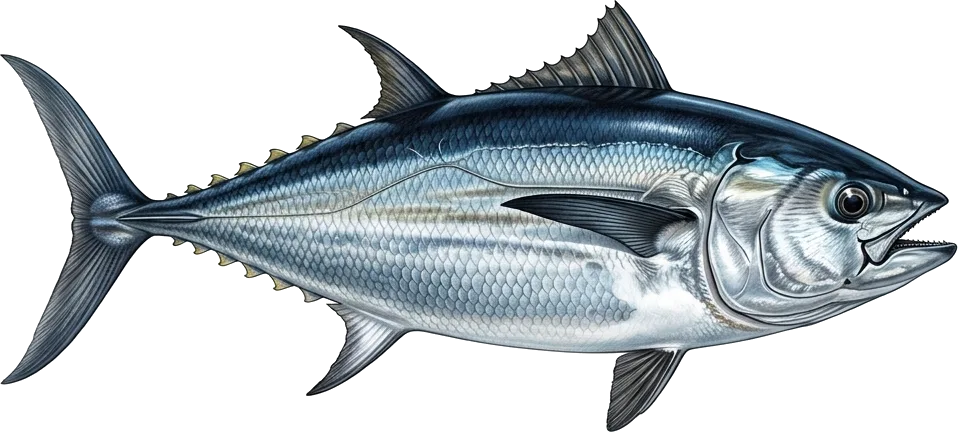
Atlantic Bluefin Tuna Atlantic bluefin tuna (Thunnus thynnus) is an apex pelagic predator of the mackerel family (Scombridae) capable of explosive sprint speeds reaching 90 km/h. The species features a counter-current heat exchange system (rete mirabile) enabling regional endothermy, and maximum weight reaching 680 kg. Anglers fight giant tuna with heavy 80–130 lb tournament chair tackle, drift chumming, and sinking stickbaits.
Atlantic bluefin tuna demands an uncompromising big-game arsenal: 2.2–2.5m heavy popping rod (PE 8–10 / 100–150 lb class) or 80–130 lb trolling blank, size 20000–30000 saltwater spinner (Shimano Stella SW / Daiwa Saltiga) with 25–30kg drag or Tiagra 80W multiplier, PE #8.0–10.0 braid (100–130 lb), 1.2–1.6mm fluorocarbon leader (150–200 lb), and top offerings: 180–230mm sinking stickbaits (140–200g), heavy chugger poppers, and whole fresh sardines for drift chunking.
- ✅ You want to definitively understand bluefin tuna biology: *rete mirabile* counter-current heat exchangers, 90 km/h swimming kinetics, and second-wind recovery.
- ✅ You want to master offshore popping and fast-sweep sinking stickbait cadences (150–200g) into breaking surface tuna blitzes.
- ✅ You need top lures: Carpenter Gamma 160–200, Shimano Ocea Sardine Ball 180S, Maria Rapido 230, Rapala Magnum X-Rap, and sardine drift chunking rigs.
- ✅ You want to master stand-up fighting harness ergonomics and anti-circling boat maneuvering to pump tuna beneath the hull without break-offs.
- ✅ You want to master bluefin tuna mechanics and legendary ocean quests in 'Volga 2026'.
Ichthyology & Warm-Blooded Pelagic Adaptations: Profile of Thunnus thynnus
Atlantic bluefin tuna (*Thunnus thynnus*) represents the pinnacle of pelagic speed, power, and regional endothermy:
Bluefin tuna is functionally warm-blooded! Counter-current vascular heat exchangers (*rete mirabile*) insulate red muscle mass, brain, and eyes, maintaining internal core temperatures 10–20°C above frigid oceanic waters to fuel explosive muscular power.
The hydrodynamic fuselage features recessed slots into which pectoral, dorsal, and pelvic fins fold flush during high-speed sprints. Rigid caudal keels and a lunate crescent tail generate sprint velocities exceeding 90 km/h.
Just as the angler believes the tuna is exhausted near the boat, high myoglobin concentrations rapidly clear lactic acid from deep red muscles. Bluefin activates its legendary 'second-wind', launching another crushing dive straight toward the depths!
Bluefin packs herd vast schools of sardines, saury, and squid into compressed surface bait balls. The boiling white froth, exploding baitfish, and diving shearwaters mark the blitz from nautical miles away.
Atlantic Bluefin Tuna vs Yellowfin Tuna vs Bigeye Tuna: Identification Guide
Comparative anatomical guide for three premier oceanic thunnid titans:
- Fins: SHORT PECTORAL FINS (not reaching base of 2nd dorsal).
- Color: deep midnight-blue/black back, metallic silver belly.
- Finlets: caudal finlets dark yellow with black edging.
- Size: LARGEST OF ALL (to 2.5–3.5m, weight 100–400+ kg).
- Endothermy: pronounced warm-bloodedness, thrives in cold seas.
- Fins: ELONGATED SICKLE-SHAPED 2nd dorsal and anal fins.
- Color: brilliant canary-yellow dorsal finlets.
- Pectorals: long pectoral fins reaching past 2nd dorsal origin.
- Size: large (to 1.8–2.2m, weight to 80–180 kg).
- Range: tropical and subtropical warm epipelagic waters.
- Eyes: PROMINENT LARGE EYES (adapted for 500m abyssal hunts).
- Body: robust, barrel-shaped, deep-bodied.
- Pectorals: very long, pointed pectoral fins.
- Size: to 2.0–2.3m (weight to 150–200 kg).
- Behavior: daytime foraging in deep mesopelagic layers.
Mechanics of the Oceanic Strike, Supersonic Run & Anti-Circling Fight
Target casting a 200g sinking stickbait to the edge of a boiling Tuna Blitz: the angler works the lure with long sweeping rod sweeps (Long-Sweep Jerking), diving it 1–2 meters down. As the stickbait rises, the sea explodes: an 80kg bluefin engulfs the lure at full sprint. The impact shock bows the angler into the harness as line snaps piano-wire taut with a deafening hum.
The initial run is unstoppable: the tuna strips 150–250 meters of PE 10 braid into the abyss. Once stopped, the grueling 'Death Circles' phase begins 30–50 meters directly beneath the keel. The skipper maneuvers the vessel to prevent line from fouling the propellers, while the harnessed angler pumps every single crank, overcoming the rhythmic tail thrashes of the titan!
Seasonal Habitats: Ocean Thermal Fronts, Upwelling Seams & Blue Water
Atlantic bluefin tuna migrates along oceanic temperature gradients and shelf breaks:
🌱 Spring (Pre-Spawning Strait Run): Migrates through deep straits toward warm spawning grounds (20.0–60.0m). Targeted via heavy trolling plugs.
☀️ Summer (Peak Oceanic Blitz Season): Explosive surface blitzing on sardines and saury along thermal edges (0.0–40.0m). Prime: dawn and midday.
🍂 Autumn (Giant Trophy Chunking Season): Massive 100–300+ kg dreadnoughts feed along outer shelf edges. Prime method: drift chunking with whole sardines.
❄️ Winter (Open Pelagic Abyss): Disperses throughout offshore oceanic basins at 50.0–200.0m depths. Shore and light sport charter operations close.
Bluefin Tuna Lures: 200g Stickbaits, Chugger Poppers, Sardine Chunking & Trolling Plugs
1. Heavy Sinking Stickbaits (180–230mm, 140–200g)
Shimano Ocea Sardine Ball 180S (150g); Carpenter Gamma 160–200; Maria Rapido 230; Tackle House Flitz 160, armed with forged BKK Lone Diablo #9/0–11/0 single hooks.
2. Drift Chunking with Fresh Sardines
Continuous tossing of fresh sardine or mackerel chunks creating an unbroken scent trail. The hookbait is a whole drifted sardine on an unweighted Owner Gorilla 5/0.
3. Heavy Offshore Chugger Poppers (150–220g)
Heru Skipjack 150g; Halco Roosta Popper 195; Yo-Zuri Bull Pop 200. Deliver booming acoustic chugs and spray plumes, calling bluefin from 30m depths.
4. High-Speed Trolling Plugs (10–14 Knots)
Rapala Magnum X-Rap 30/40; Yo-Zuri Bonita; Halco Max 190, tracking straight at high-speed trolling cadences up to 12–14 knots at 5–9m running depths.
Tackle: PE 8–10 Casting Rod (100–150 lb), Stella 20000–30000, PE #10 Braid & Fighting Harness
Oceanic combat with an 80kg bluefin requires extreme-grade pelagic heavy artillery:
2.3–2.5m Offshore Tuna Popping Blank (PE 8–10 / 100–150 lb Class)
Multilayer thick-walled carbon blank fitted with titanium Fuji SiC Ocean Guides (MNSG) and an indestructible backbone built for 20kg deadweight loads.
Size 20000–30000 Saltwater Spinner (Shimano Stella SW / Daiwa Saltiga 20000)
Solid metal chassis with IPX8 saltwater sealing, 25–30kg carbon drag capacity, and spool holding 400 meters of PE #10 braid.
8-Strand PE #8.0–10.0 Braid (100–130 lb) + 1.4–1.6mm Fluorocarbon Leader (150–200 lb)
High-density braided line joined to the fluorocarbon trace via a PR-knot or FG-knot, ensuring smooth guide transit under extreme casting loads.
Debunking Common Bluefin Tuna Myths
Fact: Bluefin tuna is endothermic—rete mirabile counter-current vessels retain metabolic heat, keeping red muscle 15°C above water temps.
Fact: Without a Fighting Belt and active boat helm maneuvers, an 80kg bluefin will cause severe back injury and gear destruction.
Fact: Bluefin regularly dives to 500–800m depths, hunting squid and mesopelagic fish in icy darkness.
Scientific Research on Thunnus thynnus
'The tuna is the undisputed sovereign of the open ocean... Its supersonic flight through the waves and indomitable power surpass all imagination.'
'Biophysical analysis of Thunnus thynnus rete mirabile confirms counter-current heat retention efficiency up to 95%. Peak caudal stroke generates propulsive thrust exceeding 300 N.'
'Thunnus thynnus: maximum recorded specimen weight 680kg (1496 lb), length 3.7–4.0m, lifespan up to 40 years. Burst sprint velocities hit 24–26 m/s (~90–95 km/h).'
4 Tactical Offshore Casting Strategies for Bluefin Tuna
Approach a surface bait blitz from the upwind side at 50m standoff distance. Drop a 180S stickbait right on the perimeter of the bait ball and begin aggressive sweeps.
Toss sardine chunks overboard every 30 seconds. Conceal a 5/0 hook inside a whole sardine and drift line completely free-spool without drag.
When the tuna enters vertical death circles beneath the boat, the skipper motors forward at idle speed, changing the line angle to plane the fish upward.
Lock into a Fighting Belt and kidney harness. The massive pulling load is transferred into legs and core, saving angler arms from fatigue.
Seasonal Matrix: Depths, Optimal Times, Baits & Rigs
| Season | Peak Feeding Time | Depth Zone | Top Baits | Tackle System |
|---|---|---|---|---|
| Spring (Pre-Spawning Strait Run) | 06:00 – 12:00 & 16:00 – 19:30 | 15.0 – 50.0 m (Straits & drop-offs) | Rapala X-Rap 40, whole mackerel | 80 lb Trolling rod, Tiagra 50W |
| Summer (Peak Oceanic Blitz) | 05:00 – 09:30 (Dawn) & midday blitz | 0.0 – 25.0 m (Surface tuna boils) | Ocea 180S, Carpenter Gamma, poppers | PE 8–10 Casting, Stella 20000, 100 lb |
| Autumn (Giant Trophy Chunking) | 07:30 – 16:30 (Full daylight) | 20.0 – 70.0 m (Outer shelf banks) | Drift sardine chunking, squid | 130 lb Stand-Up with Kidney Harness |
| Winter (Pelagic Ocean Abyss) | Deep oceanic dispersal | 50.0 – 200.0 m (Open pelagic abyss) | Sport fishery closed | Closed season |
Angling Diagnostic: Identify What's Impeding Your Bluefin Catch
Select the symptoms you are experiencing for instant technical adjustments:
Atlantic Bluefin Tuna in 'Volga 2026' Simulator
In 'Volga 2026', Atlantic bluefin tuna is simulated as a legendary pelagic living torpedo ('a living torpedo of big water that turns a mistake into an empty spool') featuring bluewater kinematics, supersonic long-run sprints, second-wind recovery engine, and tuna-plug, minnow, livebait, and pilker tactics across open oceanic surfaces. Weight spectrum spans 8.0 to 96.0 kg (up to 200+ kg in legendary events). Inhabits open ocean, outer shelf breaks, and thermal oceanic seams.
Key in-game locations: 'Open Ocean', 'Deep Oceanic Front', 'Shelf Canyon', 'Tidal Headland of Giants'.
Bluefin tuna unlocks the ultimate pelagic questline ('Living Torpedo of the Deep', 'Secret of the Warm-Blooded Titan', '96kg Oceanic Gladiator'), unlocking Tuna Popping Master Pro blanks and Stella Oceanic SW 30000 reels.
Frequently Asked Questions About Atlantic Bluefin Tuna
Is it true that bluefin tuna is warm-blooded?
Yes! Bluefin tuna possesses regional endothermy: counter-current vascular rete mirabile heat exchangers retain metabolic warmth, maintaining red muscle, brain, and eye temperatures 10–20°C above freezing ocean waters.
What is the maximum sprint speed of an Atlantic bluefin tuna?
During attack charges on baitfish schools, bluefin reaches burst velocities of 24–26 m/s (~90–95 km/h), folding its fins flush into specialized body slots to eliminate form drag.
What is the 'second-wind' stamina phenomenon during a tuna fight?
High myoglobin concentrations and vascular thermoregulation enable deep red muscles to quickly process lactic acid. An exhausted fish near the boat suddenly recovers and executes a fresh hundred-meter dive.
How does Atlantic bluefin differ from yellowfin tuna?
Bluefin has short pectoral fins and a midnight-blue back. Yellowfin possesses elongated sickle-shaped 2nd dorsal and anal fins in brilliant canary-yellow hues.
What maximum weight can an Atlantic bluefin tuna achieve?
Atlantic bluefin tuna reaches 680 kg (1496 lbs) at lengths up to 3.7–4.0 meters and ages exceeding 35 years (with 70–250 kg fish considered premier sport angling super-trophies).
Authoritative Ichthyological Sources & Literature: FishBase — Thunnus thynnus Biological Summary · IUCN Red List of Threatened Species — Thunnus thynnus · ICCAT — International Commission for the Conservation of Atlantic Tunas · Всероссийский НИИ рыбного хозяйства и океанографии (ВНИРО)
Prepared by the Volga 2026 Editorial Board in strict adherence to aquatic biology and sport angling standards. Volga 2026 Editorial Methodology.